I Manoscritti / Original Typescripts · 12 fogli
Page 1
Page 2
Page 3
Page 4
Page 5
Page 6
Page 7
Page 8
Page 9
Page 10
Page 11
Page 12
Franco Lalli’s text is an epistolary, reflective narrative that blends autobiographical confession with spiritual apologue. In a series of letters addressed to a friend, George, the unnamed narrator explains a sudden inner change that George has noticed: he has become indifferent, withdrawn, and evasive in social life. The turning point occurs one ordinary September evening when, watching night fall from a window, he feels an inexplicable “white, cold emptiness,” as if “something inside me had died.” Medical and psychiatric consultations find no physical illness, offering vague diagnoses (“a nervous matter,” “mild exhaustion”), which leads the narrator to criticize modern science for understanding machines and astronomy but not the human spirit.
After two months he identifies the real cause: he is “a man without dreams”; the ambitions and illusions that once animated him have abruptly vanished, making all human striving seem ridiculous and sad. The narrative arc then reverses when he discovers an old black-bound booklet given by his father before his departure for America. He finally reads it obsessively, rereads it, and experiences peace, joy, and a “new, nobler” meaning in life as the emptiness disappears. Later letters reveal the booklet to be the Gospel, portrayed as a unique book that transforms history and remakes the reader, prompting a decisive break with his past and a new faith.
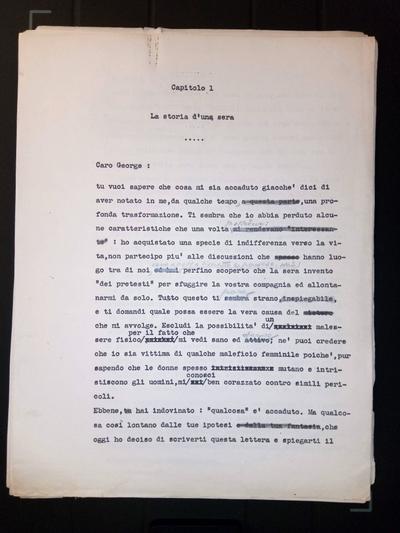
....
Caro George:
tu vuoi sapere che cosa mi sia accaduto giacché dici di aver notato in me, da qualche tempo a questa parte, una profonda trasformazione. Ti sembra che io abbia perduto alcune caratteristiche che una volta mi rendevano "interessante": ho acquistato una specie di indifferenza verso la vita, non partecipo più alle discussioni che spesso hanno luogo tra di noi, ed hai perfino scoperto che la sera invento "dei pretesti" per sfuggire la vostra compagnia ed allontanarmi da solo. Tutto questo ti sembra strano, inspiegabile, e ti domandi quale possa essere la vera causa del mistero che mi avvolge. Escludi la possibilità di [unclear: xxxxxxxx] malesseri fisico/[unclear: xxxxxxxx]/mi vedi sano ed attivo; ne' puoi credere che io sia vittima di qualche maleficio femminile poiché, pur sapendo che le donne spesso [unclear: xxxxxxxxxxxxx] mutano e intrigano gli uomini, mi/[unclear: xxx]/ben corazzato contro simili pericoli.
Ebbene, tu hai indovinato: "qualcosa" è accaduto. Ma qualcosa così lontano dalle tue ipotesi e dalla tua fantasia, che oggi ho deciso di scriverti questa lettera e spiegarti il mistero.
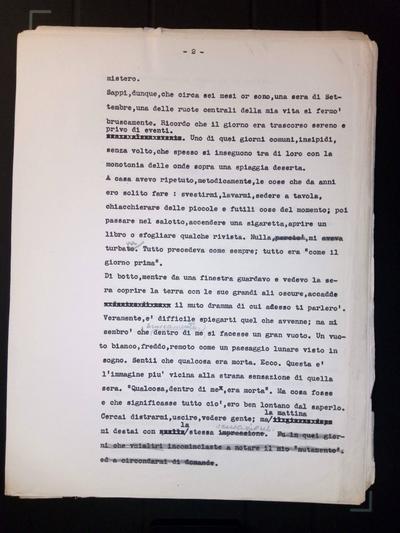
Sappi, dunque, che circa sei mesi or sono, una sera di Settembre, una delle ruote centrali della mia vita si fermò bruscamente. Ricordo che il giorno era trascorso sereno e privo di eventi. [deleted: xxxxxxxxxxxxxxxx] Uno di quei giorni comuni, insipidi, senza volto, che spesso si inseguono tra di loro con la monotonia delle onde sopra una spiaggia deserta. A casa avevo ripetuto, metodicamente, le cose che da anni ero solito fare: svegliarmi, lavarmi, sedere a tavola, chiacchierare delle piccole e futili cose del momento; poi passare nel salotto, accendere una sigaretta, aprire un libro o sfogliare qualche rivista. Nulla, perciò, mi aveva turbato. Tutto precedeva come sempre; tutto era "come il giorno prima".
Di botto, mentre da una finestra guardavo e vedevo la sera coprire la terra con le sue grandi ali oscure, accadde [deleted: xxxxxxxxxxxxxxxx] il muto dramma di cui adesso ti parlerò. Veramente, è difficile spiegarti quel che avvenne; ma mi sembrò che dentro di me si facesse un gran vuoto. Un vuoto bianco, freddo, remoto come un paesaggio lunare visto in sogno. Sentii che qualcosa era morta. Ecco. Questa è l'immagine più vicina alla strana sensazione di quella sera. "Qualcosa, dentro di me, era morta". Ma cosa fosse e che significasse tutto ciò, ero ben lontano dal saperlo. Cercai distrarmi, uscire, vedere gente; ma [deleted: xxxxxxxxxxxxxxxx] [handwritten: la sensazione] mi destai con [deleted: xxxxxx] [handwritten: quella] stessa impressione. Fu in quei giorni che voi altri incominciaste a notare il mio "mutamento", ed a circondarmi di domande.
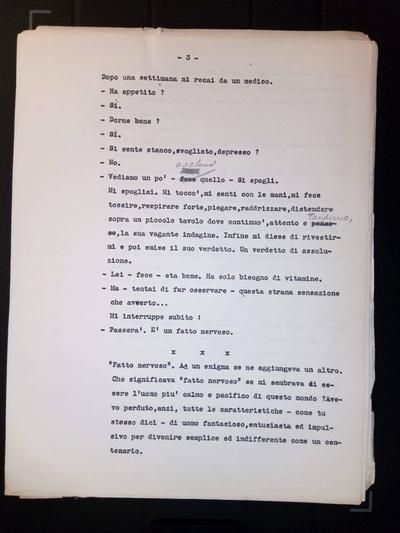
Dopo una settimana mi recai da un medico.
- Ha appetito?
- Sì.
- Dorme bene?
- Sì.
- Si sente stanco, svogliato, depresso?
- No.
- Vediamo un po' – [deleted: fece quello] [handwritten: esclamò] Sì spogli.
Mi spogliai. Mi toccò, mi sentì con le mani, mi fece tossire, respirare forte, piegare, raddrizzare, distendere sopra un piccolo tavolo dove continuò, attento e pensoso, la sua vagante indagine. Infine mi disse di rivestirmi e poi emise il suo verdetto. Un verdetto di assoluzione.
- Lei – fece – sta bene. Ha solo bisogno di vitamine.
- Ma – tentai di far osservare – questa strana sensazione che avverto...
Mi interruppe subito:
- Passerà. È un fatto nervoso.
x x x
"Fatto nervoso". Ad un enigma se ne aggiungeva un altro. Che significava "fatto nervoso" se mi sembrava di essere l'uomo più calmo e pacifico di questo mondo? Avevo perduto, anzi, tutte le caratteristiche – come tu stesso dici – di uomo fantasioso, entusiasta ed impulsivo per divenire semplice ed indifferente come un centenario.
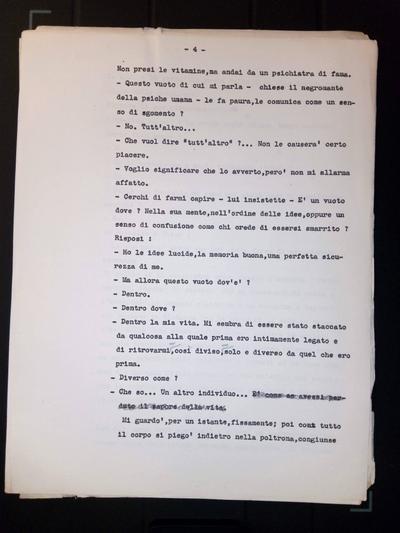
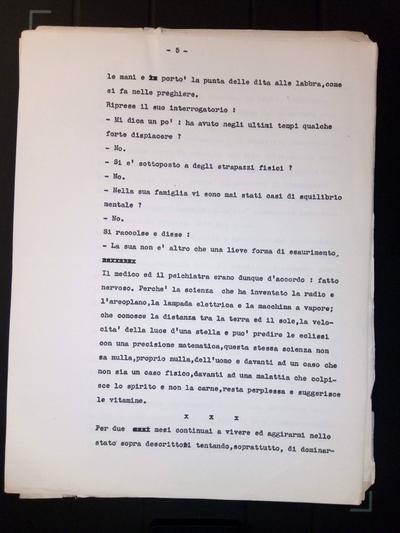
Non presi le vitamine, ma andai da un psichiatra di fama. — Questo vuoto di cui mi parla — chiese il negromante della psiche umana — le fa paura, le comunica come un senso di sgomento? — No. Tutt'altro... — Che vuol dire "tutt'altro"?... Non le causerà certo piacere. — Voglio significare che lo avverto, però non mi allarma affatto. — Cerchi di farmi capire — lui insistette — È un vuoto dove? Nella sua mente, nell'ordine delle idee, oppure un senso di confusione come chi crede di essersi smarrito? Risposi: — Ho le idee lucide, la memoria buona, una perfetta sicurezza di me. — Ma allora questo vuoto dov'è? — Dentro. — Dentro dove? — Dentro la mia vita. Mi sembra di essere stato staccato da qualcosa alla quale prima ero intimamente legato e di ritrovarmi, così diviso, solo e diverso da quel che ero prima. — Diverso come? — Che so... Un altro individuo... [deleted: E' come se avessi perduto il sapore della vita.] Mi guardò, per un istante, fissamente; poi con tutto il corpo si piegò indietro nella poltrona, congiunse le mani e le portò la punta delle dita alle labbra, come si fa nelle preghiere.
Riprese il suo interrogatorio:
- Mi dica un po': ha avuto negli ultimi tempi qualche forte dispiacere?
- No.
- Si è sottoposto a degli strapazzi fisici?
- No.
- Nella sua famiglia vi sono mai stati casi di squilibrio mentale?
- No.
Si raccolse e disse:
- La sua non è altro che una lieve forma di esaurimento.
Il medico ed il psychiatra erano dunque d'accordo: fatto nervoso. Perché la scienza che ha inventato la radio e l'aeroplano, la lampada elettrica e la macchina a vapore; che conosce la distanza tra la terra ed il sole, la velocità della luce d'una stella e può predire le eclissi con una precisione matematica, questa stessa scienza non sa nulla, proprio nulla, dell'uomo e davanti ad un caso che non sia un caso fisico, davanti ad una malattia che colpisce lo spirito e non la carne, resta perplessa e suggerisce le vitamine.
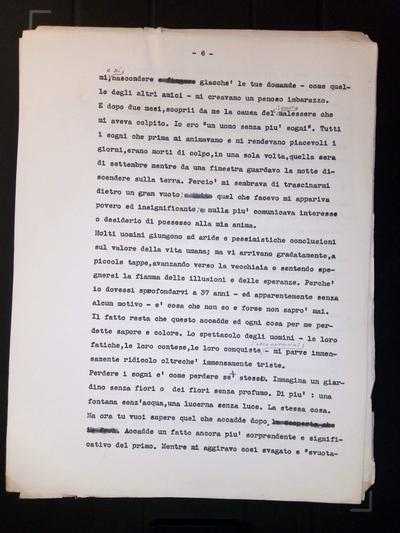
Per due mesi continuai a vivere ed aggirarmi nello stato sopra descritto, tentando, soprattutto, di dominarmi nascondere e fingere giacché le tue domande – come quelle degli altri amici – mi creavano un penoso imbarazzo. E dopo due mesi, scoprii da me la causa del malessere che mi aveva colpito. Io ero "un uomo senza più sogni". Tutti i sogni che prima mi animavano e mi rendevano piacevoli i giorni, erano morti di colpo, in una sola volta, quella sera di settembre mentre da una finestra guardavo la notte discendere sulla terra. Perciò mi sembrava di trascinarmi dietro un gran vuoto: [deleted: crossed out text] quel che facevo mi appariva povero ed insignificante; e nulla più comunicava interesse o desiderio di possesso alla mia anima.
Molti uomini giungono ad aride e pessimistiche conclusioni sul valore della vita umana; ma vi arrivano gradatamente, a piccole tappe, avanzando verso la vecchiaia e sentendo spegnersi la fiamma delle illusioni e delle speranze. Perché io dovessi sprofondarvi a 37 anni – ed apparentemente senza alcun motivo – è cosa che non so e forse non saprò mai. Il fatto resta che questo accadde ed ogni cosa per me perdette sapore e colore. Lo spettacolo degli uomini – le loro fatiche, le loro contese, le loro conquiste, – mi parve immensamente ridicolo oltreché immensamente triste.
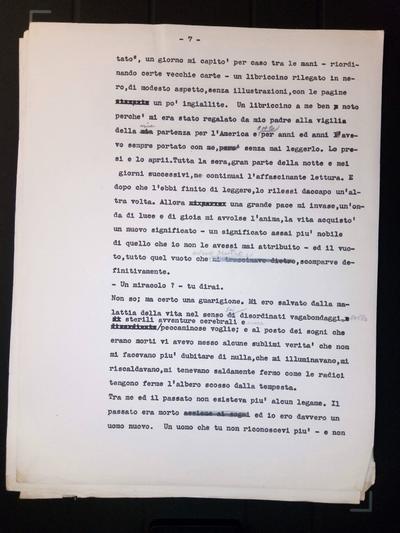
Perdere i sogni è come perdere se stessi. Immagina un giardino senza fiori o dei fiori senza profumo. Di più: una fontana senz'acqua, una lucerna senza luce. La stessa cosa. Ma ora tu vuoi sapere quel che accadde dopo, la scoperta che [deleted: crossed out text] Accadde un fatto ancora più sorprendente e significativo del primo. Mentre mi aggiravo così svagato e "svuotatato", un giorno mi capitò per caso tra le mani - riordinando certe vecchie carte - un libriccino rilegato in nero, di modesto aspetto, senza illustrazioni, con le pagine stampate un po' ingiallite. Un libriccino a me ben noto perché mi era stato regalato da mio padre alla vigilia della mia partenza per l'America e per anni ed anni l'avevo sempre portato con me, però senza mai leggerlo. Lo presi e lo aprii. Tutta la sera, gran parte della notte e nei giorni successivi, ne continuai l'affascinante lettura. E dopo che l'ebbi finito di leggere, lo rilessi daccapo un'altra volta. Allora mi prese una grande pace mi invase, un'onda di luce e di gioia mi avvolse l'anima, la vita acquistò un nuovo significato - un significato assai più nobile di quello che io non le avessi mai attribuito - ed il vuoto, tutto quel vuoto che mi trascinavo dietro, scomparve definitivamente.
- Un miracolo? - tu dirai.
Non so; ma certo una guarigione. Mi ero salvato dalla malattia della vita nel senso di disordinati vagabondaggi, di sterili avventure cerebrali e [handwritten: Dr. P.] [deleted: sterili] /peccaminose voglie; e al posto dei sogni che erano morti vi avevo messo alcune sublimi verità che non mi facevano più dubitare di nulla, che mi illuminavano, mi riscaldavano, mi tenevano saldamente fermo come le radici tengono ferme l'albero scosso dalla tempesta.
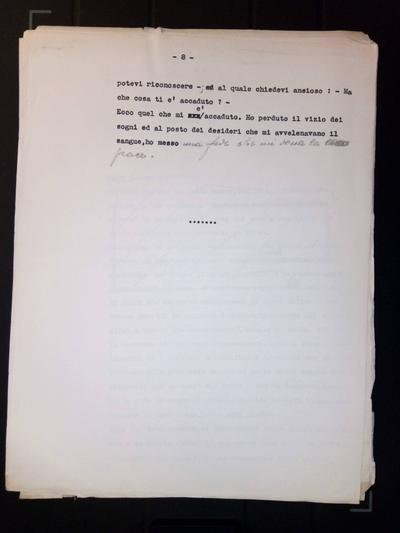
Tra me ed il passato non esisteva più alcun legame. Il passato era morto assieme ai sogni ed io ero davvero un uomo nuovo. Un uomo che tu non riconoscevi più - e non potevi riconoscere - ed al quale chiedevi ansioso: - Ma che cosa ti è accaduto? -
Ecco quel che mi [deleted: xxx] accaduto. Ho perduto il vizio dei sogni ed al posto dei desideri che mi avvelenavano il sangue, ho messo [handwritten: una fede che mi dona la vera pace.]
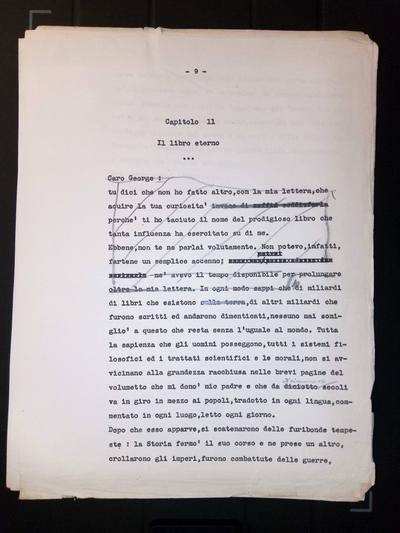
Capitolo 11
Il libro eterno
Caro George:
tu dici che non ho fatto altro, con la mia lettera, che [deleted: acuire la tua curiosità] [handwritten: invece di raffiar soddisfarla] perché ti ho taciuto il nome del prodigioso libro che tanta influenza ha esercitato su di me.
Ebbene, non te ne parlai volutamente. Non potevo, infatti, [deleted: fartene un semplice accenno; XXXXXXXXXXXXXXXXXXXXXXXXX] [handwritten: ne' avevo il tempo disponibile per prolungare oltre la mia lettera]. In ogni modo sappi che di miliardi di libri che esistono sulla terra, di altri miliardi che furono scritti ed andarono dimenticati, nessuno mai somiglia a questo che resta senza l'uguale al mondo. Tutta la sapienza che gli uomini posseggono, tutti i sistemi filosofici ed i trattati scientifici e le morali, non si avvicinano alla grandezza racchiusa nelle brevi pagine del volumetto che mi donò mio padre e che da diciotto secoli va in giro in mezzo ai popoli, tradotto in ogni lingua, commentato in ogni luogo, letto ogni giorno.
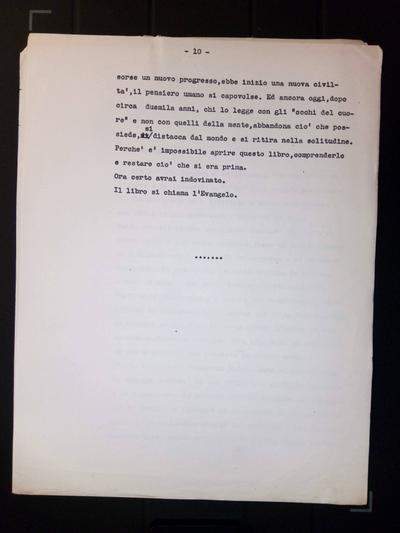
Dopo che esso apparve, si scatenarono delle furibonde tempeste: la Storia fermò il suo corso e ne prese un altro, crollarono gli imperi, furono combattute delle guerre, sorse un nuovo progresso, ebbe inizio una nuova civiltà, il pensiero umano si capovolse. Ed ancora oggi, dopo circa duemila anni, chi lo legge con gli "occhi del cuore" e non con quelli della mente, abbandona ciò che possiede, [deleted: si] [handwritten: si] distacca dal mondo e si ritira nella solitudine. Perché è impossibile aprire questo libro, comprenderlo e restare ciò che si era prima. Ora certo avrai indovinato. Il libro si chiama l'Evangelo.
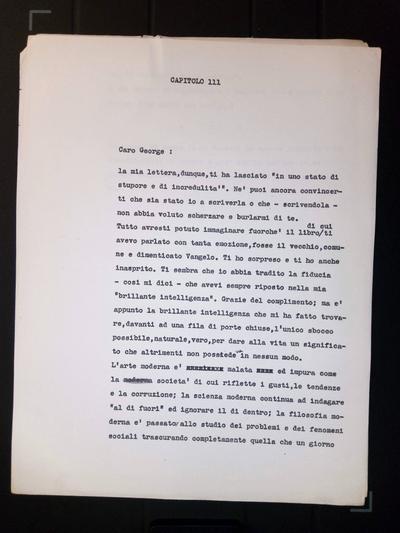
CAPITOLO 111
Caro George:
la mia lettera, dunque, ti ha lasciato "in uno stato di stupore e di incredulità". Ne' puoi ancora convincerti che sia stato io a scriverla o che - scrivendola - non abbia voluto scherzare e burlarmi di te. Tutto avresti potuto immaginare fuorché il libro/ti avevo parlato con tanta emozione, fosse il vecchio, comune e dimenticato Vangelo. Ti ho sorpreso e ti ho anche inasprito. Ti sembra che io abbia tradito la fiducia - così mi dici - che avevi sempre riposto nella mia "brillante intelligenza". Grazie del complimento; ma è appunto la brillante intelligenza che mi ha fatto trovare, davanti ad una fila di porte chiuse, l'unico sbocco possibile, naturale, vero, per dare alla vita un significato che altrimenti non possiede in nessun modo.
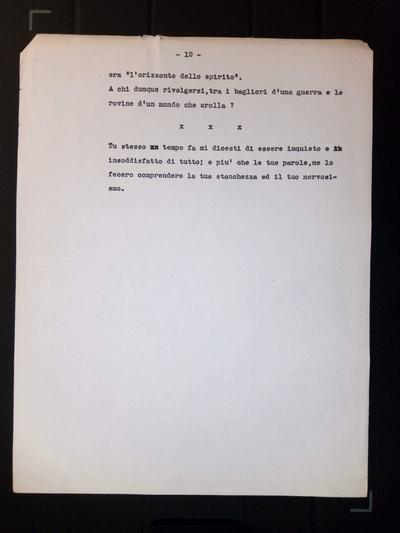
L'arte moderna è [unclear: XXXXXXXX] malata [unclear: XXXX] ed impura come la moderna società di cui riflette i gusti, le tendenze e la corruzione; la scienza moderna continua ad indagare "al di fuori" ed ignorare il di dentro; la filosofia moderna è passata allo studio dei problemi e dei fenomeni sociali trascurando completamente quella che un giorno era "l'orizzonte dello spirito".
A chi dunque rivolgersi, tra i bagliori d'una guerra e le rovine d'un mondo che crolla?
x x x
Tu stesso un tempo fa mi dicesti di essere inquieto e insoddisfatto di tutto; e più che le tue parole, me lo fecero comprendere la tua stanchezza ed il tuo nervosismo.
....
Dear George:
You want to know what has happened to me, since you say that for some time now you have noticed a profound change in me. It seems to you that I have lost certain traits that once made me “interesting”: I have acquired a kind of indifference toward life, I no longer take part in the discussions that so often arise among us, and you have even discovered that in the evening I invent “pretexts” to escape your company and go off by myself. All this seems strange and inexplicable to you, and you wonder what the true cause might be of the mystery surrounding me. You rule out the possibility of [unclear: xxxxxxxx] physical ailments/[unclear: xxxxxxxx]/you see me healthy and active; nor can you believe that I am the victim of some feminine spell because, though you know that women often [unclear: xxxxxxxxxxxxx] change and entangle men, you consider me/[unclear: xxx]/well armored against such dangers.
Well, you have guessed correctly: “something” has happened. But something so far removed from your conjectures and your imagination that today I have decided to write you this letter and explain the
mystery.
You should know, then, that about six months ago, one evening in September, one of the central wheels of my life abruptly stopped turning. I remember that the day had passed serenely and without incident. [deleted: xxxxxxxxxxxxxxxx] One of those ordinary, insipid, faceless days that so often follow one another with the monotony of waves upon a deserted shore. At home I had methodically repeated the things I had been accustomed to doing for years: waking, washing, sitting down at the table, chatting about the petty and futile matters of the moment; then going into the sitting room, lighting a cigarette, opening a book or leafing through a magazine. Nothing, therefore, had troubled me. Everything proceeded as usual; everything was “as it had been the day before.”
Suddenly, as I stood at a window watching evening cover the earth with its vast dark wings, the silent drama of which I shall now tell you took place. [deleted: xxxxxxxxxxxxxxxx] In truth, it is difficult to explain what happened; but it seemed to me that a great void had opened within me. A white, cold void, remote as a lunar landscape seen in a dream. I felt that something had died. There. That is the image that comes closest to the strange sensation of that evening. “Something inside me had died.” But what it was, and what it all meant, I was far from knowing. I tried to distract myself, to go out, to see people; but [deleted: xxxxxxxxxxxxxxxx] [handwritten: the sensation] I awoke with [deleted: xxxxxx] [handwritten: that] same impression. It was during those days that you all began to notice my “change” and besiege me with questions.
A week later I went to see a doctor.
“Do you have an appetite?”
“Yes.”
“Do you sleep well?”
“Yes.”
“Do you feel tired, listless, depressed?”
“No.”
“Let us have a look,” [deleted: he said] [handwritten: he exclaimed]. “Undress.”
I undressed. He touched me, felt me with his hands, made me cough, breathe deeply, bend over, straighten up, and lie down on a small table, where, attentive and thoughtful, he continued his wandering investigation. At last he told me to dress, and then delivered his verdict. A verdict of acquittal.
“You,” he said, “are perfectly well. You merely need vitamins.”
“But,” I tried to point out, “this strange sensation I feel...”
He interrupted me at once:
“It will pass. It is a nervous condition.”
x x x
“A nervous condition.” One enigma had been added to another. What did “a nervous condition” mean when I felt I was the calmest and most peaceable man in the world? Indeed, I had lost all the traits—as you yourself say—of an imaginative, enthusiastic, impulsive man, and had become as simple and indifferent as a centenarian.
I did not take the vitamins, but went to a renowned psychiatrist.
“This void you speak of,” asked the sorcerer of the human psyche, “does it frighten you? Does it give you a sense of dread?”
“No. Quite the contrary...”
“What do you mean by ‘quite the contrary’?... Surely it gives you no pleasure.”
“I mean that I feel it, but it does not alarm me in the least.”
“Try to make me understand,” he insisted. “Where is this void? In your mind, in the order of your thoughts, or is it a sense of confusion, like that of someone who believes he has lost his way?”
I answered:
“My thoughts are clear, my memory is good, and I possess perfect self-assurance.”
“Then where is this void?”
“Inside.”
“Inside where?”
“Inside my life. It seems to me that I have been severed from something to which I was once intimately bound, and that now, divided from it, I find myself alone and different from what I was before.”
“Different how?”
“How should I know?... Another person...” [deleted: It is as though I had lost the taste for life.]
For a moment he stared fixedly at me; then he leaned his whole body back in the armchair, clasped
his hands, and brought the tips of his fingers to his lips, as one does in prayer.
He resumed his questioning:
“Tell me: have you suffered any great sorrow recently?”
“No.”
“Have you subjected yourself to physical exhaustion?”
“No.”
“Have there ever been any cases of mental instability in your family?”
“No.”
He collected his thoughts and said:
“Yours is nothing more than a mild form of nervous exhaustion.”
The doctor and the psychiatrist were therefore in agreement: a nervous condition. Science has invented the radio and the airplane, the electric lamp and the steam engine; it knows the distance between the earth and the sun, the speed of a star’s light, and can predict eclipses with mathematical precision—yet this same science knows nothing, absolutely nothing, about man; and when faced with a case that is not physical, with a disease that afflicts the spirit rather than the flesh, it is left perplexed and prescribes vitamins.
For two months I continued to live and move about in the state described above, trying above all to con-
trol myself, to hide and pretend, since your questions—like those of my other friends—caused me painful embarrassment. And after two months, I discovered for myself the cause of the ailment that had struck me. I was “a man without dreams.” All the dreams that had once animated me and made my days pleasant had died suddenly, all at once, that September evening as I stood at a window watching night descend upon the earth. That was why I seemed to drag a great void behind me: [deleted: crossed out text] everything I did appeared poor and meaningless; and nothing any longer stirred interest or the desire for possession within my soul.
Many men arrive at barren and pessimistic conclusions about the value of human life; but they arrive there gradually, by small stages, as they advance toward old age and feel the flame of illusions and hopes dying within them. Why I should have plunged into such conclusions at thirty-seven—and apparently without any reason—is something I do not know and perhaps never shall. The fact remains that it happened, and everything lost its taste and color for me. The spectacle of mankind—its labors, its quarrels, its conquests—seemed to me immensely ridiculous as well as immensely sad.
To lose one’s dreams is to lose oneself. Imagine a garden without flowers, or flowers without fragrance. More than that: a fountain without water, a lamp without light. The very same thing. But now you want to know what happened afterward, the discovery that [deleted: crossed out text] Something even more surprising and significant than the first event occurred. As I wandered about in this distracted and “emptied-
out” state, one day, while putting some old papers in order, I happened by chance upon a small book bound in black, modest in appearance, without illustrations, its printed pages slightly yellowed. It was a book I knew well, because my father had given it to me on the eve of my departure for America, and for years and years I had always carried it with me, though I had never read it. I picked it up and opened it. All that evening, for much of the night, and during the days that followed, I continued its enthralling reading. And when I had finished it, I began at the beginning and read it once again. Then a great peace came over me; a wave of light and joy enveloped my soul; life acquired a new meaning—a meaning far nobler than any I had ever attributed to it—and the void, all that void I had dragged behind me, disappeared forever.
“A miracle?” you will say.
I do not know; but certainly a healing. I had saved myself from the sickness of life understood as aimless wanderings, sterile adventures of the mind, and [handwritten: Dr. P.] [deleted: sterile] /sinful desires; and in place of the dreams that had died, I had set certain sublime truths that left me in doubt of nothing, that illuminated me, warmed me, and held me firm as roots hold fast a tree shaken by a storm.
There was no longer any bond between me and the past. The past had died together with my dreams, and I truly was a new man. A man whom you no longer recognized—and could
not recognize—and whom you anxiously asked: “But what has happened to you?”
This is what has happened to me. I have lost the habit of dreaming, and in place of the desires that poisoned my blood, I have set [handwritten: a faith that gives me true peace.]
Chapter 11
The Eternal Book
Dear George:
you say that with my letter I have done nothing but [deleted: sharpen your curiosity] [handwritten: instead of satisfying it] because I withheld from you the name of the wondrous book that has exerted so great an influence upon me.
Well, I deliberately did not tell you about it. I could not, in fact, [deleted: make merely a passing reference to it; XXXXXXXXXXXXXXXXXXXXXXXXX] [handwritten: nor did I have the time to prolong my letter any further]. In any case, know that of the billions of books that exist on earth, and the billions more that were written and forgotten, none has ever resembled this one, which remains without equal in the world. All the wisdom mankind possesses, all its philosophical systems and scientific treatises and moral doctrines, cannot approach the greatness contained within the brief pages of the little volume my father gave me, which for eighteen centuries has traveled among the peoples of the world, translated into every language, commented upon everywhere, read every day.
After it appeared, furious storms broke loose: History halted its course and took another, empires collapsed, wars were fought,
a new progress arose, a new civilization began, human thought was overturned. And even today, after nearly two thousand years, whoever reads it with the “eyes of the heart” and not those of the mind abandons all he possesses, [deleted: se] [handwritten: se]vers himself from the world and withdraws into solitude. For it is impossible to open this book, understand it, and remain what one was before. By now, surely, you will have guessed. The book is called the Gospel.
CHAPTER 111
Dear George:
my letter, then, has left you “in a state of astonishment and disbelief.” Nor can you yet convince yourself that it was truly I who wrote it, or that—in writing it—I did not mean to joke and make fun of you. You could have imagined anything except that the book of which I had spoken to you with such emotion was the old, familiar, forgotten Gospel. I surprised you, and I embittered you as well. You feel that I have betrayed the trust—so you tell me—that you had always placed in my “brilliant intelligence.” Thank you for the compliment; but it was precisely that brilliant intelligence which, faced with a row of closed doors, led me to find the one possible, natural, true way out, the one that gives life a meaning it otherwise possesses in no way at all.
Modern art is [unclear: XXXXXXXX] diseased [unclear: XXXX] and impure, like the modern society whose tastes, tendencies, and corruption it reflects; modern science continues to investigate what is “outside” while ignoring what lies within; modern philosophy has turned to the study of social problems and phenomena, completely neglecting what once
was “the horizon of the spirit.”
To whom, then, can one turn amid the flashes of war and the ruins of a collapsing world?
x x x
You yourself told me some time ago that you were restless and dissatisfied with everything; and more than your words, it was your weariness and nervousness that made me understand.