I Manoscritti / Original Typescripts · 4 fogli
Page 1
Page 2
Page 3
Page 4
“Lettera da New York” is a journalistic feuilleton/epistolary column composed of short, loosely connected vignettes that sketch mid-century American public life with irony. The narrator opens by noting a 20th Century-Fox film advertised as “ten percent true and ninety percent invented,” treating even a small fraction of truth as rare and reassuring. He then reports on a major medical congress in New York, emphasizing the growing presence of women physicians and quoting their claim that men confide certain things only to women. An elderly observer counters with a proverb-like diagnosis: the best doctors are Diet, Cheerfulness, and Money, later adding Time.
A darker anecdote follows: the wrestler Frank Leavitt, nicknamed “the devil-man” and famed for thousands of bouts, dies at 63 after a varied life (soldier, football player, film actor, political errand-runner). After disqualification and retirement he briefly tries politics, but flees, calling it a “witch” harsher than combat.
The column then surveys public anxieties and cultural economics: relentless rain blamed by citizens on atomic tests; Broadway’s financial crisis, with costly flops by Moss Hart and Tennessee Williams and critics predicting a turn from realism toward subjective psychological drama. It closes with two comic notes: a divorcee whose maiden name becomes Miss Cork, and Presbyterians rejecting a proposal to change the Lord’s Prayer from “debts” to “sins.”
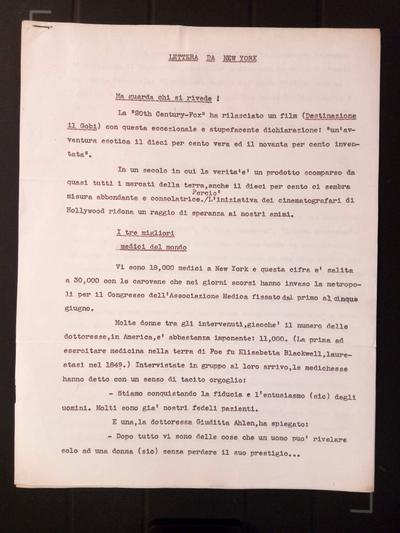
Ma guarda chi si rivede!
La "20th Century-Fox" ha rilasciato un film (Destinazione il Gobi) con questa eccezionale e stupefacente dichiarazione: "un'avventura esotica il dieci per cento vera ed il novanta per cento inventata".
In un secolo in cui la verità è un prodotto scomparso da quasi tutti i mercati della terra, anche il dieci per cento ci sembra misura abbondante e consolatrice. Perciò l'iniziativa dei cinematografari di Hollywood ridona un raggio di speranza ai nostri animi.
Vi sono 18,000 medici a New York e questa cifra è salita a 30,000 con le carovane che nei giorni scorsi hanno invaso la metropoli per il Congresso dell'Associazione Medica fissato dal primo al cinque giugno.
Molte donne tra gli intervenuti, giacché il numero delle dottoresse, in America, è abbastanza imponente: 11,000. (La prima ad esercitare medicina nella terra di Poe fu Elisabetta Blackwell, laureatasi nel 1849.) Intervistate in gruppo al loro arrivo, le medichesse hanno detto con un senso di tacito orgoglio:
— Stiamo conquistando la fiducia e l'entusiasmo (sic) degli uomini. Molti sono già nostri fedeli pazienti.
E una, la dottoressa Giuditta Ahlen, ha spiegato:
— Dopo tutto vi sono delle cose che un uomo può rivelare solo ad una donna (sic) senza perdere il suo prestigio...
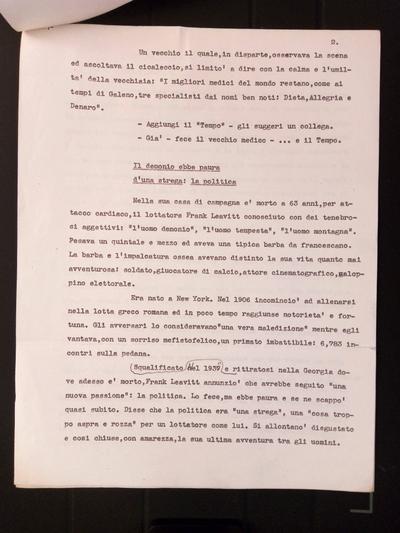
Un vecchio il quale, in disparte, osservava la scena ed ascoltava il cicaleccio, si limitò a dire con la calma e l'umiltà della vecchiaia: "I migliori medici del mondo restano, come ai tempi di Galeno, tre specialisti dai nomi ben noti: Dieta, Allegria e Denaro".
— Aggiungi il "Tempo" - gli suggerì un collega.
— Già! - fece il vecchio medico - ... e il Tempo.
Nella sua casa di campagna è morto a 63 anni, per attacco cardiaco, il lottatore Frank Leavitt conosciuto con dei tenebrosi aggettivi: "l'uomo demonio", "l'uomo tempesta", "l'uomo montagna". Pesava un quintale e mezzo ed aveva una tipica barba da francescano. La barba e l'impalcatura ossea avevano distinto la sua vita quanto mai avventurosa: soldato, giuocatore di calcio, attore cinematografico, galoppino elettorale.
Era nato a New York. Nel 1906 incominciò ad allenarsi nella lotta greco romana ed in poco tempo raggiunse notorietà e fortuna. Gli avversari lo consideravano "una vera maledizione" mentre egli vantava, con un sorriso mefistofelico, un primato imbattibile: 6,783 incontri sulla pedana.
Squalificato nel 1937 e ritiratosi nella Georgia dove adesso è morto, Frank Leavitt annunciò che avrebbe seguito "una nuova passione": la politica. Lo fece, ma ebbe paura e se ne scappò quasi subito. Disse che la politica era "una strega", una "cosa troppo aspra e rozza" per un lottatore come lui. Si allontanò disgustato e così chiuse, con amarezza, la sua ultima avventura tra gli uomini.
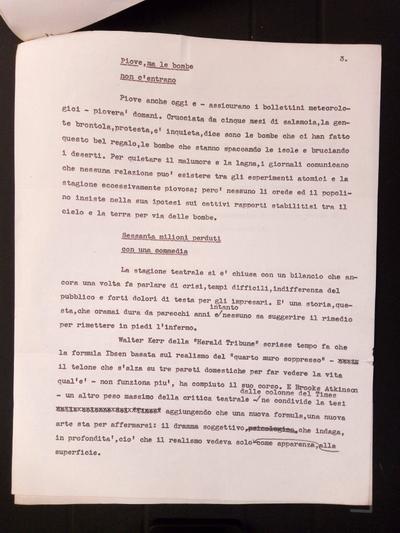
Piove anche oggi e - assicurano i bollettini meteorologici - pioverà domani. Crucciata da cinque mesi di salamoia, la gente brontola, protesta, è inquieta, dice sono le bombe che ci han fatto questo bel regalo, le bombe che stanno spaccando le isole e bruciando i deserti. Per quietare il malumore e la lagna, i giornali comunicano che nessuna relazione può esistere tra gli esperimenti atomici e la stagione eccessivamente piovosa; però nessuno li crede ed il popolo no insiste nella sua ipotesi sui cattivi rapporti stabilitisi tra il cielo e la terra per via delle bombe.
La stagione teatrale si è chiusa con un bilancio che ancora una volta fa parlare di crisi, tempi difficili, indifferenza del pubblico e forti dolori di testa per gli impresari. È una storia, questa, che oramai dura da parecchi anni e intanto nessuno sa suggerire il rimedio per rimettere in piedi l'infermo.
Walter Kerr della "Herald Tribune" scrisse tempo fa che la formula Ibsen basata sul realismo del "quarto muro soppresso" - il telone che s'alza su tre pareti domestiche per far vedere la vita qual'è - non funziona più, ha compiuto il suo corso. E Brooks Atkinson - un altro peso massimo della critica teatrale - dalle colonne del Times ne condivide la tesi aggiungendo che una nuova formula, una nuova arte sta per affermarsi: il dramma soggettivo che indaga, in profondità, cioè che il realismo vedeva solo alla superficie come apparenza.
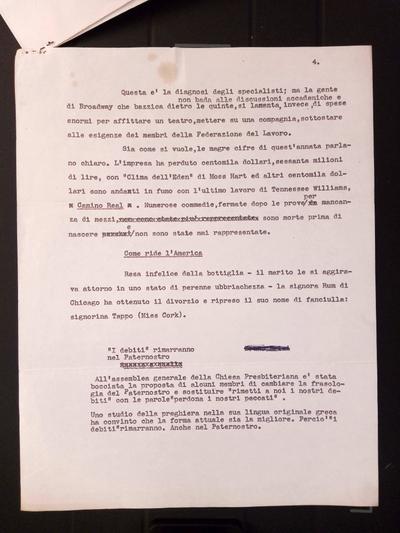
Questa è la diagnosi degli specialisti; ma la gente di Broadway che bazzica dietro le quinte non bada alle discussioni accademiche e si lamenta, invece, di spese enormi per affittare un teatro, mettere su una compagnia, sottostare alle esigenze dei membri della Federazione del Lavoro.
Sia come si vuole, le magre cifre di quest'annata parlano chiaro. L'impresa ha perduto centomila dollari, sessanta milioni di lire, con "Clima dell'Eden" di Moss Hart ed altri centomila dollari sono andati in fumo con l'ultimo lavoro di Tennessee Williams, per Camino Real. Numerose commedie, fermate dopo le prove per mancanza di mezzi sono morte prima di nascere e non sono state mai rappresentate.
Resa infelice dalla bottiglia - il marito le si aggirava attorno in uno stato di perenne ubbriachezza - la signora Rum di Chicago ha ottenuto il divorzio e ripreso il suo nome di fanciulla: signorina Tappo (Miss Cork).
All'assemblea generale della Chiesa Presbiteriana è stata bocciata la proposta di alcuni membri di cambiare la fraseologia del Paternostro e sostituire "rimetti a noi i nostri debiti" con le parole "perdona i nostri peccati".
Uno studio della preghiera nella sua lingua originale greca ha convinto che la forma attuale sia la migliore. Perciò "i debiti" rimarranno. Anche nel Paternostro.
Well, look who’s back!
20th Century-Fox has released a film (Destination Gobi) with this extraordinary and astonishing declaration: “an exotic adventure, ten percent true and ninety percent invented.”
In a century when truth is a product that has vanished from nearly every market on earth, even ten percent seems to us an abundant and consoling measure. And so this initiative by the Hollywood movie-makers restores a ray of hope to our souls.
There are 18,000 doctors in New York, and that number rose to 30,000 with the caravans that invaded the metropolis in recent days for the Medical Association convention, scheduled for June first through fifth.
There were many women among those attending, since the number of female doctors in America is quite impressive: 11,000. (The first woman to practice medicine in the land of Poe was Elizabeth Blackwell, who graduated in 1849.) Interviewed as a group upon their arrival, the lady doctors said with a sense of quiet pride:
“We are winning the trust and enthusiasm (sic) of men. Many are already our loyal patients.”
And one of them, Dr. Judith Ahlen, explained:
“After all, there are some things a man can reveal only to a woman (sic) without losing his prestige...”
An old man who stood apart, watching the scene and listening to the chatter, merely said with the calm and humility of age: “The best doctors in the world remain, as in the days of Galen, three specialists with well-known names: Diet, Cheerfulness, and Money.”
“Add ‘Time,’” a colleague suggested.
“Of course!” said the old doctor. “...and Time.”
Frank Leavitt, the wrestler known by such sinister epithets as “the Demon Man,” “the Storm Man,” and “the Mountain Man,” has died of a heart attack at the age of sixty-three in his country home. He weighed three hundred and thirty pounds and wore a typically Franciscan beard. That beard and his massive frame had marked his extraordinarily adventurous life: soldier, football player, film actor, political campaign worker.
He was born in New York. In 1906 he began training in Greco-Roman wrestling and within a short time achieved fame and fortune. His opponents considered him “a veritable curse,” while he boasted, with a Mephistophelian smile, of an unbeatable record: 6,783 matches in the ring.
Disqualified in 1937 and retired to Georgia, where he has now died, Frank Leavitt announced that he would devote himself to “a new passion”: politics. He did, but it frightened him, and he fled almost at once. He said that politics was “a witch,” something “far too harsh and rough” for a wrestler like him. He turned away in disgust, thus bringing his last adventure among men to a bitter end.
It is raining again today and—the weather bulletins assure us—it will rain tomorrow. Exasperated by five months of brine, people grumble, protest, grow restless; they say it is the bombs that have bestowed this lovely gift upon us, the bombs that are splitting islands apart and scorching deserts. To quiet the discontent and whining, the newspapers report that no connection can possibly exist between the atomic tests and the excessively rainy season; but no one believes them, and the people persist in their theory that the bombs have soured relations between heaven and earth.
The theatrical season has ended with a balance sheet that once again prompts talk of crisis, hard times, public indifference, and severe headaches for producers. It is a story that has been going on for several years now, and still no one knows what remedy to suggest to put the invalid back on his feet.
Walter Kerr of the Herald Tribune wrote some time ago that the Ibsen formula, based on the realism of the “removed fourth wall”—the curtain rising on three walls of a home to show life as it is—no longer works; it has run its course. And Brooks Atkinson—another heavyweight of theater criticism—agrees in the pages of the Times, adding that a new formula, a new art, is about to establish itself: subjective drama, which probes deeply into what realism saw only on the surface, as mere appearance.
That is the specialists’ diagnosis; but the Broadway crowd that haunts the backstage corridors pays no attention to academic debates and complains instead about the enormous cost of renting a theater, assembling a company, and complying with the demands of the members of the Federation of Labor.
Be that as it may, this season’s meager figures speak plainly. The producers lost one hundred thousand dollars—sixty million lire—on Moss Hart’s Climate of Eden, and another hundred thousand dollars went up in smoke with Tennessee Williams’s latest work, Camino Real. Numerous plays, halted after rehearsals for lack of funds, died before they were born and were never performed.
Made miserable by the bottle—her husband hovered around her in a state of perpetual drunkenness—Mrs. Rum of Chicago obtained a divorce and resumed her maiden name: Miss Cork.
At the General Assembly of the Presbyterian Church, a proposal by some members to alter the wording of the Lord’s Prayer and replace “forgive us our debts” with the words “forgive us our sins” was defeated.
A study of the prayer in its original Greek has persuaded them that the present form is best. And so “debts” will remain. Even in the Lord’s Prayer.