THE TIME : [deleted: ] 1925
Today is a bridge between Yesterday and Tomorrow.
Chapter 1
EXTRA! EXTRA!
Hello, the New York Globe.....What?.....A skyscraper has toppled over?.....Speak louder, I can't hear well.....Oh, a man threw himself off a skyscraper.....Thirtieth floor. At the corner of Fulton Street and Broadway. A big crowd......We'll send a reporter right away.....What did you say your name was? Pronounce it letter for letter, please......B-r-a-d-l-e-y.....B as in Boston, R as in Richmond, A as in Alabama, D as in Densen, L as.....I've got it.....okay. Mr. Bradley. Thanks.....What?.....Oh, of course you'll get paid. Whoever gives us a news tip always gets paid.....How much? Well that depends upon its importance. We'll see.....Good-bye.....(Robbins, have two bucks sent to Louis Bradley, 362 Ocean Avenue, Brooklyn.....Which of the reporters is free? Somebody should go to Fulton Street. A man is dead. No. No murder. Instead of taking the elevator a guy jumped from the thirtieth floor.) The "New York Globe".....Hello.....Yes, madam.....No, madam.....Listen, we are not interested in that.....You might have had it for twenty years, but the fact remains that we can't help you find your dog. Go to the police or to the Animal Rescue League.....What?
.....Oh, thanks. The same to you, Madam, double.....
Hello, "The New York Globe".....This is it.....Whom do you wish to speak to?.....Well, go ahead.....The Pope?.....Wait a minute.....(Robbins, look up the Pope's age in the almanac). The "New York Globe".....Yes, Till it is I.....What?.....Wow! Give me the address.....123 Park Avenue.....I've got it. Go on.....How many?.....Nude, did you say?.....Even Miss Mayfield? Who? Barbara? The daughter of the tobacco king?.....Wonderful!.....Yes, yes.....And Lillian May, the actress?.....Go ahead, go ahead.....Fifty cops, twenty detectives, three inspectors.....About thirty arrests.....Many women. Many social celebrities.....Stupendous!.....Listen, Till, don't move from there. I'll send somebody immediately. How about Bob Davis? And a couple of camera men. So long.....(Oh boy, the cops surprised a hot party in Park Avenue. A dope den in a dance hall. Nude girls, drunk. Among those arrested are Barbara Mayfield and Lillian May. We can fill the paper with pictures. To-morrow we'll send thousands of extra copies. Robbins, light me a cigarette. Davis hop over to 123 Park Avenue. I'll leave the front page open and at your disposal. Till March is already there waiting. Get a move on. You, Anderson, do a profile of Miss May. Say that in the winter she tours the streets of Hollywood in her automobile, nude, wrapped in a mink coat. You, Charlie, go interview Bishop Bering. Get a statement from him condemning the vice dens that foul the city. Try to stir him into dragging in politics and the indifference of the local authorities. We'll make a bigger stink that way. You, Nate, do a story on the Mayfield tribe. Tell how Barbara was engaged to a French nobleman last year but that she wouldn't marry him because she didn't like his last name. His name was Payse but everybody in America pronounced it a way she didn't like, if you know what I mean. And don't forget her mother, a woman of many adventures, who, it is said, was the cause of a duel in Argentina. You, George, get pictures of the Johnson crowd that owned the dance hall.....Oh, what a story! Robbins, get me a whiskey and soda). Hello, the "New York Globe" What?.....the Pope?.....Which Pope?.....Oh, I see. I beg your pardon.....just a moment..... (Robbins, did you find out.....it's you Mac? Well! Hot pictures with background, that's what I want. And don't take a cab. Take the Lexington Avenue, it's quicker.....young lady, tell them to leave the front page open). Hello.....Yes, the "New York Globe".....Who won what?.....I don't get you? What game?.....Wait I'll have you connected with the sports department. (Robbins, light me another cigarette). Hello.....What did you say?.....Your five year old daughter? Well?.....You want to "put her in the paper?".....But, what has she done?.....First communion?.....No, don't send it. Save the picture for when she's kidnapped by gangsters.....No, no, you didn't understand me. I said that.....Hello, hello.....operator, you cut me off! Who are you? Oh, for heaven’s sake, you are still waiting to find out the Pope’s age. Just a moment. (Robbins, tell me...... What do you mean it isn’t there? Did you take a good look?......Say boys, which of you knows how old the Pope is?......Seventy two?......Seventy nine?......Eighty five?......Well get together on it because somebody on the line is hollering like a madman?......Hello......Hello......Yes, sir......No, sir......Yes, sir......but I’ve already told you, in fact......Oh, yes?......Yet?......Well, thanks. The same to you and many of them.
Ralph’s voice continues to resound in the telephone like the hammering of a machine. He lowers it, he raises it; it becomes suddenly serious, caustic, it cuts off a phrase; it laughs, becomes silent.
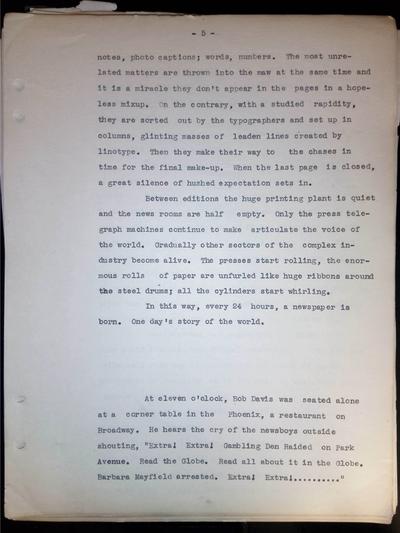
It is the most intense moment of work and fever. Nothing is heard except the continuous staccato of the telegraph machines transmitting all sorts of news; news that is nervously gathered, classified and distributed. Reporters rush out and come back with hastily scribbled notes. All the telephones are busy. From the press and composing rooms comes the roar of machinery and the whirl of motors. The "takes," nervously prepared and edited, flow down to the composing room in great confusion. Sports news, foreign cables, labor news, "spot" items; stock quotations, theatrical criticism, political notes, photo captions; words, numbers. The most unrelated matters are thrown into the maw at the same time and it is a miracle they don't appear in the pages in a hopeless mixup. On the contrary, with a studied rapidity, they are sorted out by the typographers and set up in columns, glinting masses of leaden lines created by linotype. Then they make their way to the chases in time for the final make-up. When the last page is closed, a great silence of hushed expectation sets in.
Between editions the huge printing plant is quiet and the news rooms are half empty. Only the press telegraph machines continue to make articulate the voice of the world. Gradually other sectors of the complex industry become alive. The presses start rolling, the enormous rolls of paper are unfurled like huge ribbons around the steel drums; all the cylinders start whirling.
In this way, every 24 hours, a newspaper is born. One day's story of the world.
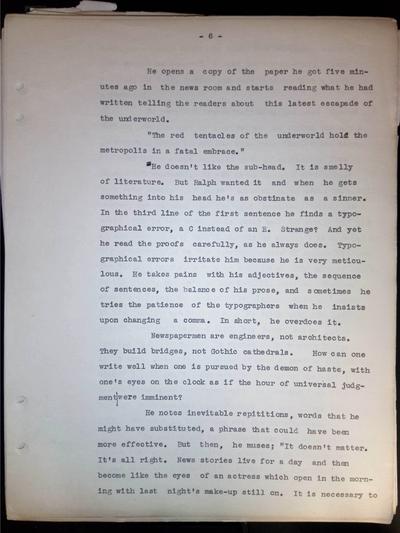
At eleven o'clock, Bob Davis was seated alone at a corner table in the Phoenix, a restaurant on Broadway. He hears the cry of the newsboys outside shouting, "Extra! Extra! Gambling Den Raided on Park Avenue. Read the Globe. Read all about it in the Globe. Barbara Mayfield arrested. Extra! Extra!........"
He opens a copy of the paper he got five minutes ago in the news room and starts reading what he had written telling the readers about this latest escapade of the underworld.
"The red tentacles of the underworld hold the metropolis in a fatal embrace."
He doesn't like the sub-head. It is smelly of literature. But Ralph wanted it and when he gets something into his head he's as obstinate as a sinner. In the third line of the first sentence he finds a typographical error, a C instead of an E. Strange? And yet he read the proofs carefully, as he always does. Typographical errors irritate him because he is very meticulous. He takes pains with his adjectives, the sequence of sentences, the balance of his prose, and sometimes he tries the patience of the typographers when he insists upon changing a comma. In short, he overdoes it.
Newspapermen are engineers, not architects. They build bridges, not Gothic cathedrals. How can one write well when one is pursued by the demon of haste, with one's eyes on the clock as if the hour of universal judgment were imminent?
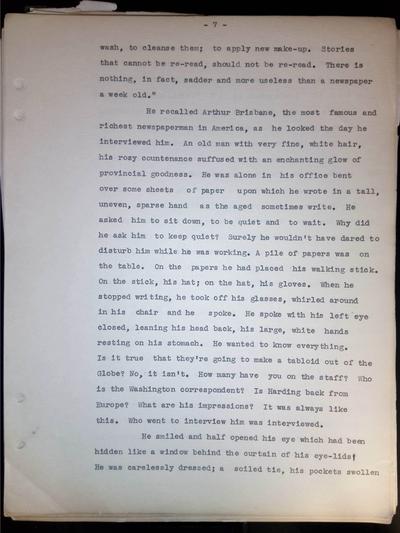
He notes inevitable repetitions, words that he might have substituted, a phrase that could have been more effective. But then, he muses; "It doesn't matter. It's all right. News stories live for a day and then become like the eyes of an actress which open in the morning with last night's make-up still on. It is necessary to wash, to cleanse them; to apply new make-up. Stories that cannot be re-read, should not be re-read. There is nothing, in fact, sadder and more useless than a newspaper a week old."
He recalled Arthur Brisbane, the most famous and richest newspaperman in America, as he looked the day he interviewed him. An old man with very fine, white hair, his rosy countenance suffused with an enchanting glow of provincial goodness. He was alone in his office bent over some sheets of paper upon which he wrote in a tall, uneven, sparse hand as the aged sometimes write. He asked him to sit down, to be quiet and to wait. Why did he ask him to keep quiet? Surely he wouldn't have dared to disturb him while he was working. A pile of papers was on the table. On the papers he had placed his walking stick. On the stick, his hat; on the hat, his gloves. When he stopped writing, he took off his glasses, whirled around in his chair and he spoke. He spoke with his left eye closed, leaning his head back, his large, white hands resting on his stomach. He wanted to know everything. Is it true that they're going to make a tabloid out of the Globe? No, it isn't. How many have you on the staff? Who is the Washington correspondent? Is Harding back from Europe? What are his impressions? It was always like this. Who went to interview him was interviewed.
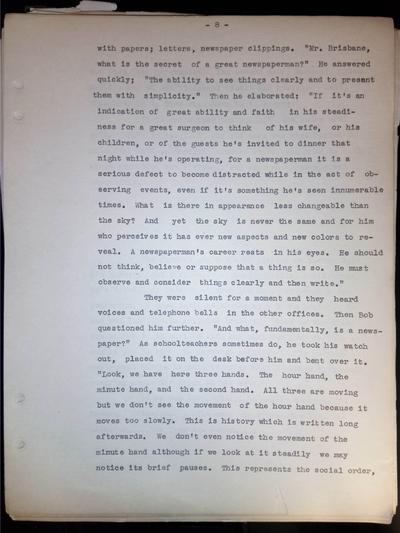
He smiled and half opened his eye which had been hidden like a window behind the curtain of his eye-lids. He was carelessly dressed; a soiled tie, his pockets swollen with papers; letters, newspaper clippings. "Mr. Brisbane, what is the secret of a great newspaperman?" He answered quickly; "The ability to see things clearly and to present them with simplicity." Then he elaborated: "If it's an indication of great ability and faith in his steadiness for a great surgeon to think of his wife, or his children, or of the guests he's invited to dinner that night while he's operating, for a newspaperman it is a serious defect to become distracted while in the act of observing events, even if it's something he's seen innumerable times. What is there in appearance less changeable than the sky? And yet the sky is never the same and for him who perceives it has ever new aspects and new colors to reveal. A newspaperman's career rests in his eyes. He should not think, believe or suppose that a thing is so. He must observe and consider things clearly and then write."
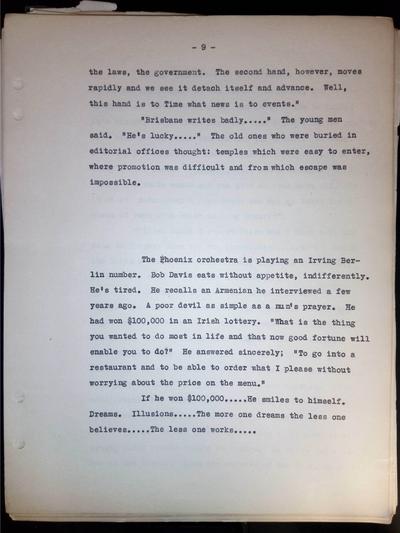
They were silent for a moment and they heard voices and telephone bells in the other offices. Then Bob questioned him further. "And what, fundamentally, is a newspaper?" As schoolteachers sometimes do, he took his watch out, placed it on the desk before him and bent over it. "Look, we have here three hands. The hour hand, the minute hand, and the second hand. All three are moving but we don't see the movement of the hour hand because it moves too slowly. This is history which is written long afterwards. We don't even notice the movement of the minute hand although if we look at it steadily we may notice its brief pauses. This represents the social order, the laws, the government. The second hand, however, moves rapidly and we see it detach itself and advance. Well, this hand is to Time what news is to events."
"Brisbane writes badly....." The young men said. "He's lucky....." The old ones who were buried in editorial offices thought: temples which were easy to enter, where promotion was difficult and from which escape was impossible.
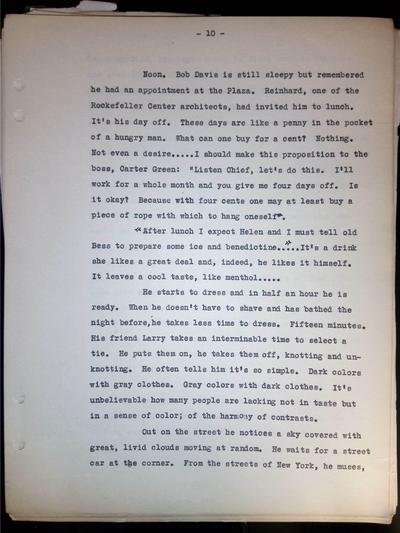
The Phoenix orchestra is playing an Irving Berlin number. Bob Davis eats without appetite, indifferently. He's tired. He recalls an Armenian he interviewed a few years ago. A poor devil as simple as a man's prayer. He had won $100,000 in an Irish lottery. "What is the thing you wanted to do most in life and that now good fortune will enable you to do?" He answered sincerely; "To go into a restaurant and to be able to order what I please without worrying about the price on the menu."
If he won $100,000.....He smiles to himself. Dreams. Illusions.....The more one dreams the less one believes.....The less one works.....
Noon. Bob Davis is still sleepy but remembered he had an appointment at the Plaza. Reinhard, one of the Rockefeller Center architects, had invited him to lunch. It's his day off. These days are like a penny in the pocket of a hungry man. What can one buy for a cent? Nothing. Not even a desire.....I should make this proposition to the boss, Carter Green: "Listen Chief, let's do this. I'll work for a whole month and you give me four days off. Is it okay? Because with four cents one may at least buy a piece of rope with which to hang oneself".
«After lunch I expect Helen and I must tell old Bess to prepare some ice and benedictine.....It's a drink she likes a great deal and, indeed, he likes it himself. It leaves a cool taste, like menthol.....»
He starts to dress and in half an hour he is ready. When he doesn't have to shave and has bathed the night before, he takes less time to dress. Fifteen minutes. His friend Larry takes an interminable time to select a tie. He puts them on, he takes them off, knotting and un-knotting. He often tells him it's so simple. Dark colors with gray clothes. Gray colors with dark clothes. It's unbelievable how many people are lacking not in taste but in a sense of color; of the harmony of contrasts.
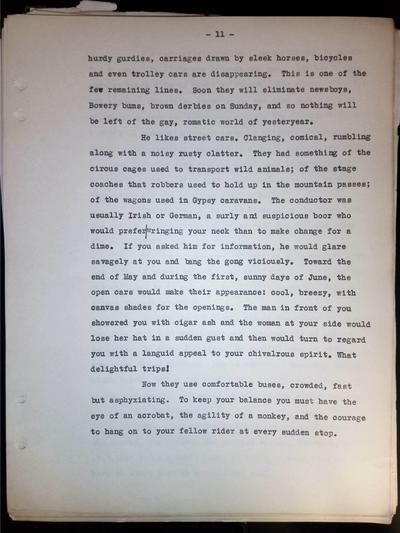
Out on the street he notices a sky covered with great, livid clouds moving at random. He waits for a street car at the corner. From the streets of New York, he muses, hurdy gurdies, carriages drawn by sleek horses, bicycles and even trolley cars are disappearing. This is one of the few remaining lines. Soon they will eliminate newsboys, Bowery bums, brown derbies on Sunday, and so nothing will be left of the gay, romantic world of yesteryear.
He likes street cars. Clanging, comical, rumbling along with a noisy rusty clatter. They had something of the circus cages used to transport wild animals; of the stage coaches that robbers used to hold up in the mountain passes; of the wagons used in Gypsy caravans. The conductor was usually Irish or German, a surly and suspicious boor who would prefer [handwritten: wringing] your neck than to make change for a dime. If you asked him for information, he would glare savagely at you and bang the gong viciously. Toward the end of May and during the first, sunny days of June, the open cars would make their appearance: cool, breezy, with canvas shades for the openings. The man in front of you showered you with cigar ash and the woman at your side would lose her hat in a sudden gust and then would turn to regard you with a languid appeal to your chivalrous spirit. What delightful trips!
Now they use comfortable buses, crowded, fast but asphyxiating. To keep your balance you must have the eye of an acrobat, the agility of a monkey, and the courage to hang on to your fellow rider at every sudden stop.
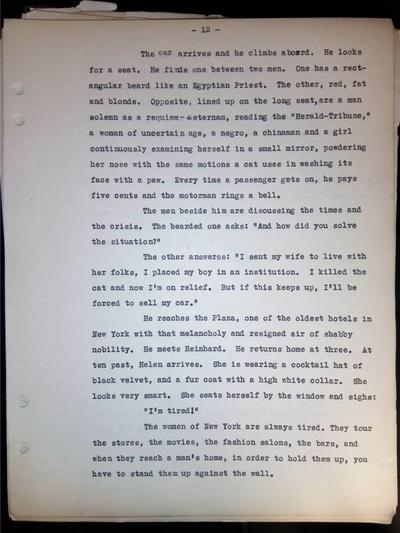
The car arrives and he climbs aboard. He looks for a seat. He finds one between two men. One has a rectangular beard like an Egyptian Priest. The other, red, fat and blonde. Opposite, lined up on the long seat, are a man solemn as a requiem-aeternam, reading the "Herald-Tribune," a woman of uncertain age, a negro, a chinaman and a girl continuously examining herself in a small mirror, powdering her nose with the same motions a cat uses in washing its face with a paw. Every time a passenger gets on, he pays five cents and the motorman rings a bell.
The men beside him are discussing the times and the crisis. The bearded one asks: "And how did you solve the situation?"
The other answers: "I sent my wife to live with her folks, I placed my boy in an institution. I killed the cat and now I'm on relief. But if this keeps up, I'll be forced to sell my car."
He reaches the Plaza, one of the oldest hotels in New York with that melancholy and resigned air of shabby nobility. He meets Reinhard. He returns home at three. At ten past, Helen arrives. She is wearing a cocktail hat of black velvet, and a fur coat with a high white collar. She looks very smart. She seats herself by the window and sighs:
"I'm tired!"
The women of New York are always tired. They tour the stores, the movies, the fashion salons, the bars, and when they reach a man's home, in order to hold them up, you have to stand them up against the wall.
"Where have you been?"
"I can't find a cape like Maude's. A clear blue mohair swagger. Awfully pretty."
Maude is a friend of hers, blonde and as slim as an illusion. Everybody falls in love for her. But she leaves him cold. Once when they were alone and he took her in his arms he felt the bones of her arms, her shoulders and her hips and he thought of a skeleton.
Old Fred makes him laugh. When he sees one of the boys with one of those thin women, he warns them: "Remember, women should be like soup chicken, meat and bones, and not like spring chickens that are good roasted only during the months of July and August."
"I would have come earlier but you weren't home." she said.
"Did you telephone?"
"Yes. At two o'clock."
"I had lunch with Reinhard at the Plaza and he told me some interesting things about modern construction."
He takes a seat near her and offers her a cigarette.
"Wait," she says, rising. "I'm going to take off my hat and coat. It's warm here."
She comes back into the studio. She pauses near the large table where he works and, as usual, starts examining the papers scattered on it.
"What have you written lately, Bob?"
"Nothing."
"Not even one story?"
"Not even one story."
"Why?"
"I didn't feel like it."
"You never feel like doing anything."
"That isn't true because I always feel the need of you."
"What a fibber. Besides that's a vice not a virtue."
She may be right. A vice. Like a cigarette. Like gambling. Like liquor. [deleted: Soon they will enter the other room and close the door. Two hours later they will reopen the door to come out.]
The same thing happens with Jole. With Ada, Wanda, with May and with all the women who pass through his life like water passing under a bridge.....
At six Helen starts dressing again. After twelve months of freedom and exploration she doesn't want him to look at her when she gets out of bed, and if he takes her by surprise, she quickly hides herself behind the screen formed by her dress that she hastily picks up from the chair and [deleted: covers herself with it].
They dress quietly, distracted, with hardly a word. To her questions he answers with monosyllables. This is a time during which he experiences a deep boredom. Each time he would like her to dress in a twinkling so that they might hurry into the street to mingle with the passing crowd.
At seven they go into a restaurant. At 8:30 they go to the movies. At midnight he takes her home.
It's always thus.....always.....
Chapter 3
A BOOK IS BORN.
"Doctor, I am really sick. Do something for me."
Seated in a large easy chair in his small and quiet study, Dr. Leonard smiles with amusement before answering. He is eighty, but he is young. He has the vigor, the enthusiasm and the friendliness of youth. Tall, erect, his features still youthful, capped by long, snow-white hair, his clear gaze reflects benevolence and strength.
Dr. Leonard came to New York when it didn't go beyond 42nd Street, and one disembarked from sailing vessels at the Battery. But during all these years the city hasn't changed him, it has not touched him with the fever of speculation, with the mania for sudden wealth. In this way he came into the age of radio and aeroplane, modern in spirit, but as decent and as olympian as a patriarch. More than healing the ailments of the body he likes to cure the ills of the soul because he knows that in this world, people are neither entirely healthy nor unhealthy but merely satisfied or dissatisfied.
"I understand the sickness of youth," he tells Robert Davis who comes frequently to see him and over whom he exercises almost a paternal influence, "It's called restlessness. A furious and disordered tempo that leaves them tired and discouraged. Perhaps it's due to the dreams, the illusions they chase. It's true that sometimes we close our eyes in order to make things seem more beautiful, but young people exaggerate and ignore that saying by Seneca: 'Beatus nemo dici potest extra veritatem projectus'."
"No, Doctor. Mine is another kind of disease and far more terrible, boredom. I'm bored because I don't believe in anything and I don't believe in anything because everything bores me."
"Then I shall tell you a story," the old doctor says, the story of the mango that Sam Kamroff tells in a marvelous manner. Listen carefully."
He folds his hands in an habitual gesture, resting his elbows on the arms of the chair. In this position he remains for an instant without speaking while looking at him, and then he begins;
"About 35 or 36 years ago I went to China with a scientific mission composed of English and Germans. We went to Hankow from Shanghai, a very difficult trip, and following Dr. Leonard stopped talking. He finished his story and his eyes were far away. Obscure and luminous, terrible and sweet, the quotation rests in the mind of his youthful listener: 'Only the lamb is endowed with the grace to suckle kneeling.'
"One must believe," the aged man resumed. "One must have faith; faith is light for him who possesses it. Blessed is he who is the dawn of his own day....."
Staring at him he suddenly asks:
"Why don't you work?"
"Because I can't do anything," Davis calmy answers.
"Nothing? You can write. You enjoy a reputation that many envy, a talent possessed by few."
"Oh, write.....write what? Novels? There are thousands upon thousands of books in the libraries of the world and nobody feels the need of another one. Then what would be the use if everything that can be said or revealed by the letters of the alphabet has already been written?"
"That doesn't make any difference. We have the paintings of Titian, the symphonies of Beethoven, the sculptures of Michelangelo. Yet people continue to paint pictures, to compose music and to carve marble."
"That's the trouble. It should be prohibited or permitted only to a chosen few to enter the realm of art."
"A mistake. The mediocre are useful and are as necessary as the superior ones are. If Wagner's music thrills ten intellectuals, a popular song thrills a thousand who are not intellectual. And for those ten, should we deny spiritual pleasure for the thousand who have not been endowed by nature with the gift of appreciation of the finer things?" He shakes his handsome head of pure white. "I have told you what ails you and what you must do to cure it."
"I prefer you as a philosopher than as a doctor," Robert Davis said smilingly.
"Good," agrees Dr. Leonard. "For a young man like you my philosophy is better than my prescriptions." He rises, approaches him and rests a hand on his shoulder. "And now get to work, young man. And let the words you put down on paper be enlightened by the faith of one who has found himself....."
Write a book.....intelligent, with a soul, without any bunk, without sentimentalism; as chaste and tasty as home made bread. A book that shall leave the reader a little sadder after the last page, that sense of vague melancholy always felt when one has sensed the beautiful.
As it usually happens when he comes into contact with a dream, the idea obsesses him and fills him with fervor.
He feels mature and sure enough of himself to face the test. In truth, he is an expert dealer in words, knows them intimately and, like bees, he sends them from imaginary flower to flower from which to draw honey. He loves them, he nurses them, he protects them. He knows that words have a world and life of their own. First of all the way they sound depends upon how we breathe into them; then their color, the shade of meaning they embrace and their soul, which is the thought they communicate, and hands, supplicant's hands— with which they cradle our dreams. And, yes, they have feet. Indeed words travel more than men do. He knows, further, that some are always ailing — ABANDON, WANDER —; some are just bursting with health — FECUNDATE, BATTLE —; some are tired — ATTEMPT — some are agile — TRAVEL —; some are young — TODAY — some are old — STONES —; some are rich — ARRIVE — some are poor — WAIT —; the lovers — GIVE — the wicked — TAKE —; the honest — NEVER — the shrewd — PERHAPS —; the humble — YES — the terrible; TOMORROW.
Write a book.....About what? Love? Adventure? Experiences? He has already had so many adventures, he has so many memories. He would have to re-organize them, bind them around one central action like a bundle of nerves, to make them live again. What does anybody do to build a house? Well, it's the same with a book. One chooses a lot and then the plan. How many floors? Two? Three? According to the number of floors one distributes the rooms. One takes great care with the walls, with the windows which, if they are large, will let in more light and air. When all is ready, the rooms are furnished. A picture here on the right wall where the light is better and where the table isn't in the way, and shelves in the corners and the light in the center and other things scattered carelessly in order to avoid artificial symmetry; not too many things otherwise it will look like an antique shoppe. Modern writers are divided into two groups; those who can write and those who can tell a story. The former are like fireworks: a feast for the eyes. The latter are like the cinema: a feast for the imagination. If one combined the two qualities.....Ah, if one only could!.....
If you want to cross a river without getting wet, what would you do? You would reach out a foot and step on to a stone. That would be the first thing. Then you place your other foot on to another stone. This is what you would do next. And so on until you crossed to the other side. Without these stones you couldn't cross the river. Can you satisfy a starving man by just feeding him crackers? It's possible, but his stomach will be ruined. The same with literature. The writers must decide: they must either be agriculturalists, cultivating wheat, vegetables and grapevines — or they must be horticulturalists, cultivating roses, lillies and pinks.....In other words: either they are poets with nothing to say or story-tellers with something to say.
To give birth to a book.....He mentions it to Helen, it makes her happy, and she hugs him and wants to know what the title will be; he mentions it to Phil Lewis and he says: "You can do it, but don't forget a very important thing: you are a newspaperman not a literary man." He looks puzzled. He doesn't understand. "What do you mean? That I must always be a newspaperman." "Yes. You will not achieve Glory, but at least you won't have Boredom on your trip as a companion."
One morning he was seated before his large table covered with books and newspapers. He picks up some sheets of paper, a chaste white, like snow. With the harmony of words sounding within him, with a feeling of ecstasy, he starts to write. He wrote for fifteen days in a row, mostly at night, during his spare time. On the 16th day he awakes with a heavy head and a bitter taste. He hastens to examine himself in a mirror. He is pale.
What's the matter? Is he ill? No. He isn't feverish, he doesn't feel any pain anywhere. He slept well and everything was calm at the paper yesterday. Well, then? From midnight to three A.M. he smoked ten cigarettes, and twenty or more during the day. He recalls the words of Dr. Leonard; "It's suicide. Insomnia, lack of appetite, all the disturbances you mentioned are all caused by this terrible poison which has affected your nervous system: nicotine. You must smoke less, absolutely." But he can't smoke less. It's impossible to cut down on the number of cigarettes. He tried but failed. For two or three days everything was all right and then without realizing it, he violated his rule once or twice and finally started to smoke again. That's why they are called vices because they cannot be controlled. They are beyond the reach of our will power. He believes, rather, in the efficacy of the other system, that of the clean break, of total suppression. "I also counsel you to stop because it may affect your memory. Smoking is a malefic pall that clouds the mirror of the memory. I am entirely convinced of this. I visualize a fog rising from a lake full of corpses. For years and years you have breathed that fog."
Memory, nerves, sleep, the stomach. He looks again into the mirror, sees his pale face, his tired eyes and he exclaims:
"From today on I shall not smoke anymore."
The first day is full of the will to win, the second, a slight feeling of misgiving, the third, doubt that he can hold out. At the office they find out about his resolve and they ride him; they approach him, light cigarettes, inhale avidly, and declare: "What a voluptuous habit!"
Andy Parker observes: "Well, at least you might wear a black mourning tie so that people would show some respect for your bereavement!....."
Phil Lewis: "If what I hear is true, I won't speak to you anymore because my colleagues must be, above all, intelligent people. I have very few convictions but one of these is that only damn fools don't smoke."
"Only damn fools don't smoke." He laughs to himself but is conscious of a hidden fear, as if he were facing some danger, some threat. He believes that, possibly, Phil Lewis is right because he doesn't see things the way he used to see them, he feels differently: empty, strange, uninspired. He can't work either because he can't stay seated in one place. After five minutes he is possessed by a heavy anxiety as if/had been propelled to the bottom of a deep well; he must stand, move around. But because he fears that his eyes might betray his torment, he avoids company: he keeps looking through the window at the end of the news room, he goes out from time to time for a bar of chocolate, he pauses in the long corridor that leads to the composing room, and bites his nails: he has an insane desire to bite something — was he going crazy? If only he had something to chew on.
Helen comes and starts counting the number of pages he had done.
"Is that all you've written?" She asks in surprise. "You didn't even finish this page I read when I was here before."
"Please, Helen don't say anything to me. You know how I feel these days."
She doesn't say anything further but curls up in an easy chair and starts thumbing the pages of a magazine.
On the ninth day he is no longer persecuted by the hallucination of desire as during the first week; but it always becomes acute and insupportable after each meal. As soon as somebody lights a cigarette, the aroma of tobacco hits him as a message of fragrant but forbidden sweetness. For years he no longer recognized this fragrance; it had completely disappeared from his sense of smell. "What a strange thing!" he says to himself. "The prostitutes, the alcoholics, the habitual smokers, are without feeling and can no longer experience the pleasure for which they give their very soul. What a strange thing! It's almost a punishment....."
On the tenth day he dines with the Townsends. A smart and congenial atmosphere. Excellent dinner. If you would do well in life, converse with the learned but dine with the wealthy. Henry Townsend is very wealthy. He amassed a fortune in steel.
At dinner he was seated near a personable fellow who, from his name, he judged to be Swedish. After dinner while the others got ready for bridge they repair to the end of the dining room and continue a conversation embracing a great variety of subjects: from the last crisis of the French cabinet to the experiments of Dr. Karrel with the artificial heart at Rockefeller Center. At this point his companion takes from his pocket a beautiful gold cigarette case, opens it and extends it towards him.
"No thanks, I don't smoke."
The man regards him incredulously. And then he asks: "Have you ever smoked?"
"I've always smoked. If I wanted to kid you about it I would say ever since I was in the cradle, but because abuse generally leads to sickness, I've had to give them up."
"So?....."
"So I haven't touched a cigarette for ten days."
"Do you think you can do it?"
"I am succeeding but with great sacrifice, believe me."
"Oh, I understand very well," the other answers putting the match out and taking his first puff. "I am also a great smoker and I once stayed six months without smoking."
"Six months!"
"Yes."
"And after six months?" Bob asks eagerly.
"After six months I deliberately took up the habit again in order to restore to myself something important that I had lost."
"What was that?"
"The joy of living. Everything seemed vain and futile and the procession of days was a procession of monks following a bier without flowers or mourners......"
He looks at him in amazement. Again he hears the words of Phil Lewis. "Only damn fools don't smoke."
He must have noted the expression on Bob's face because he hastily added:
"But you shouldn't let that discourage you. It may be different with you. You may be able to accomplish your purpose. Each of us is capable of selecting a narcotic that lulls one and lessens, for us, the weight of the world. Here is mine, a little roll of white paper with a pinch of yellow tobacco in it. Centuries of civilization and research, of study and progress, have been able to offer me nothing more perfidious or more delightful."
He talks with a smile as tranquil as his eyes and his voice.
"Evidently," Bob points out to him, "smoking doesn't cause the disturbances to your organism that it causes to mine: loss of appetite, insomnia, nervous disorder."
"On the contrary. The action of nicotine is even more serious and fatal to me. I have heart trouble, cardiac trouble, and I might drop dead any minute, even now." He pauses, studies his hands. Then he continues: "But it's better this way. Just as in our diet it doesn't make any difference what we eat but what is absorbed, so in life, it isn't the number of years we live that counts but how we live them. And you musn't be surprised if I tell you that I'm a doctor because, often, only great sinners can give good advice. The doctor's mission in my opinion is not to pass sentence so much as to give absolution. He should not be a tyrant but an accomplice who enables his patient to continue the transgression. Let me explain further: keep gathering the forbidden things of life."
Changing his tone, he says, almost facetiously; "Try to sleep a lot because only in sleep do our memories and desires rest in peace. Or else try the ancient cure of driving one nail out with another. If cigarettes hurt you try a pipe which may be less harmful. The only way to forget a woman is to fall in love with another one, that's the only system. An axiom based on an old therapeutic principle says: fight one poison with another, a disease with another disease. Try it. It almost always gives good results."
Fourteen days. Two weeks. He figures it out: four hundred and fifty cigarettes. In fourteen days he would have smoked four hundred and fifty cigarettes if..... "the fog rising from a lake full of corpses....."
But the deprivation has become the torment and the all-absorbing thought of his life: nothing else matters.
Good God, is it possible that a habit which, apparently, is so common and so trivial can disturb one's rhythm of life so profoundly? If he tries to reason or to reflect, he usually concludes that he is losing his grip on himself, and he no longer is certain of what's good for him, renunciation or abuse, because there is no middle course in such cases. Before, the ribbon of smoke that accompanied him everywhere was a torture: discomfort, sluggishness, pallor. Now, without that ribbon of smoke curling up from between his fingers, it's hell: weariness, melancholy, an abyss of boredom.
He thinks of the women who never marry. Poor lonely creatures who are left to sigh before the closed gates. And he thinks of the women who marry and are left to sigh behind the gates of an empty garden. Where then, is happiness?
Happiness? That fairy godmother with the alluring eyes whom everybody follows, sighing? Ah, no! he isn't seeking happiness. Only peace. He seeks that tranquility and immobility of the spirit that so resembles the repose of the flesh when a body has entered the silent realm of sleep. If only he could free himself from the leeches of desire that are draining his blood!.....If only he could put his soul to sleep as they put children to sleep in the cool innocence of the cradle!.....This is what he would like but he never succeeds in achieving it, neither through the poison of vice nor the balm of virtue.
He re-examines himself in a mirror: "I am definitely a mistake!"
"Please give me a package of cigarettes."
He pays for them. He leaves. It is nine o'clock at night.
Coward! You have surrendered! You are weak in character, strength, will-power! That's why men of genius are the servants instead of the masters of the world, occupying minor positions and usually ending up insane or with a bullet through their heads. Because they lack character, they prove to be weak, they are great egotists who are determined to get what they want, no matter what, no matter how. Without struggling. Without suffering.
It isn't true, I haven't surrendered, I'm not a coward. I shall only smoke one. Not even a whole one: just half. Just for the fun of it. To find out how it feels after so many days. I may not even enjoy it. I may throw it away.
Shall I light it here? No, down farther, towards Central Park. Yes, towards Central Park. In fact, I'll find a seat someplace. The parkways are deserted. Here we are. Now, it's understood, I mustn't smoke all of it. I mustn't resume a habit which I have practically conquered. All I have to do is to hold out one more week, a few more days and then.....
But the cigarette gathers him in its arms like an old sweetheart and it's so sweet to allow the delicate chains of smoky blue tresses to envelope his wrists.....
Now, at last he can sleep.....Now the fugitive is back in his cell.....
Chapter 4
THE LOVES OF MADAME PAULA
Each time Madame Paula loses a lover she gives a big party.
"My God!" she exclaims with a sigh that possesses more simulation than truth. "How difficult it is to get a little happiness!"
It's true, it is difficult. But this is also due to the fact that we have a mistaken sense of values. It's not possible to define happiness, to encompass it in a mathematical formula. But if it were possible, this formula would be the simplest and the shortest in the order and philosophy of numbers.
Then there is the individual peculiarity, the color each of us chooses. Napoleon's happiness would have been a torture for Shelley. And vice versa. Shelley was a dreamer, vibrant, winged, whose joy was born and died in the flight and the song of a nightingale, under the calm splendor of the heavens. Napoleon was a genius moved by the sound of hoof beats over a panorama of smouldering ruins. Therefore some seek happiness building a cathedral, composing a symphony, growing dahlias in their gardens;
some by living cloistered lives; by star gazing, by deciphering Egyptian papyrus, by embalming the dead, by digging up dinosaur eggs in the Gobi desert.
Madame Paula Dixon seeks happiness in love. That's why she gives a big party as soon as she loses one lover so that she might fish out another.
Her nocturnal dansants are notorious in newspaper circles because she usually selects her companions for her delectable campaign against boredom from newspapermen.
On this cold January morning she is sitting in the dining-room of her beautiful Riverside Drive home. She was at the table which a young servant was clearing where, five minutes earlier, the family, as usual, had gathered for breakfast. It was during breakfast that she revealed her intention of giving another party. Her announcement had caused the members of her family considerable astonishment.
"Another one?" Henry Dickson, her husband asked, lifting his head and showing the meek countenance of a peaceful man more interested in business and the market than the spiritual and biological problems of his wife.
"A party?" George, her oldest boy, exclaimed, a husky lad of eighteen with square, muscular shoulders like a prize fighter.
"But you just gave one," put in Maxine, [handwritten: a younger] sister, a girl still as tender as March wheat but already filling out curves like a nascent moon. Maxine has just washed her hair and has a rose colored turban wound around her head. Two large curls, like two huge ear-rings, hang dark and damp upon her cheeks, bearing the imprint of the finger that pressed and shaped them.
"So what?" the mother answers, regarding her husband and then the others with imperturbable serenity. "Why can't one give two parties in one season? Louise Field gave two of them last year, didn't she? Then again most of our dearest friends were missing last December. The Wilburs hadn't returned from California, Mabel was in Europe, and Hal Stanley was in Washington. Now they are all here, including Muna Winslow who is visiting New York."
"Who, the actress?" inquired George who had begun to distinguish the various types of butterflies among womanhood.
"Yes, the actress, I met her the day before yesterday at Dorothy Cater's tea and she was quite cordial. Her presence would give the occasion a very special flavor."
"Will you also invite the newspapermen who were here the last time?" inquired Maxine, who had no special weakness for the gentlemen of the press, [handwritten: who] psychologically, [deleted: were] so indispensable to her mother, because she always photographed badly and, as a consequence, was not anxious to present to the public an unflattering likeness of herself.
attention to our manner of living. Don't make too much fuss, in other words."
"Well, one can't give a party in secret....."
"No, but you don't have to have too much display, like the last time. It was a little exaggerated, you must admit. Let's be more moderate. Let's confine it to our friends. You can enjoy yourself just the same, don't you think so?"
"Just as you say, Henry."
"I think you can even invite the Hon. Felstein, you know his wife."
"Felstein? The socialist congressman?"
"That's right. He is a man who is making great headway, and, like the newspapermen, he belongs to the category of those who talk too much. It wouldn't [handwritten: do] too much harm to have him as a friend: a sort of a mortgage against the future. What do you expect? You tell me not to worry; I feel a storm brewing up nevertheless. My grandfather was a sailor and, traditionally, our family has had a good sense of direction."
After which, Mr. Dixon wipes his large mouth, lights a cigar and having done the three things he has been doing for years each morning, kiss his wife, count his money in his pocket and asks his secretary for the opening prices of the London Market, he leaves for his office. His son follows him shortly after. Maxine reads in the New York Globe that Barbara Mayfield, daughter of the tobacco king, who was arrested not long ago in a Park Avenue night club, has been released. A large picture of her is on the front page. A snapshot. Barbara coming out of the court, smiling and very smart. That's just how she likes to be photographed, with that look, with that smile, and with her eyes wide open almost as if she feared something. What was it Mr. Gluyas had said. "You are not photogenic." That's it. She is not photogenic. If she were, she would let all the newspapermen in New York court her and, with their support, she could surely become a great actress.
She gets up and leaves too.
Madame Paula was alone, seated at the great table where the morning light kindled a brilliant reflection on the silverware. Through a large window she sees the Hudson flowing under the Washington Bridge. She sees New Jersey opposite with its small towns scattered like toys along the wooden shores. She sees Gen. Grant's Tomb, the leafless trees, the Harlem landing. The highway with its never ending trail of autos. And she thinks of something very strange: that love affairs, like consumptives, usually die in autumn. Fragile mirrors, love affairs, and so fickle ..... You place yourself before a mirror and you see your reflection. Then you leave and another comes to look into it, and the mirror reflects this other image.
Because experience gives her the basis of a solid knowledge of the matter, Madame Paula has been able to realize and to fix this truth which perhaps not even the anatomists of human passion had fathomed. Yet It's true. Loves die in autumn. One by one she opens the small tombs of her memories in the cemetery of her heart, and she finds that all the tombs indicate the month of October or November. For the last one, as a matter of fact, the day is January 7th. But the last was but a stupid and brief adventure. After she had paid two thousand dollars to have his book published by one of the big New York publishing houses, and after she had presented him to one of the critics of the most influential newspapers, Carl Lynn eloped to Florida with a second-hand doll he found in a Broadway cafe. She should have expected it, however. This pale novelist, seeking inspiration and glory, from the very first proved to be distracted and nervous, always far away [handwritten: the more] [deleted: even when] he was near her. The same thing happened with the painter, John Holt. Even then she had to give another party! She is just about convinced that men are self-centered like foxes, and only a few succeed in saving themselves from the distrust that the years developed in these beings---newspapermen. Not that she holds them as champions of tenderness or as faithful as custodian angels, which, for various reasons, she doubts. But because they are by nature alert, they at least can offer you a lulling bit of illusion. Everybody knows that there is trickery behind the show of magic. But when it's well done we enjoy the trickery.
During the last few weeks she has been thinking a great deal about two newspapermen in particular. One is Robert Davis; the other one, Paul Whelton of the Mail. She prefers the former, but doesn't know upon which of the two would fall the fortune of her choice.
"Lily?" she suddenly asks the maid, "are my clothes ready?"
"All is ready, Madame," answers the maid who has been a faithful and patient servant for five years.
She rises and goes to her apartment. For a long time now there had been the peaceful solution of a neutral zone between her and her husband; they slept in separate rooms. Her bath is off the bedroom, leading into another small room, brilliantly lighted, with many mirrors, with an infinite variety of small bottles, phials and jars. This is the laboratory, the seduction department, the sanctuary to which she repairs each day to replenish with oil the lamp that reflects the light of her ebbing youth. She is obsessed by the thought of old age, and restoration specialists, retouch experts, and the ministers of beauty have fleeced her of large sums in an attempt to unveil for her Faust's secret. Therefore for these many years she has submitted herself to a complicated and prescribed ritual that keeps her occupied for hours on end; massages, tweezers, razors, soaps, talcums, cosmetics, make-up, henna and creams.
She is right. What is the price of being able to smile; of being able to look into a pair of wonderful eyes, of being just a bit happy? It costs a fortune. Almost as much as a disaster.....
She goes to a mirror. As she always does before a mirror, she regards herself lingeringly as do beautiful women, actresses and men in love.
How old is Madame Paula? Her husband thinks she's thirty-seven; her friends, thirty-four; the men, thirty-two; herself, thirty-nine. She expects to stop the calendar which is, after all, nothing but an arbitrary division of time — at thirtynine for a few years, preserving the sweet balance that exists between autumn and winter.
"Lily, where is my dress?"
Her voice is heard through the rooms but nobody answers. She calls again;
"Lily where are you?"
Chapter 5
THE LADIES AND THE KNIGHTS
It's the Thursday selected by Madame Paula. It's eight o'clock at night. Twenty-five men and twenty-five women who live in the turbulent Babylonia of the vertical city are in their homes dressing for her party. All are looking forward to it with anxious expectation.
The Indians dance as they prepare to kill their enemies — men and women dance to kill Time, who kills his children one by one.
In her apartment on 57th Street, Doris Foster lets fall the book she has been reading and, with a yawn, she stretches herself indolently on the divan which, for the past two hours, has accommodated her. She’s annoyed. She has no desire to dress. She’s going to the party because Marion, wife of Baruch the banker, begged and insisted so much that she accompany her; but she would gladly pass it up. New York parties tire her and, besides, she has never been to the Dixons; she doesn’t know any of them: Madame Paula, her husband or the children. They’ve told her that the Madame is a woman of great prestige among the elite of the Metropolis, but not even this interests her.
Today something strange happened to her. She was buying flowers, some roses in a little shoppe on Trafalgar Square which she frequented. She saw some wonderful carnations. Red and white. Carnations at this time of the year? Curious. She doesn’t like them. They seem to be such provincial flowers, bourgeoisie in the midst of the aristocratic languor of a garden. The proprietor circled about as usual with his excessively obsequious and droll manner, smiling, bowing and full of agreeableness. Adulation, no doubt.
She was buying some flowers when she saw a girl with celestial eyes intently regarding her through the plate glass window. "Curiosity." She thought. But the look was deep, insistent. On her way out she paused on the threshold as if inviting the girl to approach her. She did.
"Lady, I have been walking for five hours. I am very tired. I can't go back home." She said.
Doris looked at her in surprise. She was eighteen, or, at best, nineteen. Timid, embarrassed.
"Why can't you go back home?"
"I haven't any carfare. I've been looking for work for a long time but without any luck."
She understood. Another victim. The usual story.
"You're probably hungry too," she observed regarding her kindly and compassionately.
"I haven't eaten since yesterday."
"Come with me."
So she took her to this apartment on 57th Street. Her name is Mary; Mary Guinan. She was born in the Middle West and is in New York alone. She has lost the job she had in an office. She has a younger brother, a sailor; her father and mother are poor and they live on a farm, on a Government subsidy. A sister is married. She is the youngest, a nice girl with a sweet voice, celestial, melancholy eyes.
"But why did you come to a place like New York; you're so young?"
"A man....." she answered. Then, blushing, lowering her eyes: "I'm pregnant....."
Doris Foster asked no more questions; she became very thoughtful. She offered sandwiches to the little derelict, a cup of tea and ten dollars. They shook hands. Nothing more. And yet something of the one had fixed itself permanently into the other.
To fight off the sadness that Mary had left behind, she had started to read.
Now she reaches out to answer the phone. Marion is speaking.
"Are you ready?"
"Oh Marion I'm not dressed yet!"
"Not yet? Don't you know it's almost eight o'clock?"
"Yes, I know it."
"Well?"
"I'll start to get ready right away."
"Hurry up because we'll come after you in an hour."
"I'll be ready at nine."
"Which dress will you wear?"
"I don't know; I haven't given it any thought."
"I'm wearing the silver with long sleeves. You've seen it."
"Yes, I've seen it."
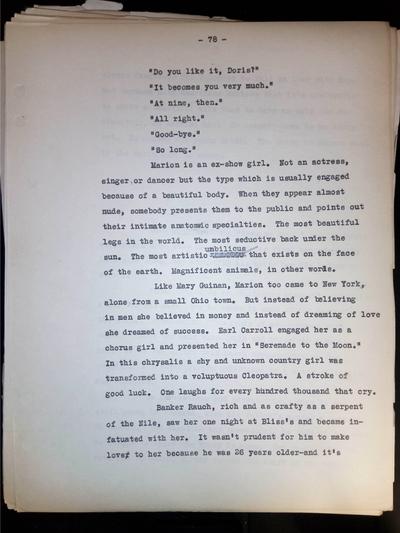
"Do you like it, Doris?"
"It becomes you very much."
"At nine, then."
"All right."
"Good-bye."
"So long."
Marion is an ex-show girl. Not an actress, singer, or dancer but the type which is usually engaged because of a beautiful body. When they appear almost nude, somebody presents them to the public and points out their intimate anatomic specialties. The most beautiful legs in the world. The most seductive back under the sun. The most artistic [handwritten: umbilicus] that exists on the face of the earth. Magnificent animals, in other words.
Like Mary Guinan, Marion too came to New York, alone, from a small Ohio town. But instead of believing in men she believed in money and instead of dreaming of love she dreamed of success. Earl Carroll engaged her as a chorus girl and presented her in "Serenade to the Moon." In this chrysalis a shy and unknown country girl was transformed into a voluptuous Cleopatra. A stroke of good luck. One laughs for every hundred thousand that cry.
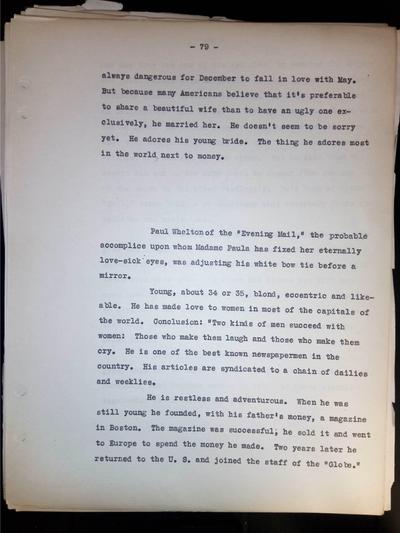
Banker Rauch, rich and as crafty as a serpent of the Nile, saw her one night at Bliss's and became infatuated with her. It wasn't prudent for him to make love to her because he was 26 years older—and it's always dangerous for December to fall in love with May. But because many Americans believe that it's preferable to share a beautiful wife than to have an ugly one exclusively, he married her. He doesn't seem to be sorry yet. He adores his young bride. The thing he adores most in the world next to money.
Paul Whelton of the "Evening Mail," the probable accomplice upon whom Madame Paula has fixed her eternally love-sick eyes, was adjusting his white bow tie before a mirror.
Young, about 34 or 35, blond, eccentric and likeable. He has made love to women in most of the capitals of the world. Conclusion: "Two kinds of men succeed with women: Those who make them laugh and those who make them cry. He is one of the best known newspapermen in the country. His articles are syndicated to a chain of dailies and weeklies.
He is restless and adventurous. When he was still young he founded, with his father's money, a magazine in Boston. The magazine was successful; he sold it and went to Europe to spend the money he made. Two years later he returned to the U. S. and joined the staff of the "Globe."
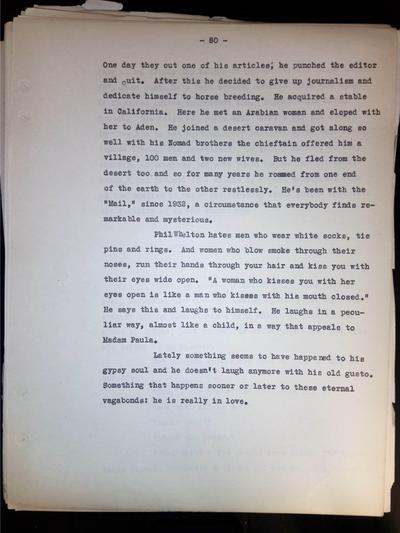
One day they cut one of his articles; he punched the editor and quit. After this he decided to give up journalism and dedicate himself to horse breeding. He acquired a stable in California. Here he met an Arabian woman and eloped with her to Aden. He joined a desert caravan and got along so well with his Nomad brothers the chieftain offered him a village, 100 men and two new wives. But he fled from the desert too and so for many years he roamed from one end of the earth to the other restlessly. He's been with the "Mail," since 1932, a circumstance that everybody finds remarkable and mysterious.
Phil Whelton hates men who wear white socks, tie pins and rings. And women who blow smoke through their noses, run their hands through your hair and kiss you with their eyes wide open. "A woman who kisses you with her eyes open is like a man who kisses with his mouth closed." He says this and laughs to himself. He laughs in a peculiar way, almost like a child, in a way that appeals to Madam Paula.
Lately something seems to have happened to his gypsy soul and he doesn't laugh anymore with his old gusto. Something that happens sooner or later to these eternal vagabonds: he is really in love.
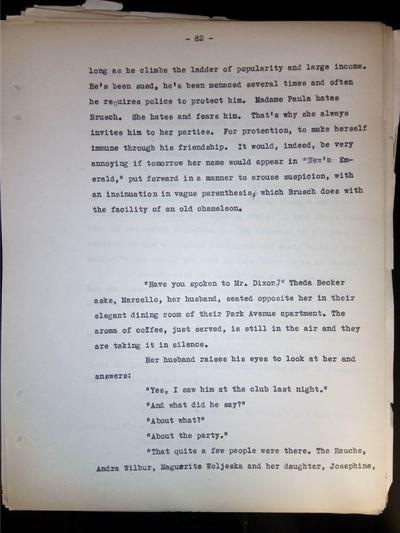
long as he climbs the ladder of popularity and large income. He's been sued, he's been menaced several times and often he requires police to protect him. Madame Paula hates Brusch. She hates and fears him. That's why she always invites him to her parties. For protection, to make herself immune through his friendship. It would, indeed, be very annoying if tomorrow her name would appear in "New's Emerald," put forward in a manner to arouse suspicion, with an insinuation in vague parenthesis, which Brusch does with the facility of an old chameleon.
"Have you spoken to Mr. Dixon?" Theda Becker asks, Marcello, her husband, seated opposite her in their elegant dining room of their Park Avenue apartment. The aroma of coffee, just served, is still in the air and they are taking it in silence.
Her husband raises his eyes to look at her and answers:
"Yes, I saw him at the club last night."
"And what did he say?"
"About what?"
"About the party."
"That quite a few people were there. The Rauchs, Andra Wilbur, Maguerite Woljeska and her daughter, Josephine, and that newspaperman of the "Globe," we know, what's his name?"
"Who, Bob Davis?"
"Yes, Davis, Brusch of the "Star," an actress whose name I don't remember....."
"Mona Winslow maybe....."
"I think so....."
"And even the Honorable Felstein who is causing so much disturbance in Washington, making charges and provoking investigations into banking deals. I told Dixon frankly that he was making a mistake for two reasons: he's either crazy or he has a troubled conscience and wants to ally himself with one who he may have to face tomorrow as an enemy."
"And who else was there?" she would like to ask but she doesn't for fear her husband would guess her hidden concern that has been tormenting her for two days.
Would Walter Werner, her ex-husband whom she divorced three years ago after a marriage full of love and unhappiness, be there? Of course he would be there. He was there the last time, at the party the Dixons gave in December. And she did well not to go.
"Do you want to smoke?"
"No, thanks, Marcello. We haven't got much time left. It's eight o'clock."
"You had better go."
"I'll finish this cigarette and join you."
She leaves and enters the room where her children are sleeping. She meets the maid on the threshold who tells her in a low voice that they are sleeping. They are two, Guy and Julius. The first is six, the other, four. They both have the eyes of their father, the eyes of Walter Werner.....
She looks at them tenderly, tucks them in, kisses them. Then she goes into her own room and closes the door. She sees her tall, slim figure in the mirror, and her oval countenance which she likes to enhance by parting her hair so that her ears and part of her cheeks are hidden, so that it falls like two dark leaves enclosing a flower. The line of her nose is delicate, her mouth is even, giving her a calm aspect without a trace of the sensual. Her eyes are large and limpid. At one time with her slim body and large eyes she possessed something ethereal. Now after her second marriage it is no longer easy to define her dominant physical nature. A new expression has fixed itself upon her countenance and has served as a mask for the past three years.
The Woljeskas, mother and daughter, are examining the dresses brought by their dressmaker.
"When we used to give parties, we used to send invitations at least a month ahead and not three days," tired of the sudden decisions of Madame Paula.
"A month ahead was also inconvenient too because one would forget about it."
"Oh no. In my day we didn't have the freedom and distraction that you modern girls have and a ball was a colorful event that filled in the long hours of an entire winter season."
"You must have been bored a great deal in those days, mother dear."
"Yes we were bored a lot but as compensation we enjoyed ourselves more."
Which is true. Give a poor man one good dinner a month and he'll appreciate riches. Give him riches and he'll lose the joy of dining.
Marguerite Woljeska is an old-fashioned Russian. Her hair is completely white and she carries her age with the dignity of old lace. Josephine is her youngest daughter and the only one left at home; three others are married and scattered throughout the world. A son was killed in the war. His one fond hope is that she might straighten out this daughter of hers whose virtue she has always held in doubt and about whose future she has always been worried. Josephine is no longer a child; she is twenty-six; and her mother would like to see her settled in a good home with a distinguished professional man. For example there is Walter Werner, the ex-husband of Theda Becker.....Mrs. Woljeska likes him a great deal. Serious, notable and still very young. Divorced? Well this is common these days, like barber chairs and restaurant dishes: everybody sits in them and everybody eats out of them without regard..... It happens often that while a mother still remembers her husband's first kiss, a daughter doesn't remember her first husband's name.....
Josephine was looking over a new suit: a light, transparent which a silk worm must have spun in but a few minutes. Then she starts beautifying herself. God gave her a face but she, not satisfied, is trying to give herself a new one.
She is thinking that within a hour she'll be dancing. In whose arms?.....
"Mother come and see how I look....."
The Hon. Felstein is in bad humor. One of the cylinders of his conscience isn't functioning properly.
"I want you to get this straight, Sarah, I don't intend to compromise my future nor to renounce my political past. This is the last time I'll let you talk me into accepting the invitations of your friends."
His wife, a small but stout Jewish woman, is trying in vain to violate a physical law by trying to enclose the rebellious mass of her bosom in the small limits The newcomer announces:
"Mr. Otis is almost here."
"Alone?"
"Alone."
"Good," the gangster in evening clothes exclaims. "Take care of both of them and don't move until you get a phone call. Understand?"
"Okay."
Then he approaches the bed and says, with a bow:
"Good-bye, Count.....Rest well....."
Bob Davis leaves his apartment whistling "La Cucaraccha." He stops on the sidewalk to call a taxi and as the driver leans out to get his instructions, he says:
"63 Riverside Drive."
A ball! He recalls on a wave of old memories, Viennese waltzes and the verses of Byron's Childe Harold: "On with the dance! Let joy be unconfined—unconfined—no sleep till morn, when youth and pleasure meet—to chase the glowing hours with flying feet."
Madame Paula phoned him today....."Make sure you come, Davis.....I would be greatly disappointed....."
and don't keep us waiting; come a little before the others.....I haven't seen you for such a long time....."
What a strange and interesting woman. Madame Caprice.....He calls her that and she smilingly answers: "The only difference between a caprice and a great passion is that a caprice lasts a little longer....." Shrewd..... too bad she's a little passe'.....
Madame Paula has met Helen.....How long ago was that? At least a year. Yes, at least a year.....
The Madame isn't ready yet. Her toilette like that of cats, swans and flies, is interminable. She has been in her room preparing herself for more than two hours; she has been nibbling lettuce, like a rabbit, for a week, drinking pineapple juice; she has been getting massages, she has been anointing herself with creams in order to radiate the charm of her second youth.
"Lily where did you put my pocketbook?"
"On the table, Madam."
"Get it. The powder I bought today is in it. It's a new kind recommended by Mona Winslow."
"Is Mona Winslow beautiful, Madame?"
"Haven't you ever seen her in the movies?"
"Yes, once."
"Well, she isn't exactly beautiful, but she's attractive. She dresses in excellent taste."
Her husband enters:
"Aren't you ready yet?"
"Please, Henry, don't waste my time with foolish questions."
What's the matter? Nervous? She's been closed in her room since six this morning, and now, when he asks if she is ready, she tells him that he's wasting her valuable time.
"Where is Maxine?"
"Downstairs in the reception room."
"Will you tell her that I want her."
He goes out, closing the door after him. As he has always thought, women are a paradox, an absurdity, a waste of money. He has never understood them; he will never understand them. For more than twenty years he has lived with his wife and he doesn't know yet whether he married her or she married him.
Chapter 6
THE WOMAN WITHOUT A NAME
When Robert Davis arrives at 63 Riverside Drive and enters into the luxurious and brilliantly lighted home of Madame Paula, it is ten o'clock.
The ballroom on the second floor had been transformed — by one of those miracles frequently performed in the homes of the wealthy — into an enchanting corner of Florida: palm trees, trailing plants, giant orchids, virginal white blossoms with white leaves. A perfumed vision in the blazing ecstasy of tropical country. Silent splendor.
Two orchestras are hidden behind the foliage, playing alternately. One is Ted Noll’s.
The first person Bob met was Walter Werner, the novelist now enjoying a vogue. Although his fame is new, his work is old for he has been writing novels for more than twenty years. He is an ex-physician and this training is reflected in all his writings. He is attracted by pathological cases, types met with in the necromancy of Freud; the strange phenomena, the curious sides of personality. The creatures of his fancy are, indeed, his patients;
and, like a good physician, first he cures then he kills them one by one in the closing pages of his novels.
Madame Paula spies Bob and flashes her most brilliant smile. They meet.
"Oh, Davis I am so glad to see you! If you had disappointed me again as you did the last time, I wouldn't have hesitated to drop you from my list of friends."
"Which would have made me very unhappy."
"Really?"
"Yes, because I would miss such excellent company."
"What do you think of the party?"
"Quite successful don't you think?"
"What a job! If you had any idea. Henry never helps me. I have to do everything myself."
"With incomparable intelligence and taste....."
"Don't flatter me, I beg you....."
"All of New York recognizes in you....."
She interrupts him:
"Why don't you call me Madame Caprice anymore?....."
"I hope to have the opportunity to do so soon....."
They smile looking at each other shrewdly.....
What a delightful thing life is when women are capricious and men are eccentric.....There is so much understanding and harmony.....
guests interrupt her search, the men to compliment her and the women for some triviality or other, with whom she must pause in order to maintain her reputation as a hostess.
She can't even find Paul Whelton and she asks Edwin Brush about him. He says he saw Whelton leaving.
"Going away? When?" she exclaims without concealing her surprise.
"Just a moment ago.....It seems that he forgot something at the office and he was going to get it."
"Without even saying good-bye? And since when are newspapermen behaving like painters? If I lose faith in this section of humanity, then good-bye everything....."
Robert Davis is at the buffet at the other end of the ballroom with Count Kopalsky, Alba Reynold and Gilbert Nathan, noted Jewish merchant.
The waiters are serving sweets and champagne; but those who are really/select what they want; appetizers placed mosaic-like, shaped like huge roses, covered with tidbits from the sea; little, pink crabs, black, Perigod snails, silver filet of anchovy, thin, wafer-like slices of salami. Biscuits as soft as silk, piquant and slightly bitter, make good company for the caviar as the small towers of jelly quiver on the China trays.
At the buffet Bob watches Maxine flirt with an overgrown boy with a full face covered with that down that makes one think of the woolly softness of peach-fuzz. He sees George Reynold conversing animatedly with the Hon. Felstein; Mona Winslow, surrounded by a group of admirers.
Madame Clara Walsh enters, a mature woman of medium height, covered with jewels like a saint that performs miracles. She advances alone with the pomp and solemnity of a flagship. Her countenance is as ageless as an Etruscan vase. The purveyors of beauty, the plastic surgeons, the skin beautifiers have accomplished a miracle for her. They have halted Time in its flight between her forehead and her mouth, leaving the oval that was her face, cold and macabre like an admirable example of the art of embalming.
The Count's alert eyes catch the glimpse of the expensive jewelry and in a lowered voice he asks Bob Davis:
"Who is she?"
"Mrs. Clara Walsh," he answers glancing at the exceptional lady. "Her husband owns a mine in Alaska. Her mother was Greek and she passed on to her daughter her Levantine blood. She has had a most interesting life."
"Introduce me to her, will you?"
"If you want me to....."
Just then another woman comes to the buffet and she immediately attracts Bob Davis's attention. She is a woman whose countenance reflects a healthy pallor, a voluptuous mouth, especially when she laughs, superb eye-brows arched over two dreamy eyes, colored a sea-blue. She walks in the way he likes, as Helen does. She is with a couple. He can't explain at once what there is about the stranger that attracts him: her beauty or the exquisite elegance she radiates. Twice their glances meet and each time she averts his eyes, turning her head.
From the ballroom is heard the precipitous music of a rhumba. He looks at his watches and sees it is two o'clock.
Theda Becker is alone on the porch, looking out at the night. Of the three men who figured in her life, Walter Werner, Paul Whelton and Marcel Becker, one disappeared forever. For a woman to lose a man is unforgettably tragic. It's like an Empire that loses a possession, no matter how small.
The glass door opens and somebody is revealed standing in the light. She recognizes him at once. Her husband. The shadow advances hesitantly and then moves towards her. A few paces away it stops, still undecided.
the ex-actress whom he has known since her Earl Carroll days, "and you saw Theda Becker....."
".....in her first husband's arms."
"Walter Werner?"
"Walter Werner. They were kissing."
"Are you absolutely sure?"
"Absolutely sure. But be careful, for heaven's sake don't compromise me....."
A tall, melancholy gentleman, Gothic style, approaches Josephine Woljeska, and with a rigid bow, like an embalmed duty, he invites her to dance. Without answering, the girl allows him to embrace her and after a few dance steps, lets her full weight fall upon him. She is drunk.
It is one o'clock.
Bob Davis is accompanying the strange woman home, the one he saw at the buffet, the one with eyes the color of an azure sea.
Doris. Pretty. Like the name of a flower. And her last name? Foster, he thinks, but he isn't sure. When Arlen, the Vanity Fair cartoonist, presented her to him, he didn't get the name well because he was looking at her the same way Adam looked at Eve the first time, and he was so distracted and confused he couldn't understand anything. Strange. What happened to him tonight had never happened to him before. Losing his self-control so that he was almost embarrassed. But her name is Doris. He understood this and he remembers it very well.
They danced together twice, exchanging only a few words; and they were convenient expressions, vague and superficial. She dances very well: conservatively, gracefully. Immediately afterwards they went to the buffet for a glass of brandy. He was thirsty but she wasn't apparently, for she drank only a little. Or else she didn't like the brandy. Everybody looked at her. She was for everybody the same mystery and the same surprise that she constituted for him. And then when he found that she had come to the party alone, accompanied by friends, he offered to take her home, and she, who up to this moment had given no special importance to their meeting, who had stood quiet and absent-minded beside him, answered yes at once, looking at him in a different way.
Now they are in a taxi, near each other, on their way home.
He offers her a cigarette and she refuses it, saying that during the day she had a sore throat. But she tells him not to worry about her, to go right ahead and smoke.
How old can she be? Twenty-four — twenty-five. Twenty-six, at most. Married? Rich? Poor? A respectable woman or an adventureess? In short, who is she? Shouldn't he ask her? Shouldn't he find out? Of course. By shrewd questioning, with a little investigating, little by little ..... anyway, he can start talking ..... why doesn't she say something? She could say something. Didn't he offer to take her home? What does she want? What does he want? nothing. He is a bit mad, and if he can escape the narrow boundaries of everyday reality, rise above the clouds, believe what he knows is not to be; bend over onto a mouth's secret, pluck a new flower, he is happy. His incurable disease, his eternal quest for adventure, the allure of curiosity that lasts but an hour. That's all right; but now he must speak to her, at any cost, he must even use one of those useless phrases that people use in such circumstances. Which? That she is beautiful? Ah, he would never say that to her. That he is glad he met her? Not that either. Banality. If she had a good time at Paula's? Foolish question because even if it weren't true she would answer in the affirmative. Then.....
The taxi swings into Broadway. A red light impedes its progress. He reads the illuminated advertisement in front of a motion picture theatre. A news boy is selling a "Daily News," shouting out the head-lines.
He unexpectedly hears her voice. She asks him:
"You are a newspaperman, aren't you?"
"Yes."
"Your life must be very interesting," she adds looking out at the traffic.
"And terrible, too. It damns us. It's like a disease. It gets into your blood and it's never cured."
"That happens with everything we really love. And it is fortunate."
"To be ill?"
"No, to live with intense passion."
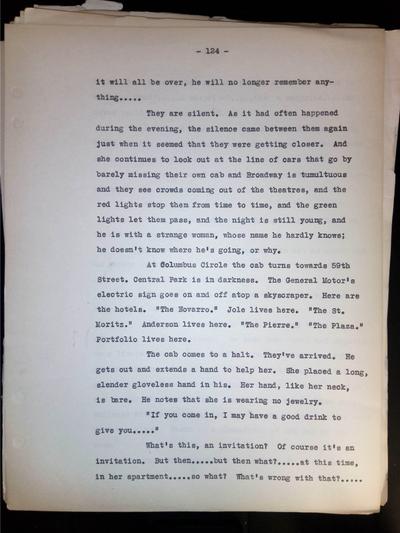
She turns her head towards him and he sees again those thoughtful and inscrutable eyes which in the semi-darkness of the cab, seem more profoundly fascinating; he sees again her pale countenance, but not a sick pallor, a healthy and fresh one, tending to ivory. Like the colors of images in a dream. And for the second time he is conscious of the perfume that exudes from her. The first time was when they were dancing, a refined, tenuous, very intimate perfume. The kind that, for some reason, made one immediately think of music. Or of gardens sleeping under a moon. Poems, poems.....prestidigitation, illusion, the fantasy created by that great magician, night. Tomorrow it will all be over, he will no longer remember anything.....
They are silent. As it had often happened during the evening, the silence came between them again just when it seemed that they were getting closer. And she continues to look out at the line of cars that go by barely missing their own cab and Broadway is tumultuous and they see crowds coming out of the theatres, and the red lights stop them from time to time, and the green lights let them pass, and the night is still young, and he is with a strange woman, whose name he hardly knows; he doesn't know where he's going, or why.
At Columbus Circle the cab turns towards 59th Street. Central Park is in darkness. The General Motor's electric sign goes on and off atop a skyscraper. Here are the hotels. "The Novarro." Jole lives here. "The St. Moritz." Anderson lives here. "The Pierre." "The Plaza." Portfolio lives here.
The cab comes to a halt. They've arrived. He gets out and extends a hand to help her. She placed a long, slender gloveless hand in his. Her hand, like her neck, is bare. He notes that she is wearing no jewelry.
"If you come in, I may have a good drink to give you....."
What's this, an invitation? Of course it's an invitation. But then.....but then what?.....at this time, in her apartment.....so what? What's wrong with that?.....
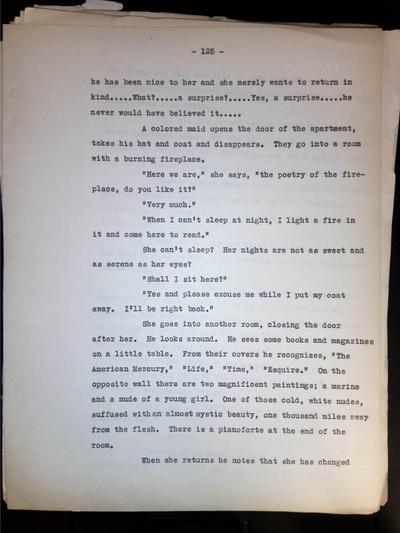
he has been nice to her and she merely wants to return in kind.....What?.....a surprise?.....Yes, a surprise.....he never would have believed it.....
A colored maid opens the door of the apartment, takes his hat and coat and disappears. They go into a room with a burning fireplace.
"Here we are," she says, "the poetry of the fireplace, do you like it?"
"Very much."
"When I can't sleep at night, I light a fire in it and come here to read."
She can't sleep? Her nights are not as sweet and as serene as her eyes?
"Shall I sit here?"
"Yes and please excuse me while I put my coat away. I'll be right back."
She goes into another room, closing the door after her. He looks around. He sees some books and magazines on a little table. From their covers he recognizes, "The American Mercury," "Life," "Time," "Esquire." On the opposite wall there are two magnificent paintings; a marine and a nude of a young girl. One of those cold, white nudes, suffused with an almost mystic beauty, one thousand miles away from the flesh. There is a pianoforte at the end of the room.
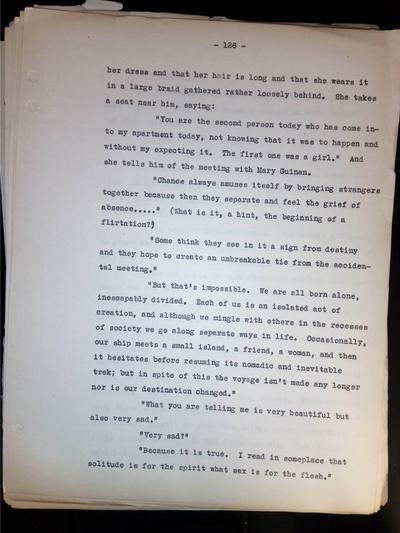
When she returns he notes that she has changed her dress and that her hair is long and that she wears it in a large braid gathered rather loosely behind. She takes a seat near him, saying:
"You are the second person today who has come into my apartment today, not knowing that it was to happen and without my expecting it. The first one was a girl." And she tells him of the meeting with Mary Guinan.
"Chance always amuses itself by bringing strangers together because then they separate and feel the grief of absence....." (What is it, a hint, the beginning of a flirtation?)
"Some think they see in it a sign from destiny and they hope to create an unbreakable tie from the accidental meeting."
"But that's impossible. We are all born alone, inescapably divided. Each of us is an isolated act of creation, and although we mingle with others in the recesses of society we go along separate ways in life. Occasionally, our ship meets a small island, a friend, a woman, and then it hesitates before resuming its nomadic and inevitable trek; but in spite of this the voyage isn't made any longer nor is our destination changed."
"What you are telling me is very beautiful but also very sad."
"Very sad?"
"Because it is true. I read in someplace that solitude is for the spirit what sex is for the flesh."
"Exactly."
"A beautiful thought that appealed to me very much because I have never found a companion more satisfying than solitude."
"And the most patient."
"Indeed....." she agrees.
But what is this romantic and abstruse conversation, this talk of solitude and the need of the spirit at one o'clock in the morning, after having attended a ball, in clothes still redolent of sin and paganism?
The colored maid reappears. She brings a liquor, as green and as burning as jealousy. "I may have a good drink to offer you....." He sips, watching her in the meantime.
Now she wants to know what book she can read because she has read the ones she has. And she didn't like any of them. She wants one that will hold her attention from the first to the last page as it happened when she picked up "The Lost Horizon," which she couldn't leave until she fell asleep, dead tired at five in the morning. He answers that there are very few such novels and that the best authors are dead. Which ones does he prefer? American writers? Yes, Americans. Modern, naturally. Yes, modern. Theodore Dreiser, Sherwood, Anderson, Mencken, Willa Cather. And Thornton Wilder? Hasn't he read "The Bridge of St. Luis Rey?" And James Branch Cabell? He had forgotten him. Yes, he likes Cabell too. Then they talk of the theatre. Of music, Of horses. Of dogs, and she sits by the fire, almost bent over it towards the flame, and the flames play about her hair, lighting it with wavelets of light and he continues to gaze at her, and it seems impossible but wonderful to be near her at such a late hour, in this house, so little known to each other, and yet so near, so alone.....
There is already an unmistakable note in their conversation, caused perhaps by the affinity of their thoughts; and although they haven't inquired and know nothing of each other's life, they already feel that they have overcome the discomfort and embarrassment of being strangers.
He again looks at his wrist watch: it is twenty past two. He must go, it's late. But he can't go without really having told her anything yet, without.....
"Will you forget for a moment," he says suddenly, "what I may or may not mean to you, and allow me to ask you something now?"
"Go ahead!" She answers, without turning her head away from the golden glimmer of the flames. "What?"
"Whether I may see you again, whether I now may become a friend of yours....."
She turns to look at him. They hadn't appeared to each other as they appeared at this moment.
"I don't think it's possible," she answers and while he is silent, not knowing how to take or to justify the refusal, she adds; "In your desire to see me lies the same danger of my desire to accept. We shouldn't allow this thing to go too far and so upset our peace of mind."
He sees her sea-azure blue eyes become pensive and inscrutable.
"Upset our peace of mind? I don't understand."
"Oh, you understand very well.....Let chance amuse itself by bringing us together again sometime.....some day, who knows, we shall meet again just the same.....maybe at the Dixons, maybe at some other place....."
At the door he kisses her hand which she had allowed, limply, to remain in his. He takes his hat and coat handed to him by the maid who appeared suddenly beside him like a shadow. He leaves.
At the corner of 42nd Street, the Paramount clock tells him it is three o'clock. They are loading trucks in front of the "Times" office with newspaper for the news stands. He asks for a copy. As he walks along he opens it to glance at the front page. "France To Submit Russo Pact To The Hague Tribunal." "Japanese Naval Representatives Quit Naval Conference." "German Troops Push Rhineland Occupation." "$200,000 Necklace Stolen At Party." He pauses. He seeks a street light. He reads it again:
PART TWO
THE TIME: TOMORROW
********
*“Tomorrow is a song sung
By Youth......”*
Chapter 1
WHEN SPRING COMES
"Hello, New York Globe".....Yes, the dance marathon is still going strong.....How Many? Seven.....not nine, seven. Seven couples are left.....Excuse me, but are you deaf? Why do you insist on nine? I said seven, seven as the seven days of the week, as the seven sins.....Ah, thank God!.....You're welcome, you're welcome (Bob light me a cigarette) Hello, New York Globe.....Yes, madame.....your friend had an accident. Let's have it.....she ran away with your husband. Poor girl! You have a lot of nerve.....What?.....All right, come to the office.....Yes, now.....Hello, New York Globe.....go ahead, your Honor.....No, no comment yet.....Of course.....The correspondents telegraphed a summary of the speech to the European capitals.....It will be done.....Thanks.....Be good, your Honor.....Hello, who is it?.....it's you, baby? How are you?.....What?.....two tickets for the Roxy.....I'll try to get them for you.....Baloney! You remember me only when you want passes for the movies.....Really.....What do you know about that.....cut it, cut it or you'll fill me with so much sweetness I'll get diabetes.....Listen, woman, I can't keep this line tied up forever.....Tell me: where are you going Saturday night?.....Are you doing anything? Then we'll make it for eight. Okay?.....okay.....yes, I understand.....so long darling.....New York Globe.....New York Globe.....go ahead.....(Robin, didn't I tell you to light me a cigarette? What? You did and I smoked it? You're nuts!)"
Bob Davis is looking at a small calendar he has before him in the news room. One of those memorandum calendars given away by business houses; and he sees the date, Monday, February 21. A month has elapsed since Madame Paula's party. It's exactly one month today he met Doris Foster. He hasn't seen her since and yet she has always been with him. Perhaps nothing has stuck to his mind so insistently, in a succession of visions; her hands, her voice, her voluptuous mouth with its quiet smile, the supercilious curve of her eye-brows, her sea-azure eyes..... He still sees Helen on Wednesdays and Saturdays; at the paper he does the same work with more or less enthusiasm;
at night he goes out with his friends. But his life has changed. From time to time he gets that same feeling of emptiness and futility he got when he was trying to eliminate from his pleasures on earth, the most tenacious and indispensable habit, that of smoking.....He is again seized by a desire to run away, to be free.....Doris Foster.....The next day he inquired about her from Arlen who had introduced her to him. "But I don't know her," he said. "When you came I was talking to her for the first time. A nice girl. Marion Rauch might be able to help you. They are friends." He waited. Finally he couldn't hold out any longer. "Be careful, Bob Davis, don't lose your head because if you did, you would only lose time. Doris is a very serious girl." "But I don't want to lose my head I merely want to satisfy my curiosity about her identity." "She comes from a fine Oklahoma family. She has only been in New York a few months." "Does she live alone?" "Alone. She is waiting for her divorce from her husband who is either a doctor or a lawyer, I don't know which, I didn't quite get it, I didn't think it would be wise to ask her about an episode which obviously she doesn't want to talk about. But didn't you take her home the night of the party?" "Yes but we didn't talk about such things." "You did well. Try to avoid it in the future because Doris is exceptionally sensitive. You'll get to know her. A fine girl. Too bad I can't help you. I'm leaving tonight for California and I shan't see her again for several months....."
For a week he walked the streets of New York with a telephone number written on the back of an envelope in his pocket. Circle 5-6534. One night.....The maid answered. He immediately recognized her voice. "The Madame is out, who's calling please?" He gave a name at random. He said he would call again the next day. He went by her home twice that week; he stopped to look at the door and was siezed by a desire to go in but the thought of seeming inopportune or ridiculous stopped him. This always held him back. The pattern of his ideas is upset, the conflict gradually taking shape in his mind and in his heart, is becoming clear. He blames himself for not having insisted, for not having taken advantage of the situation, of the friendliness she so obviously showed towards him, and says to himself: "A dangerous woman because she is different. She might turn my life upside down. It's better to forget her." The days go by and Helen asks: "Why are you so sad?" He lies. "I don't feel well." "Bob, when will you work on the book again?" He lies again: "Last night I wrote a few pages. I've decided at last to go right ahead." But, actually, he makes the nocturnal rounds of Broadway with his chums Phil Lewis and Max Norton, and he has been lazy and indolent for two weeks, and for two weeks, something that never happened before, he fails to answer his mother's letter. As if it were a conspiracy can't help you. I'm leaving tonight for California and I shan't see her again for several months....."
For a week he walked the streets of New York with a telephone number written on the back of an envelope in his pocket. Circle 5-6534. One night.....The maid answered. He immediately recognized her voice. "The Madame is out, who's calling please?" He gave a name at random. He said he would call again the next day. He went by her home twice that week; he stopped to look at the door and was siezed by a desire to go in but the thought of seeming inopportune or ridiculous stopped him. This always held him back. The pattern of his ideas is upset, the conflict gradually taking shape in his mind and in his heart, is becoming clear. He blames himself for not having insisted, for not having taken advantage of the situation, of the friendliness she so obviously showed towards him, and says to himself: "A dangerous woman because she is different. She might turn my life upside down. It's better to forget her." The days go by and Helen asks: "Why are you so sad?" He lies. "I don't feel well." "Bob, when will you work on the book again?" He lies again: "Last night I wrote a few pages. I've decided at last to go right ahead." But, actually, he makes the nocturnal rounds of Broadway with his chums Phil Lewis and Max Norton, and he has been lazy and indolent for two weeks, and for two weeks, something that never happened before, he fails to answer his mother's letter. As if it were a conspiracy against his peace of mind, the papers continue to write about the stolen necklace, and about the fake Count Kopalsky who can't be found, of the real one who is about to the leave the U.S., of Paula who fled to Florida to get away from the authorities, the police and the newspapers. Each story leads him like a lost child back to the famous evening. The enchanting memory of two things, mostly, poison him with desire: her eyes and her voice. "If it were possible to ask a generous and powerful God for a favor, what would you ask him?" She said this, bent over the fireplace. He laughs and answers: "To make me over again." A brief pause. "And what would you ask for?" "To stay as I am until the day of my death." "That is, to stop time, to stop getting old?" That's right, Not to grow old." "I don't think it's necessary to ask any God for that favor. The beauty parlors are already capable of achieving this miracle." "The beauty salons!" she exclaims incredulously. "Did you see Clara Walsh tonight? A mask that disturbed and frightened me. That's why I was glad when you asked to take me home. I wanted to get away from her....." After five minutes: "Which of the arts do you prefer?" She asks. He thinks a moment and then answers. "It's hard to say." "For me it's music because it seems the purest, the one nearest the spirit, and for its creation one has almost no use for physical or material means." "Bragdon says," he tells her, "that music represents one of the two gateways through which we enter the nine muses, the other is architecture. And that's true because music rest alone in time, a succession of notes, without any relation to space while architecture rests alone in space, 'a frozen image,' without any relation to time. All the others merge in order to direct themselves into these two fountains: drama enters into poetry and poetry becomes music; painting becomes decoration; decoration, sculpture, and sculpture is gathered into architecture".....He can't discuss such things with Helen. She understands but can't evaluate them because she doesn't possess a really artistic temperament. Not even Jole had it. Perhaps that's why, after having possessed their bodies, he was annoyed and uncomfortable and didn't know what to say, returning to his own world like one who has opened the door to receive guests and then sees that he has been left alone notwithstanding.....
The passage of days and weeks find him brooding over these melancholy memories, these stones over which he stumbles because he has yet to look where he is going..... And today it is one month since the party. Monday, February 21.....
He sees the proofs of one of his stories, says Good-bye to his associates, takes his hat and leaves. It is a calm evening, without any trace of the rain which had fallen during the day, the sky is once again serene. He is In the afternoon he goes to a dog show at Madison Square Garden with some associates and friends. They go along discussing the events of the day after having emerged together from a bar on Times Square. The sun is shining, and it is hot. The girls are dressed in vivacious colors.
This is the time of the year when women begin to comb their hair differently and men begin to look for the first signs of greenery. Spring arrives from distant skies.
About 3000 canine specimens are gathered at the Garden, from all America and from many European countries. St. Bernards, greyhounds, Great Danes, hounds, Irish setters, airdales, Boston Terriers, "samoyedes" Bull dogs. Some are famous, others are unknown but all are of illustrious birth and of noble aspect.
They are brought into the arena in groups, led by their owners, and they circle around in front of the judges who award prizes by a process of elimination. The hairy and docile St. Bernards, with almost human eyes; the Great Danes, imposing, statuesque; slim, agile greyhounds, prancing; police dogs, bold and cunning. In no beauty contest had he ever seen so much allure.
At the end of a long corridor he meets the Marquise Caradonna who has made and lost an entire fortune on dogs. He has come from the coast expressly for the show.
Thin and as nervous as a rabbit's nose, when he shakes hands he holds his on a plane with his forehead. He says he has bought the most pure-blooded Irish setter in the world. He stops in the middle of the conversation and scurries like a mouse at the sound of a whistle announcing the entrance of a new group.
Just at this moment as Bob turns to look for his friends who are lost in the crowd he spies Doris Foster. She doesn't see him but he seeks her out and greets her. She is surprised. She smiles. Then she says:
"You see, chance has made the date you wanted to arrange."
"And which you would not arrange."
"Because I knew that we would meet sometime just the same. I told you so."
She is wearing a bizarre hat, a pale blue Jersey Turban that brings out the elegance of her dark coat. She looks taller.
"Do you find the show interesting?" he asks studying her intently.
"Very much. This type of show always interests me."
"From which I assume that you like dogs very much."
"More than men," she answers smiling.
"I can't blame you nor do I, as a man, feel insulted. I like them too."
They start off together. He again notices that she walks like Helen. No, her step is firmer. More voluptuous.
He doesn't know what to say to her. To see her again is unexpected good fortune, to talk to her again an unexpected joy. All the hopes, the dreams and desires he believed to be lost in the fog of the past, re-emerge with shining visages, with the tumult of prisoners delirious with the joy of unexpected freedom.
"What happened to poor Count Kopalsky?" she inquires.
"He sailed back incognito last week, greatly annoyed by the unfortunate adventure that overtook him in America and by the attendant publicity."
"And Clara Walsh?"
"She regrets the loss of the hands that caressed her more than the loss of her necklace....."
"And Paula Dixon?"
"She is in Florida from where she sent me some photographs which she would like substituted for the ones the papers continue to publish."
"Apparently she likes these photographs better."
"Naturally."
"What a strange woman! I can't understand her."
I am still thankful for having extricated myself from the scene that night and from the embarrassment felt by everybody."
"I was thankful too even though as a newspaper-man such opportunities....."
"It's a pity.....I know that and I realized it the next day when reading about what happened. It was my fault. If it hadn't been for me you would have remained....."
"Yes, but I would have lost something far more important than the story of a robbery....."
She neither answers nor looks at him. She seems to re-enter into the world surrounding her. A thin, aristocratic greyhound as hairy as an ancient patriarch passes before them. He has the snout of a misunderstood and bored personality. He was either dissatisfied with the environment or he had failed to win a prize. A gentleman as crooked as a lie drags two little Maltese pups who are making an infernal racket after him. Soon they see a superb police dog coming towards them. Doris stops to caress him and asks what his name is. His name is Rex. He is two years old. They should prohibit the display of such animals: the human race suffers so much by contrast.
"I think that God," he observes, "repentant, after having created man, in order to remedy things, created the dog....."
She laughs and exclaims:
"There are more stories about the loyalty of dogs than there are about the loyalty of friends."
"Or the loyalty of women," he would like to add but checks himself.
"This morning I read your beautiful short story in the Globe."
"Thanks for the compliment."
"It's the truth, I too, you know, hate doors and would like to escape to sea."
"Why don't you?"
"Because they don't want women on ships." She laughs and goes on. "They might disturb the other seekers after peace."
"Who said so?"
"I don't know but I know that so the world judges it."
"If you only knew how often I thought of you these days and how much I wanted to see you".....he tells her very simply and naturally as if they were old friends, as if around them there existed no imminence of intrigue and sin. She understands and, lowering her head, she answers with a studied calmness, so as not to give too much importance to her words:
"I have thought of you too."
"Why did you tell me that we shouldn't see each other any more?"
"Because it seemed necessary."
"But you really think so?"
"I still think so."
It's an answer that parts them again, that places between his frankness and her secret, the reality of the world that surrounds them, the distance that strangers drag after them.....
They continue to make the rounds of the show together but they no longer say the things they would like to say. Their conversation is light and frivolous, revealing an undertone of forced indifference. Only when they are about to part company does Bob ask:
"May I hope that in the future I will no longer have to rely on the whims of chance?"
She answers:
"On Wednesday I must get some books at Dutton's to send to a friend. If you aren't doing anything, come to help me select them."
"We'll meet tomorrow at eleven and I'll tell her..."
The United Press machines are hammering, the telephones are ringing, Ralph's voice keeps saying, "Hello, the New York Globe.....Hello the New York Globe....."
He's trying to write a head-line for the story of a speech by the head of the Belgian government and he studies the news item before:
"We are confronted with the problem of the reform of our institutions. A certain stability, required as a basis for energetic action, must be assured for the Government; a better way must be found, permitting the Chamber to carry out, with complete authority, the initiation of this task, to have complete supervision, complete freedom of action. The press was permitted so many liberties and abuses that it has become necessary to change the legal procedure affecting it."
He reads on but thinks of other things, distracted by the reiteration of a phrase: "Wednesday about eleven, 'I'll be at Dutton's.....'"
Why do men have to make believe, to hide and not be able to reveal that which they feel inside, that which weighs upon their souls, to weep when they are unhappy and laugh when they are happy? Why is this gift of innocent expression and privilege conceded only to children? If he were Carter Green, the managing editor of the paper, he would give a three-column head to a piece of news he considers more important because it's more human than the Belgian official's speech. He would write: "I am in love..... I am in love again!....." Aren't miracles news? Unexpected pieces of luck? Isn't illness news? That's exactly what it is: a miracle, a stroke of good luck, and an illness. But why, "Again?" This is really the first time he's fallen in love. He has never before felt what he feels now. The story of his sex is etched upon the memory of his years between 18 and 20; that divine infirmity of the flesh, that memorable and nostalgic period in which he felt an abandon close to death, ecstasy close to insanity.....But was the passion real? Ah, no.....Romanticism, sensual pleasures, fascination. All revealed mysteries have the attraction of surprise. But surprise is not pure joy.
Among his confused and faded memories, he recalls to mind the first girl that attracted him. Her name was Mae and she was thin, a bit ugly, because in literature and in love, we generally show bad taste in the beginning. "She was such a sentimental girl," he wrote later describing the episode in a short story, "that if she could have married a sonnet or a flower, she would have been the first faithful woman on earth and the third happiest. The two others who lived in the realm of happiness were: the widow and the woman about to get married....."
But this wasn't a question of boyish fantasy; now it was different, just as lightening is different from fire.
"We are confronted with the problem of the reform of our institutions. A certain stability, required for energetic action....."
He looks at each of his associates as they work.
Jaro Harding: an original iconoclast who doesn't even believe in the days of the week. He says that while in the U. S. it may be Thursday, in Australia it's Friday. It doesn't make sense. When he is irritated or annoyed by somebody, he exclaims; "The tragedy is this: We go through life expecting to meet ideals, and instead we meet idiots....."
Bernard Link, the literary critic, highly cultured, old, absent-minded, always wearing old, spotted clothes, so greasy you might plant broccoli on them. "There are no pornographic subjects, but there are pornographic writers." He considers the story of Christ and the Adulterous Woman the most beautiful story in the world. When he affirms something he is as definite as a proposal of marriage. "The difference between life and fiction lies in this: in fiction he married at the end while in real life, he marries her in the beginning." Sometime ago he gave a superb definition of style. "Style is a mark of respect, the factor which maintains for each part a constant sense of the thing as a whole." Very true. To write badly generally implies a deep rupture between the parts and the whole in the web of that admirable art called prose.
James Krupp, one of the reporters. Big, sanguine, active, as versatile as a safety pin. Solid, German tenacity is profoundly rooted in his character. He seldom speaks. He is always occupied, like a button. In his work there is the quality of fish-glue, it sticks.
Stuart Lubin, a very interesting type, extravagant, as full of enthusiasm as a catalogue of plants and seeds.
Paul Flynn, Bob's good friend, who reflects in his smile and in his clear blue eyes something childish and fresh. He writes well: he has an excellent ear: he thinks in rhythm. He loves life in concentrated form, as if it were contained in a capsule. When the circumstances of his life are enclosed in a six-foot square room, he understands and appreciates them more. He declares that when life is gathered on one point, it's like a sun's ray shining through a magnifying glass, it burns with greater intensity. He belongs, in short, to the category of lonely spirits: he is a monogamist of the epigram, a worker in miniature, in form expressed singly. A tree, a rose, a brook, and not the forest, the garden, the sea.....
And then he sees Phil Lewis taking a drink of whiskey, Andrew Parker, talking to a stranger, Till March, walking around with copy paper in his hand.
It is seven o'clock in the evening. They are working under blinding white lights, bunched over the news items they are developing, their thoughts far away from one another.
In Japan, in Africa, in Russia, in Rome, Berlin, London. They are very serious. They are deeply pensive. Seeking a word, an adjective, a phrase. They seek them, chewing cigarettes, guzzling liquor, some of them biting their nails because they are nervous for lack of time, for they must write the story before it changes. They have the eyes of falcons and a dog's sense of smell. They see a little stain on the face of the earth and they hasten to rub it, they spot a little trail and they rush to sniff at it. When a king dies, a cabinet falls, a president is elected, [deleted: Mussolini makes another speech], the White House authorizes a statement, a catastrophe hits a nation, they sit before the typewriters and hastily and agitatedly, like disturbed ants, they begin pecking away at the keyboards like hens.....
What strange people.....
Stewart Lubin is calling him:
"Come here Davis....."
It's Stuart's job each day to concoct three or four items to have in readiness for an emergency. They are required as fillers. Indefinite items, unconfirmable, generally humorous. A woman bitten by a viper in the French countryside after which the snake dropped dead and the woman remained in excellent health. The immoral lightening bolt that struck and stripped a young woman in Hungary, leaving her nude but unhurt out on the street. The man condemned to the guillotine who appears before the executioner with a line drawn around his neck and says, "Please cut here."
An Arizona farmer who counted the number of feathers on a chicken and found them to be 37,754.
Very often these are prepared in collaboration with the cartoonists who, illustrate and comment upon them the following day. Some of them go around the world.
Bob goes to the fabricator of curiosities and finds him absorbed:
"Have you run out of material?"
"I can't find a thing after what happened yesterday....."
"What happened?"
"Don't you know?"
"No."
"One of the most unusual events in the history of journalism. Sometime ago I wrote that a New York man found a pack of letters in an old trunk he had bought at auction, love letters signed, "Josephine," which had been forgotten in one of the compartments. To his astonishment, the man, I stated, recognized from certain characteristics of the handwriting and from photographs he found with the letters, his own wife who had died a few years before, whom he had loved tenderly as a good and devoted consort."
"A good plot for a story, and then?"
"Well, a certain James Sherman came to the office yesterday and announced: "I am the man referred to in your story, the husband who found the letters of his dead wife."
"For Christ's Sake!".....
"You can imagine what happened....."
"How about the story....."
"It was my invention, I swear, from the first to the last word and from the first and the last word it was exact to the last detail. The piece of furniture bought at auction, the photograph, the woman's name, her death, all was terribly true. I felt a cold sweat. The man wanted to know, at any cost, just how I happened to know about this secret and he suspected me to be either an accomplice or his late wife's lover."
"God, that's fantastic!"
"Fantastic? It's positively horrible. We couldn't make him believe the truth: of the fact that it was created out of whole cloth right here in the news room, born of the imagination feeding on the intimate secrets and experience of the trade. He couldn't believe it and you couldn't blame him. I could no longer believe it myself. In short, it was a situation without precedent."
"The n?"
"Then he left infuriated, in a threatening mood, saying that he would return today. Fortunately he hasn't shown up yet."
But the man suddenly appeared like a shadow at the door of the news room. As soon as Stewart Lubin sees him, he stops talking. The man is not alone. A policeman is with him and he is heard to exclaim, "I have finally caught up with you." Another dramatic scene. Everybody surrounds them, realizing that the man is a lunatic, the type who rings false alarms and reports imaginary crimes to the police and goes from one newspaper to another, posing as this or that character in the news according as they impress him.
Without wasting another minute, Stewart Lubin starts writing:
The Insane Lover
"Recently we published a story of a strange case, in New York, about a husband, whose name cannot be divulged for obvious reasons, who found some old love letters, written ten years before by his late wife to one who was her lover at that time.
"Following the publication of this story, a man came to the office and asked one of the reporters for the return of the letters referred to. It was impossible to dissuade him from his strange request, and, yesterday, when he re-appeared, he was grabbed by a policeman. He is apparently, the lover mentioned in Josephine's letters. It is presumed that his mind is deranged by the unforgettable memories of his dead sweetheart and of their unhappy romance.
"Now, nobody knows, not even Stewart Lubin, what the truth is."
Wednesday, at eleven, they met at Dutton's. She selects the books to be sent to her friend, substituting some that Bob suggests for some of the titles she has listed.
"Give me the name of an author your friend likes so that I may get an idea of her taste."
"Like all women, she likes love stories."
"Then we'll have to look among the authors of the past because among the moderns, this theme is old and out of fashion. Love, which for centuries has been the dominant subject in the literatures of all countries, is disappearing from books, as kerosine lamps, horse-and-buggies and poets have disappeared. The novels of today are based on psychology, philosophy and social problems."
"That's why nobody reads anymore," she answers.
"No, that's not the reason," he observes. We must look for the reason in the appearance of the three Gods that have taken the book's place as a medium of relaxation and entertainment: the cinema, the auto, and the radio. Now, a Greta Garbo in the flesh is preferred to a Madame Bovary of ink; the dissonance of jazz shouted by Louisiana negroes is preferred to the music of Poe's poetry."
They go out again into the brilliantly lighted street. This is one of those days when one feels a desire to sing the old, half-forgotten and dear songs, when one's soul is light and one's step seems even lighter, and life walks with one, arm in arm, content to go along by one's side. He walks with Doris and it seems as if she is life, happiness, and the refrain of an old song, long forgotten.
Along the sidewalks, coming out of shoppes, or getting out of cars with liveried chauffeurs, are women that one may meet in no other part of the country. One meets them only here on the incomparable and aristocratic Fifth Avenue. Women one sometimes sees on magazine covers, on the society pages, on canvasses, between the covers of books. These women men call fatal because when you look into their eyes, or kiss their lips something happens to change forever the shape of your destiny.
They continue to discuss books, and the private lives of writers and artists whom she knows through their biographies.
"Almost always genius is associated with a physical or moral infirmity," he tells her. "In every literature one finds the names of great writers associated with tales of inferiority and degeneration. Men like Coleridge, Byron, Shelley, Beaudelaire and Villon, were weak in charactor and were out of harmony with their surroundings. No insurance company today would risk a penny on the lives of Mozart or Heine, Moliere, Cervantes, DeMusset, Swift, Leopardi, Ibsen, Poe, Chopin, Stevenson, Flaubert and all those others who were infirm or unbalanced.
"Therefore genius is a disease?"
"I think so; it is certainly an immutable suffering. An Italian scientist, Lombroso, goes farther and regards it as an actual form of insanity."
"I remember the definition Edison gave just before his death who said genius was 99 percent perspiration and one percent inspiration."
"In science it may be true. But in art it is fever and torment."
They turn into the square at 59th Street and head towards the park. Here gaiety is visible: it's in the trees, full of flight and song; in the laughter of the children at play, in the movement of the swans on the quiet waters of the pond, in the bright colors of peoples' clothes, in the green flame of the lawns, in peoples' faces; in the air.
"Tomorrow, we shall meet at Dutton's, and I'll tell her....."
They have met and he says nothing to her. He has her close to her, far away from the noises and distractions of the street and he says nothing — he who is such an able merchant in words. Once again silence separates them like the golden frame of a harp keeping apart the hands that seek each other.
They are walking along a lane of pines. She asks:
"Do you remember what you said to me that first night? You said that we are all born alone and yet, while living together with others, we go through life alone."
"Yes, I remember."
"Don't you think that it's possible for two beings to become one if they go along the same path?"
"No, I don't think so. They may come very close to each other but they can never become as one. Not even in love may one escape one's own eternal solitude. We may kiss, but we can't go beyond our souls. Even when we go beyond the barrier of the flesh, that of individuality remains insuperable."
"And yet I believed," she says, "that it was possible to become one through love."
"On the contrary, in love, the fear of loneliness is even greater, even though the illusion of oneness is greatest in moments of ecstasy. All true lovers are jealous, because they are always afraid of losing each other, of not having really entered each into the life of the other, of not having attained each other's soul though it be unattainable....."
"What, then, is this high barrier that separates us called, this disturbance of the flesh that feels the need of fusion to be complete, and yet it cannot achieve it?"
"It is called torment."
"I know, but what causes it?"
"It is caused by the mystery of our being."
A fountain appears at the end of the lane and around its base, some small boys are playing. An old woman typical in old-fashioned clothes, with a mid-Victorian basket hat tied with a black ribbon under her chin, lifts her head from a newspaper she is reading to watch them go by. Life goes on intensely in the tree trunks, in the tender blades of grass; among the flower bushes, in the ripples of the water, under the earth they disturb with their feet; a life awaiting to burst open and to reveal itself in the rebirth of Spring.
They return through the lane of pines.
She exudes the same perfume of that night in the taxi on the way home from the party; every so often he becomes aware of it as if it were an invisible ribbon moved by a capricious breeze.
Who said women were more beautiful at night with their shoulders bare, in decollete'? Who ever gave coin to that foolish legend? He once said it himself in an article. But it isn't true. It's an absurdity. With those long dresses that look as if they had been retrieved from antique ward-robes, proud and artificial raiment; the artifice of jewelry, the colors, the coiffures, all as ridiculous as stage extras. One must see them in the daytime; simple, unaffected, revealed in their true light, in the anonymity of the street, to understand what the Greeks sustained: "The sun for women, the shade for the old."
"Today," he tells her, "an illustrious guest is coming, a sorceress with unusual power....."
She stops to look at him. She understood, but prefers to say nothing. She smiles.
"Who is this sorceress?"
"Spring, and we must celebrate."
"How?"
"By having breakfast together, probably at the Crillon."
"You're not very romantic," she observes playfully. "One can celebrate Spring only in one way. By going out to meet it in the woods, or atop a mountain or in those recesses where brooks are born."
"That's something I would willingly undertake; but we who live in the city are like prisoners whose liberty is limited, with the duty of having to put in appearances at specified times. At two o'clock they expect me at the office, as I've already told you."
"I couldn't do it either because I have so much to do today."
They take leave of each other in front of the Plaza. That night he sent her a bunch of roses: "To Doris Foster..... The Springtime....."
Chapter 3
TWO MINDS AND FOUR WORLDS
The traffic along Park Avenue is heavy, congested and he tries in vain to beat the lights: he is constantly forced either to stop or to shift speed. After leaving White Plains he finally gets a clear road and he steps his speed up to sixty. She is seated silently beside him: without even asking him where he is taking her. The women who have always pleased him are those who talk little, allowing him to dream unmolested.
"Tell me, where would you have gone tonight if I hadn't insisted on having you with me?"
"I don't know, maybe to the theatre."
"Alone?" And he smiles to make the question less indiscreet.
"Yes," Doris answers without turning to look at him.
There must be a mystery in her life. I feel it. The first man in her life must have made her suffer. Many women are left that way afterwards; diffident, bitter, enigmatic. She probably loved her husband. But I shall never inquire into her past. Marion Rauch was right: "An exceptionally sensitive creature; very subtle." Why should I inquire? I like her as she is and that's enough. The past is a corpse with its eyes open, curiosity is a weakness. Even St. Augustine says so in his confessions. "Hoc morbo cupiditatis." Hare claims that curiosity is but another name for hope. And this, too, is true. All lovers are curious.
It's getting dark. The countryside is still bare, sad, deserted. The first bud is hesitating in the plants.
He has decided to take her to Gill's, a restaurant on a cliff past Yonkers. A quiet and picturesque spot. They pass by long rows of elms, in front of quiet estates with their gates closed.
He feels her to be so near him that if he but extended his hand he would touch hers. But he must not even do that much. He must do nothing that would be a repition of what he did with other women: the adventure, the easy conquest. I shall act differently with her. Differently? But, then, what does he want. It isn't her mouth, so secretly promising voluptuousness; not her breasts which he imagines to be flowing over and bursting with pleasure; her body which he imagines to be full of slenderness and warmth; her arms, her hips, and her limbs? Mes, he shall explore and touch all these things. But not now, not now. To wait is to know how to avoid that which exists between our ego and somebody else's; it means to know how to keep the harmony of desire in its proper balance. And this is something he must do. To desire and to imagine always in a different way, each with a different promise, in keeping with the fascination of things far off and not yet possessed.
At Gill's they went into a private dining room that was almost like a reception room. A divan, leather pillows on the floor, a mirror at the end of the room, a radio. In the center was arranged a table for two. A bouquet of flowers was in the center.
They sit down. This is the first time they eat together at the same table, in the private intimacy of a room.
She is telling him about an exhibit she has seen at an art gallery. She is enthusiastic about the surrealists: about Dali who depicts dreams, DeChirico who portrays strange horses with tails as long as those of comets. He asks her if she is acquainted with the pictures of [deleted: Yomura, a Japanese] and she answers that she isn't; or those of Max Weber, a prodigious colorist, and again she answers in the negative.
"Of all the artists he is perhaps the least understood," Bob says, because the public as a whole wants to see in his pictures either a magical effect or else something a little closer to real life. That is: a miracle or the exact reproduction of a photograph."
"That's true. But, also, many do not have a sense of color, and sometimes they can't even distinguish them. A school chum of mine didn't recognize blue. That is, she saw it but confused it with red. On the contrary another possessed this perception of color acutely, to the enviable degree of being able to detect it in music, in vowels, in perfumes and even in the names of people. For her a symphony was as magnificent as a rainbow."
Then they talk of travels and cities. Have you been to Europe? No, never. Would you like to go? Oh, of course.....Last year she was all ready to go when her mother unexpectedly became ill. Are your parents living? Only her mother; her father is dead. And.....the question comes to his lips automatically:
"And are you married?" He asks as if he knew nothing of her life.
"I was," she answers lowering her head, and then adds, smiling weakly: "Perhaps, after all, your theory about the loneliness of the soul is true and now I am no longer married."
The waiter has finished serving the dinner and he leaves the room, closing the door in a way to suggest that he will not disturb them further. He thinks to himself that waiters and cooks are the shrewdest and most effective accomplices of lovers in all the world.
For a little while the silence allows their minds to wander off into different channels. No noise is heard from the street or from the main dining room. They have the impression of being in a hiding place, of living in far-away remoteness.
"Why don't you ever tell me anything about your world?" she asks all of a sudden.
"I don't know which world you mean. I live in several different worlds....." he says, his eyes and his smile reflecting a sort of playful enigma.
"Different worlds....." she repeats, her glance becoming one of deep curiosity rather than one of simple interest.
"Yes, at least two: the everyday world of reality, and tomorrow's world of imagination and fantasy."
"Tell me something about each of them."
"You already know something about the first one. Books, sheets of paper to be filled with words; proofs, telephone instruments, work. You can imagine the other one too: it consists of dreams, hopes and aspirations....."
"We all have those two worlds: visible and invisible, the universal and the individual," she says absorbedly. "Life is nothing but an escape from one to the other. Often we have to fight to avoid retracing our way back to the dividing line....."
"Some have even succeeded," he says recalling what Dr. Leonard had once told him, "in eliminating the contrast and the conflict existing between these disparate worlds and to create in one of them a refuge that receives and protects them from the devastating impact of reality. These are the mystics, the ascetics and the saints. Slowly, laboriously they climb towards the conquest of a new plane and they live alone without fear because they say that one man alone united with God constitutes a majority. To acquire their freedom, or to possess oneself of their secret, is, however, something almost impossible, conceded to very few."
"But why should it be so very difficult?" she asks regarding him and revealing a new, pure aspect.
"Because, above all, it would be necessary to know how to enter into silence: a discipline that some religious orders carry out to the highest degree. To enter into silence means to lull the senses, to escape from the prison of the flesh, to abandon the world of substance for the world of the spirit."
"But it also means one must die a little, don't you think?"
"That's just the point because to die is for them a cure for the disease of life....."
"The disease of life....." She exclaims as if she had been escorted to the threshold of a room in which she sees tragedies she had never seen before. "Do you really believe it possible that life is a disease?"
"No. It is a healthy force disturbed by the metamorphosis of evolutionary change, of constant mutations. Think of a fountain. A fountain violently releases a spout that goes straight up into the air, it reaches its zenith and then descends to the earth from which it sprang. But it doesn't remain there. It will rise again in another aspect, it becomes transformed again into water, falls again to earth."
"Are you religious?" She asks as if she would probe his most intimate thoughts and secrets.
"When I'm not hungry, when I'm not thirsty, when my senses are surfeited, it's possible to become spiritual and to believe with faith because, in such moments, matter, is resting in peace and quiet. But as soon as it re-awakens.....then other chains grip us, tighten around us and one easily forgets one's belief.....as with our dreams. They are with us as long as our eyes are shut, the eyes open and the images vanish....."
"You are refreshingly frank."
"But what good is it?"
"What do you mean, are you trying to attain perfection?"
"No. Only the inert and immutable things are perfect and I hardly envy the silence and peace of statues. I would only like to counteract one of the two forces which conflict in all of us and to be either a true saint or demon....."
She starts laughing gaily.
"Evidently," she remarks, "the middle course doesn't appeal to you."
"It didn't even appeal to the Greeks who were all physical nor to the first Christians who were all spiritual." He lights a cigarette and continues; "And yet setting aside the religious, I believe that the faculty of creating a world that spans both reality and the spirit is accessible to all; that is, that equilibrium of the soul which many seek and only a few acquire, and we may still stay as we are. In order to bring this about, one must find another, bound and circumscribed by the same illusion. Lovers and artists are best adapted for its realization because they are best able to transform the commonplace and to lift themselves to a higher level of imagination and beauty; where dreams begin....."
"Then, why don't you do it?" She inquires with an insidious note of suspense.
"Because we are often lost in the search for a woman who will follow and help us, and so the beautiful longing remains unfulfilled....."
As it happened the first night in her home, as it happened at the dog show, and, again, along the pine lanes of Central Park, silence comes between them just as they seem to be closest together, on the verge of complete understanding. When finally they are out on the street again and get into the car, they realize that they have been alone like two thieves but that they have stolen so very little.....
It's a moonlit night. Stupendous. The road is wide, white, open. These are the moments in which you drive with a sure hand and you feel one with the machine. Houses, trees, telegraph poles come at you like a procession of ghosts, watching you go by in a rush of wind, and the world seems to be coming towards you, and you are devouring distance, hurtling over obstacles, turning, slowing down, resuming velocity; leaving behind a whirl of dust, like a pursuing wing; viewing the fields, cliffs, brushing by death, not afraid because a kind of ecstasy grips and speeds you, and your spirit is wild and your heart is singing with the engine.....
He is immersed, all his senses alive, in the color and the breath of night, and before his eyes reappear the two worlds: that of imagination and that of reality; of desires and of frustrations; of hopes, of delusions; of the things that he has and the things that he wants. And between these two worlds rises a high wall, and on the wall is written: torment.
Chapter 4
I DON'T LIKE YOU ANYMORE
He wakes up the next morning rested and serene. He recalls having read in one of Christopher Morley's books that people sleep an average of eight hours, alternating, in this way, eight hours of [deleted: virtue] innocence with sixteen hours of sin. He slept ten hours but it's unusual because he seldom sleeps more than seven. He has in mind Sarcey's aphorism: Do imbeciles sleep more than intellectuals because they are imbeciles or are they imbeciles because they sleep more? He was tired last night. The long ride, the pure night air, the supper with Doris and their conversation that ranged from common sense to fantasy, had prepared him for peaceful sleep, just as toys soothe little children.
A ray of sunshine comes in through the half-closed window, as straight as a message of happiness, and touches the edge of his bed. For the sallow creatures living in the confines of the metropolis, sunshine is sweet charity in the form of light, blue skies, and wide horizons, forgotten things he no longer has. For years and years he hasn't been in the woods, seen a brook or heard the mooing of a cow. When he was younger, about twenty, he visited a little town in the Pennsylvania mountains with his mother and sister and he got acquainted with a little country girl whose name he still remembers, Peg. She had teeth as white and as sound as a she-wolf, and breasts as firm as fists, with full round hips. The Greeks were right. No line in nature is more beautiful than the curve of a woman's hip. Peg adored him like a God and when he took her in his arms she paled as if she were about to die. George Rowell has a wife like that, who adores him and follows him everywhere, as mute and faithful as a shadow. But he doesn't like it that way. He doesn't want a slave; he wants a woman with a personality of her own, capable of helping him construct that much-discussed world of his dangling halfway between the real and the unreal. Why did he hesitate in the middle of his conversation with her? Why didn't he say to her: "But now I am no longer thirsty. I need no longer search for it because I have finally discovered the hidden fountain." She would have understood. Surely she would have understood.
He starts to dress. Everything, at bottom, consists in the changeless drama of buttoning and unbuttoning one's existence. One buttons up in the morning and unbuttons at night.
He opens the window wide. The sky is as limpid as the eyes of a baby. "An unusual Spring," he thinks.
May is a week old, the most artistic of all the months. Painter extraordinary. Musician par excellence.
Now he can go ahead with his book. He is calmer, he feels again the joy of living. Indeed, the joy of living. A fact which, by this time he has noted on several occasions: he has written his most beautiful, his most satisfactory and most successful things when he felt himself in that state of contentment which only the desire and anticipation of a new woman can bring about. For the rest, all artists require some stimulant, some impetus; a narcotic of some kind. Some seek paradise in a bottle, others in munching coca leaves, still others in opium. He finds ecstasy in.....fragile clay.....
That same night Helen called him up at the office; but Bob Davis is busy, he hasn't a moment to lose and he asks her to call later, and she does call later. She insists upon seeing him. He tries to explain that he can't because he still has work to do; but she won't listen to reason and says she will wait. So they fix an appointment and meet in his apartment in an hour.
She is seated in the same chair that Paul Flynn sat in that morning.
"What's the matter?" noting her dark, angry mood.
"That's what I would like to know from you."
What's the matter?
"I don't know what you mean, Helen.....nothing is the matter."
"Listen Bob, it's no use trying to kid me. I haven't seen you for two weeks and you haven't even phoned me."
"Well you might have very conveniently called me."
"I did tonight when I felt it was useless to wait any longer and to kid myself any longer."
"I have been very busy. You know....."
"Yes, I know. Last Wednesday you were in Washington....."
"Well, isn't that true?"
"Very true. And this Wednesday, that is, yesterday?"
"I told you, yesterday I was in Detroit."
"Oh yes....." She's sarcastic and this annoys him. "I had forgotten that you have the gift of being in two places at once. For instance, in Detroit and in New York. Because you were in New York yesterday and you can't deny it. They knew it at the paper too but they didn't attribute it to a miracle, they just naively said that you hadn't left New York."
This control she is exercising over him, even though she has a right to do it, and this locking him up inside the iron cage of a lie where he finds himself imprisoned, looking foolish and ridiculous, finally irritates him.
"So what?" he asks. "What are you driving at?"
She looks at him. She has a look in her eye he has never seen before. A sort of boldness.
"That you might be sincere and tell me that you are tired of me, that you don't care for me anymore, that you are looking for excuses to avoid seeing me."
Now he must make her understand that he is not a child and that he doesn't fear her anger.
"I didn't have a chance to tell you before," he answers her harshly, "but I'll tell you now with complete frankness. It's exactly as you suspect it is. I don't care for you anymore."
She regards him sadly, the hurt showing in her eyes. She answers:
"Thanks."
"I don't care for you anymore." This is the first time he uttered these to a woman he had loved, Or, at least, to one with whom he once thought he was in love. "I don't care for you anymore....." But this is terrible: It's like stabbing one in the back, like a double-cross.....With the others it had never been necessary to pronounce this phrase, he has always allowed the affairs to wear out by themselves, gradually, intelligently, like a light that dies out slowly and not distinguished by a sudden gust of wind....."There was no more oil, so it went out." "But why didn't you fill it again?" "Me?" "Why didn't you do it?" That was the open door. And he escaped through it. But now, instead.....
He lights a cigarette, goes to the table and makes as if to straighten out some papers, then he starts walking up and down the room. She remains still and silent in the easy chair in the corner. Is she still looking at him in the same way? He doesn't know. Her head is bent, he can't see her face. He already regrets having been so harsh, and having so abruptly, with his cruel words, broken off the idyll, bringing to a close the last scene of a story they wrote together: she with feeling, generosity, and abandon; he with caprice, gaiety and with egotism.
He unexpectedly hears her voice in the room. It is a firm, clear voice, still hostile. This surprises him. He lifts his head to look. She isn't crying as he thought she might. No, she isn't crying. Well then he was right to speak as he did.
"I know that victims confronting tyrants have no right to know nor to ask. But you may become generous and answer this question: what have I done?"
What has she done? Nothing. He used to like her but now he simply doesn't like her anymore. That is, he will always like her but now he likes somebody else better and the desire he has for the other one, not satisfied as yet, is stronger than the desire he has for her. That's all there is to it. It's the old story. Two people are hungry and they seat themselves at a table. They eat. It always happens that one has eaten enough and would get up while the other is still hungry and has no desire to leave. So they start to quarrel. An old story. It's unfortunate, of course, but what can we do if love was imperfectly designed and that instead of fading simultaneously in two hearts just as it was simultaneously born, it goes out first in one and then in the other, causing tears and unhappiness in the one in which it lingers? A barbarous system, I agree, but who's to blame?
"Won't you answer me?" She persists.
"Of course I will answer you."
"Well, let's hear. What have I done to you?"
"Nothing. I'm the one who is living embittered, misunderstood, continually bothered in a fevered job that's full of ingratitude. That's why I should like to make a change and stop seeing anybody anymore....." There, that's the actor in him. He's reappeared. Now he has the stage, he dramatizes, exaggerates, shifts the papers on the table.
"You asked me to be sincere; but you too might be sincere and realize that you don't love me as you once did. You come to me almost out of force of habit, distracted, often indifferent, and oftener, in a hurry. Don't you think I knew it, that I have been aware of it for a long time?"
What kind of talk is this? Is she the one really to blame? Is she perhaps responsible for what happened?
She looks at him with her eyes blazing. The cold flame of hatred.
"You're not only a liar," she exclaims, "but also a coward....."
Ah, no, this is too much. This is going too far. Now I'll really give her a lesson.
"I cared for you," she continues, "as few women have cared for a man. With all my soul, without ever asking for a thing, at your beck and call like a slave. Always, always, from the very first.....that's the only thing I regret."
She loses control of herself and her voice is broken with sobs; she seeks a handkerchief in her handbag, and weeps.
Even her tears annoy him because a woman's tears are always an accusation.
"Where is your courage, your strength and nerve now?" he asks her. "You're all alike, all absurd. You're bold to the point of challenging destiny, and timid to the point of fainting at the appearance of a mouse; cruel enough to make fun of the man who adores you and foolish enough to despair and cry for a man who doesn't want you."
Hurt, she rises as if she could no longer suffer something that was choking her, she goes to the door and goes out without turning. It's all over. So quickly? Yes, so quickly.
You can find out better if a woman loves you by her laughter than by her tears. Weeping is an old device. It's a simple thing for her to open the little faucets and to shed thirty carat drops of pain. And yet there is a different kind of weeping, a secret one, hidden, consuming, indicating that a woman gave you her heart and you weren't worthy of it. Like Helen's.
Not even in books does it happen as it happened in this room between him and a woman, so rapidly, unexpectedly, so strangely.
He closes the door which she had left open, turns out the lights, the one on the table. He sits down, looks for cigarettes but doesn't find them. He finds the package empty. It's impossible to do without them: he is nervous and needs a smoke. There's a store on the corner that doesn't close until eleven. It's still open. He gets his hat and goes out. He goes down the stairs to the landing. In the hallway he sees somebody move at the sound of his foot-steps and approach the door. He doesn't take long to recognize her. Helen, powdering up before going out into the street. She recognizes him and thinks he has followed her back and impetuously she rushes to him and throws her arms around his neck:
"Oh, Bob!.....please forgive me....."
He buys the cigarettes and together they return to the apartment. She immediately takes off her hat and sits in his lap, her eyes still moist with tears. She kisses him and each kiss is like an earthquake destroying every trace of remorse.
What happened tonight between him and a woman doesn't even happen in the movies. But it happens in life which teems with unhappy people; unhappy people because women love too much and men love too often.....
Chapter 5
RENDEZ VOUS WITH DESTINY
At noon it rained; at two the sun was out; at three a heavy fog settled over the city; at four, it starts raining again. It is a sick day pervaded with the sadness of dead winter.
Doris Foster is nowhere to be seen in the lobby of the Waldorf-Astoria. He walks around, watching the doors, observing the people who go in and out but he doesn't see her. At ten minutes past four she is still missing. At four fifteen he says to himself: "She won't come now." But right after that she puts in an appearance. She is walking rapidly, seeks him out with her eyes and moves towards him.
"I didn't think I would find you anymore. I know I'm late!" she exclaims in a voice that is as caressing as her look.
"One always waits ten minutes longer out of courtesy, fifteen for friendship and an hour for love."
"So you waited an hour?" she says playfully.
"Two, if necessary," he answers.
"Forgive me, but it really wasn't my fault. In fact I'm afraid I shall have to force you to waste your afternoon and evening. And I'm very sorry."
"Force me to waste them, how?"
"We can't go to Gill's, nor anywhere else."
"Why?"
"I have to go away."
"Go away?"
"Yes, I'm leaving New York at exactly eight o'clock. I received a telegram urgently requesting me to go back home."
"Nothing serious, I hope....."
"No, nothing serious. Some relatives to meet and certain things to be straightened out."
The Waldorf bar is always so crowded that one never finds a place at it. So they leave to seek another nearby. There's a rendez vous not far away on Madison Avenue that he knows. A little dining room, hidden, in semi-darkness, reeking with somnolence and silence in the afternoon. He takes her there and they sit in a corner. They order cocktails.
"Dry martini, plain, for me," she says to the waiter.
Is she prettier today? Indeed, she is even prettier today.
"Will you come back to New York soon?"
"In about a week I think."
"Well then I shan't lose you, I'll merely have to wait and count the days."
"Would you be sorry to lose me?" she asks more in a tone of sincere solicitude than of flirtation, putting her head near his as if to get his answer a little sooner.
"Very, very sorry," he assures her taking her hand almost automatically.
She has a glove on but she takes it off and gives her hand back to him, bare, white, languid. He gently feels the hand, the fingers, the finger nails, even her slender wrists. "Now you tell me, would you be sorry too?"
"More than I should."
"You always talk to me with a tone of regret and doubt as if you were afraid of something."
"In fact, I am afraid."
"Of what?"
She looks straight into the eyes. Then she answers without any of those feminine artifices so common in such circumstances:
"Of falling in love with you if I haven't done so all ready."
He likes her frankness even better than her revelation. A wave of unrestrained happiness rises from deep within him and envelopes him like a flame, just as life, asleep in the tree roots during the winter, courses upwards through the branches with the approach of Spring. But he doesn't give himself away; he controls himself just as she does.
"So you are afraid to love me. That's strange! .....I thought I inspired more faith than that in you....."
"Oh, don't misunderstand me. It's not you I'm afraid of."
"Well then, of whom? Love? But love should make you happy and communicate to your heart what it has already communicated to mine: the joy of loving you."
She raises her eyes and looks at him as she did before.
"What do you know about me, that you can talk like that?"
"I know a great deal. I know everything that's worth knowing: that you're adorable."
"I might even be," she answers without turning her gaze, "a wicked women....."
He laughs and says:
"Very good then. We're perfectly matched because I'm wicked too."
"Oh, stop kidding. What we're doing is very dangerous."
"That's why what we'll obtain tomorrow will be more attractive."
"What will we obtain?"
"A grand passion. Do you know what a grand passion is like?" Now he gets lyrical, intoxicated by the wine of his own words, losing himself again in dreams. "It's like a storm over a forest. It breaks full of wind, fire and crackling thunder. It sweeps furiously by, bending the tree tops, howling. All that is dead, old and dessicated--the dry leaves, the withered branches, the worm-eaten tree trunks--it gathers and carries off. But what remains is sound, strong, alive, and when it becomes calm again, the forest, fresher and greener, welcomes the sun with a symphony of rebirth."
"It's possible to get killed too," she exclaims, carried away, "storms knock down men as well as trees."
"I know, but they are beautiful just the same." He moves nearer and squeezes her hand, then asks her, almost calmly, almost like a judge addressing an accused: "Do you want me.....?"
She is profoundly perturbed, she pales, but she answers without hesitation:
"Yes."
Now they have nothing further to say to each other. They now have a terrible secret in common, a divine promise.
The rain, continuing to fall monotonously, fills the room with a drab light, like the fall of invisible ashes. The tables are empty, and the young cashier on a bench near the door, is reading a love story in a popular magazine, and nobody enters, and the waiter rests standing with his hands behind his back, taciturn and immobile, like a general after a series of defeats.
He recalls the scene with Helen, her tears, the empty package of cigarettes, the meeting in the hallway. "Bob, forgive me please....." She was asking his forgiveness.....The wicked are always stronger.....
They leave the little dining room. She gets into a cab and gives the driver her address. She says good-bye in the rain.
"So long, Doris."
"So long, Robert."
It is the first time she calls him by name. He walks along. He doesn't bother to walk close to the buildings to avoid the rain. He gets wet. "So long Robert....." A dog is in front of him, an ugly mongrel with reddish hair. He is probably a cross-breed, born of a street adventure. From a doorway a peddler offers him an umbrella for a dollar. "A bargain.....very good....." He doesn't answer. He doesn't stop. He just keeps walking. Hannibal?.....Caesar?.....no.....no.....the gait of a God walking upon earth....."So long, Robert....." He crosses the street and comes into Lexington Avenue and turns down towards the Grand Central. A young man without a coat, with his lapels turned up, comes up behind him and asks him for a cigarette. He gives him one. He crosses over to another sidewalk. He passes by a motion picture house. He collides with a boy who is running. The boy says politely, "I'm sorry sir." Fog drifts swirl like ghosts, assuming strange forms. "So long, Robert....." The rain is cool, comforting, musical. These thousands upon thousands of wet, sonorous walls shut him off from the world, hiding him. He listens to his thoughts. What is this exultation that sings like the rain--like a beating, imprisoned wing--in his blood, in his heart, in his pulse? But then it's true?..... But then it's true?..... Is it possible for souls to merge, to become one? To escape from the limits of the flesh, from the remote solitude of the past and to leap over that wall labelled; torment?..... Or is it that man and woman are already one in spirit but divided into two bodies? And that's the reason for the anxiety, the fever, the need to re-unite? This eternal search among themselves and this eternal desire to give themselves?..... "Do you want me?" "Yes....." In a past, older than time, at the end of the abyss of the centuries, a man asked: "Do you want me?" And a woman answered: "Yes....." Water asks the same question of the earth, light asks the shadow, dawn asks the night, the wind asks the grain of grass, the flower asks the bee, the wave asks the shore, and they all answer, "Yes," with the ecstasy of a religious offering..... but then it's true, but then it's true?..... cab drivers keep hailing him at the corners. "Taxi, taxi." He ignores them. He keeps on going. He gets wet. The rain falls upon his throbbing temples, upon his burning hands. The sing-song of the waters, envelopes him in a choir of subdued prayer.....
"So long, Robert....."
Part Three
THE TIME IS YESTERDAY
**********
*Oh Lord turn time backwards
and give me back my yesterday.....*
Chapter 1
THREE PATTERNS
"Hello, New York Globe......Yes......Yes...... wait a minute please......give me a chance to write it down......repeat the address......I don't get it. C as in Chicago or D as in Detroit?......D as in Detroit......Good......Don't worry about it. In the first edition...... Good bye......Hello......Hello......The population of the United States is 130,000,000......New York about 7,000,000......The Jews? They are mostly in Cleveland, Chicago, Philadelphia, Detroit, St. Louis, Baltimore......No that isn't right. There are two million in New York......Hello......Doctor?......Butler?......Tell me Doctor......A baby apparently born dead has been resuscitated with an injection of adrenaline......What?......Something new in the annals of medicine?......I'll send somebody over to interview you......Yes at your office......I don't know, in about an hour. Okay......Hello, New York Globe......I understand......Yes, in the third page......No, no the facts are quite accurate......Why are you surprised? Morality is It's always a question of boundaries. You can do in Morocco what you can't do in New York. For example, have five wives.....The same thing.....You'll find more details in tomorrow's paper.....Hello.....New York Globe.....Who?.....Charlemagne?.....Wait a minute.....(Bob, please look into the encyclopedia and find out what the name of Charlemagne's first wife was, some damn fool needs it for a crossword puzzle. Damn these cross word puzzles!) Hello.....the New York Globe.....Yes Madame.....You found your dog?.....Which dog?.....I don't remember but anyway I'm very glad.....No we can't publish stories about......Oh yes?.....Thanks. The same to you, Madame, and many of them....."
Bob is reading a long letter from Madame Paula in Florida.
"In such a case I would never again invite newspapermen who.....run from my house the way Counts do.......
"I hate to come back to New York because I've gained about eight pounds. Henry thinks I look better this way, but I must confess I've always been skeptical of my husband's taste................................................................
"specialist has advised me to go on an iodine diet because it seems that it purifies the blood and helps one slenderize. I believe that it's better to exercise, a thing I've long neglected.......................................................
"Is it true that a suspect has been arrested lately who might shed some light on the theft of the necklace? Tom Harris says he read it in the Mirror. Let me know, will you? Let me know also if you need more photographs. Clara Walsh is with us and yesterday she got a check from the insurance company covering her loss. She's leaving for Europe in June. I would like to go too but Henry can't go and I don't like to travel alone. Where are you spending your vacation this year?.......................................................
"You must have learned about the death of Adrienne's husband, Ernst Heigham, you knew him too. An unexpected tragedy--only the day before we were together on the beach--unbelievable almost. We found Adrienne crying desperately when we went to her, especially since she had no black clothes and the dressmakers here are not so good......................................................."
"Mr. Davis, the boss wants to see you."
Bob puts Paula's letter into his pocket and starts for the chief's office. He reads the familiar legend on the door, "Managing Editor." He enters. He finds Carter
Chapter 3
V E R T I G O
"Are you angry with me?"
"Yes."
"Why, because I didn't write to you?"
"Yes."
"Because I didn't come back sooner?"
"Yes."
"But I was tired....."
"It isn't true."
"Why isn't it true?"
"It isn't true."
"So," she continues obviously enjoying his boyish pout, "don't you love me anymore?"
"No."
"And you won't forgive me?"
"No."
"And don't you want to see me anymore?"
"No."
She laughs and exclaims:
"Very good then.....I must resign myself to the expiating of my sin....."
They haven't seated themselves yet. They are standing close to each other. He takes her hands and squeezes them tightly and they look at each other. For awhile they don't talk and she knows and feels that he wants to kiss her. As if to dodge this peril she breaks away from him, calls the maid and tells her to prepare cocktails.
It is ten o'clock at night. A solitary light is burning in the very room where they sat near the fireplace to talk upon their return from the ball last January. Just as on that night he sees books and magazines everywhere. On a little smoking table near a window he sees the telephone. This is the instrument, apparently, that received during recent days, his continuous calls, unless there is another in the bedroom.
They sit upon the same divan along the wall, without a back.
"You know Davis, I heard that when one goes on a trip one should always carry two bags, one full of money and the other full of patience. I didn't need a great deal of money for the short trip I took but I required a great deal of patience. Just think of it: my folks didn't want me to come back right away, they wanted me to stay on."
It annoys him to have her address him formally as "Davis" after having called to him so graciously and intimately as the taxi pulled away two weeks ago, "So long, Bob."
"But where have you been?"
"In a small town among villagers who dream about life in the city as you dream about life in the country. If it were possible to satisfy these longings I believe many spiritual ills would be cured because, when we travel, we see things as they are and not as we imagine them to be."
"And why didn't you write?"
"I wrote three letters but tore them up just as I was about to mail them. I was afraid that they might sound foolish or they didn't express what I wanted to say very well....."
"What were you trying to say to me?"
"That we must be sober and good and not talk anymore about the state of our souls so we may keep this friendship that seems so nice."
His annoyance mounts. He doesn't answer. He doesn't look at her.
"And what have you been doing these days?"
"Nothing. I've been waiting for you. I walked around the streets of New York alone for two nights....."
"Why?"
"A very tragic event. My closest associate killed himself."
"Young?"
"Forty-six."
"Why?....."
"No apparent reason. He was tired of the world."
"We say we are tired of the world when we are tired of ourselves. But I am sorry you were unhappy."
The same negro maid is preparing cocktails. She is tall, well formed, still young in looks and appearance. She doesn't look at him; she has never looked at him.
Down South, in those ports where sailors disembark from five continents, in Georgia, you meet many girls like this who offer themselves to you on the street for a little money.
"Hello, where are you going?"
Some of them are so young, practically children that, seeing the animal look of desire in their eyes, causes you embarrassment. You think they are kidding you. He has never possessed one; but Max Norton says you must try them in order to appreciate them because they are like chestnuts:--dark outside and sweet inside. He doesn't like chestnuts.
The maid goes out. They drink.
Each time they are alone he feels in his hands, on his countenance, throughout all his flesh, the joy of being with her. But it is best to explain what he feels. When you are in the company of a woman you always feel something. Ennui. Fastidiousness. Peace. Delight. Desire. Abandon. Strength. Strength, rarely. When he first met this beautiful child the first thing he felt was a sense of joy. And each time he meets her he gets the same feeling. But perhaps not even this explains it. There are, for example, certain forms of art, certain pure bred animals, like horses, so sound and so perfect, that a fluidity of well-being emanates from them and you sense it and feel a pleasure in having sensed and felt it.
"Have another cocktail," she says.
"If you have one with me."
"It's something I never do but I'll do it for you."
He moves nearer to her and takes one of her hands. The maid must have turned on the radio because they hear the refrain of a song popularized by Rudy Vallee: "Good Night, My Love." A woman is singing. They know her. Kate Smith.
"Why did you say that we must remain simple friends?"
"Because we musn't disturb the peace we are enjoying. I told you that the night we got acquainted, too."
"I have no peace: I'm searching for it."
"It's a great illusion to believe that you might find it in me. We would both become restless."
"The restlessness of a wave is better than the immobility of water at the bottom of a well."
"Don't try to convince me because I know you are stronger; but I also know that truth is strong too."
He continues to caress her hand. New, unusual thoughts, never before communicated to him by the women who passed through his life, go through his mind, spinning a web of sentimentalism he had never felt before. He imagines always walking along like this, holding her hand as if she were a child who might get lost; he would like to go with her into the woods, along country lanes, along flowered paths, through fields, over the hills, and, in summer, to stretch upon the sand in the sun, still, hot, absorbed in looking at the sea unfolding upon the shore, wave upon wave, eternally, the pages of its eternal book; and never to leave her and to fill the days and nights of his life with her voice, her name.
His thoughts are full of desire and time passes and they continue to drink, to stay near each other on the divan, long and yielding, and the maid must be asleep because they no longer hear the radio and he feels a flame of insanity glowing throughout his entire system and he takes her in his arms and he kisses her as she lies stretched beneath him and her sea-azure eyes are half-closed, her lips and her teeth are moist and sweet, and she doesn't rebel and says nothing and whispers, 'don't move, let's stay like this, let me put out the light,' but she doesn't want the light out, and as if she had been called back to reality, she pushes him away and tells him to leave her for it's enough, that it's late and he must leave, at once, begging him to listen to her and instead he doesn't because he is stronger and he puts out the light makes her recline again upon the divan but she doesn't want to and she protests that she doesn't know what might happen and she pleads, not here Robert, not here, and so many other things that he doesn't listen to because he knows that all women say the same thing the first time, Jole, Wanda, Mae, and he continues to hug her so that she no longer protests and surrenders and he feels her rigid and hard in his arms as if she had died and the room is in darkness and her hands are convulsed and on her lips he feels a cold moisture and he knows she is crying.....
The next morning he awakes with a heavy head and a bitter mouth, just as drunkards awaken. He has smoked numberless cigarettes from midnight until four in the morning. At four he was still unable to sleep. He is thirsty. He would like an orangeade with cracked ice, in a big glass. Now he summons old Bess and asks her to prepare it. At the Ritz bar they make a delicious orangeade with a few drops of rum. The bar-tender told him never to use more than 20 drops. He's tired. His arms, his legs, his wrists. Tired and sick. He feels the nausea of what happened, persecuted by the memory of the conquest of Doris Foster. He spoiled everything; once again he couldn't wait. A low, dirty, almost vulgar episode. He feels ashamed and disgusted. The ideal? Escape? The woman, different from the others, always to be desired but never possessed? The good friend, the divine lover, the hidden fountain whose mouth you approach but immediately withdraw in order to feel temptation and the voluptuousness of drinking? Nonsense.....Nonsense.....Nonsense.....The spirit, the soul, moral values, the need of acquiring that equilibrium called peace, that abandon called repose?.....All nonsense he invents to delude himself, to intoxicate himself somehow.....The truth is that, in spite of so many dreams and so many promises, he is still an atheist by instinct and like all such non-believers, an egotist. His spirit is frozen in his flesh like the glare in ice..... Four months.....Four months to arrive fatalistically to the same end.....He recalls the scene in that little cafe where he asked her: "Do you want me?" And he sees her again as she was in his arms tonight, he feels again the physical contact. Cold, passive, hostile. Tears flooded her face.....Illusions.....Our minds are as full of illusions as the world is full of wind. If it weren't for the imagination, a man could be just as happy in the arms of a chambermaid as he is in the arms of a duchess. No more. No less. Perhaps more because the chambermaid expects nothing and has the same thing the duchess possesses. Even silk stockings. He will not work today. He'll call and say he isn't feeling well. He'll say he needs rest, that he is going to stay in bed and that he can see no one. He doesn't want to see anybody. He is sick of everything like Phil Lewis was. He will kill himself too.....Now it has started to rain again--it had to come now after so many beautiful days? And the rain brings with it a mantle of solitude and dreariness and he is closed up in the house and he can't help thinking of her, of her who is closed up in another house and is, perhaps, as unhappy as he is and, perhaps, like him, needs somebody to speak to.....He goes to the phone; but he stops and moves away. He has a bottle of rye in the house. He gets it, opens it. It burns but it makes him feel good, it re-animates him, loosens him up, clears his mind. From today on he will get drunk. Life is a rag. It is better to burn rags than to dry them in the sun. He goes to the phone again. Hello.....the maid answers. Is madame home? Yes, she's home. She isn't up yet. Will she call her? Yes. Who's calling, please? Robert Davis. All right. She'll find out. Will he wait? Of course he'll wait. Silence. On the floor near his bed, lies a copy of the "Globe" he bought during the night. He doesn't intend to read it. Here she is.
"Robert?"
"Yes, it is I, Doris....."
Her voice is still full of sleepiness and the invisible telephone wire brings to him something of the semi-darkness of her room, her bed and something of a nocturnal intimacy that excites him.
"Where are you?"
"Home."
"Didn't you go to work?"
"No."
"Aren't you going?"
"No."
"Why?"
"I don't feel well."
"Are you ill?"
"I don't feel well."
"Don't you want me to come there?"
"Here, to my apartment?"
"Yes."
"Of course, I would like to have you come?"
"Well then wait for me."
She gets there in less than half an hour and it's almost impossible to believe that she's here by his side, so quickly, after such a short telephone conversation. She doesn't enter immediately. She pauses on the threshold and studies his room, his effects, and her eyes rest for a long time on the book-laden shelves, on the table covered with papers and finally upon the man who thinks he is ill. A maroon felt with its rim down over her eyes and a form fitting raincoat that makes her look slimmer and taller. She is fresh with rain. She is fragrant with wind.
All the imaginary troubles that beset his solitude have disappeared, just as dawn's light disperses the night's shadows. What has become of the terrible memory of his possession, his restlessness, his disturbance, of the rancor, almost, that he had felt towards her? It seemed as if he had never touched her, as if he had never felt the mouth of this beautiful creature, and the white embrace of her arms, and the outline of her bosom, and the secret of her body. An hour ago he was the unhappiest man in the world and he sought peace like that old woman who searched for the glasses that were perched on her nose. What a mystery!.....
"Doris dear.....I am so happy....."
"If I told you that this is the first time I have ever gone into a man's apartment, you wouldn't believe"
me because I know that all the women say that. And yet it's true and I don't know where this will finally lead me."
He takes her hands and pulls her towards him; but he doesn't kiss her. He looks at her and says:
"There is something in your life I can't understand." She returns his gaze without flinching. Perhaps it's another man, it's a doubt, a profound doubt.....I have noticed it for a long time but I never mentioned it because I have no right to inquire into a past that belongs to you alone. But now I, however, would like you to have more faith in me, I believe it is coming to me. Why don't you say something."
"Because I don't want to refer to the things that make you unhappy, make you afraid and expose you to the very dangers you hint at."
She smiles.
"Love is always dangerous," he answers. "Because it's a double egotism. Isn't that true?"
It's useless to waste more words. In love, man is blind, innocent and inexpert; with each new passion he is born again, naked as a new-born. He possesses neither the knowledge nor the memory of past experiences. The woman of the moment seems entirely different from the others and he loves her as he has never loved before. This explains why he finds himself exposed to the danger of repeating the mistakes made once before. As indeed he does. Not like women who never forget anything, who remember past experiences and from these learns to hush and to doubt. Always.
She removes her hat and coat. She begins to examine the rooms with curiosity. She says, pointing to the confusion on the table:
"There is the table of the famous writer."
"Please, not famous."
"Why, aren't you?"
"No because I stopped in midstream, just as I was becoming a celebrity."
"Did you stop because you were modest?" she asks smiling.
"Because I was lazy. I am very lazy."
"Really?"
"Really."
"A very bad weakness," she admonishes.
"When foolish things are being done, laziness isn't a weakness but a virtue."
The rain continues to fall and they hear its voice borne on the wind past the window. He takes her into the other room and they are both impatient and nervous. And she is more impatient and nervous than he is. And she gives herself, not as she did last night, but vibrating with pleasure. Like a sound wave, and he kisses her finding on her lips the miracle he thought impossible, to become one after having been two, fusion, oblivion, while the rain passes by the window, timeless, transporting them to faraway remoteness, beating on the glass, singing, singing, singing, a dirge as ageless as the centuries, their sin as old as the world.....
Chapter 4
BLOOD MERCHANTS
Till March accompanies him to the "White Bat" just as yesterday he went with him to police headquarters to interview Inspector Birgham who had some interesting material and statistics on crime.
Till March is the ablest, most intelligent and best reporter on the "Globe." He has learned more in the street, that educational center of ill-repute, than he did in school for, in the former, very often are born true erudites in worldly matters. He knows all the prostitutes, thieves, and gangsters of New York. There isn't a policeman whose name and rank he doesn't know. He is too young and too old for his age and he is always seen with a smile which, apparently, was placed upon his lips by his mother when he was still in the cradle. He always smiles, even when he's alone, as if he were continually holding a secret conversation with somebody who greatly entertained him. He might have become famous. He possessed the intuition of Sherlock Holmes, the resourcefulness of Nat Pinckerton and the spirit of a great explorer. He is so imaginative that, hearing him talk, one feels the giddiness of being up in an airplane.
But he also likes statistics. From him Bob learns that New York requires 600,000 houses to sleep in, 48,000 restaurants to eat in, and 2100 theatres and cinemas for entertainment, 190 hospitals for cures, 1700 churches to pray in, 40 cemeteries to be buried in.
He hates women because he must love them. "You can't be indifferent, cold, passive, understand?" He says as they approach Times Square. "All they do, their make-up, their manner of walking, dressing, smiling, they do to provoke you, to get your attention, and distract you in order to fix themselves in your mind. It's a presumption, an abuse, a brazen imposition. They spend hour upon hour looking into a mirror, beautifying themselves, studying a pose, a gesture, in order to show them off and thus turn you up with desire."
"But don't you pay any attention to them?"
"How can that be done? You meet them everywhere, bump into them, they climb on your back. Did you notice the clothes they're wearing now? Tight around the waist-line, the hips so that when they walk.....But for heaven's sake let's cut it....."
"In spite of all this, however, you like it....."
"That's why I hate them so much. Because I know it's deceit, high-pressure, blackmail. The more I stumble into them the angrier I get. I wish they were homely, that they showed themselves as they are at home, like their mothers made them and see them; that they would, in short, leave me in peace."
"You would die with yawning, bored; you would lose half of life. And the other half, the masculine half, would soon convince you to renounce the remainder.
They arrive at their destination. The "maître d'hôtel," receives them cordially and ceremoniously welcomes them, like a wet puppy. They seat themselves. The lobby is crowded.
"Why is this named the 'White Bat?' he inquires of Till March when they are alone.
"In the language of the underworld, the White Bat means the joker in a poker deck, therefore good luck."
"I understand. And Jack Tilden owns the place?"
"Jack Tilden is the owner but he has associates as in all his other enterprises."
"Now tell me something about the personality and the activities of this man."
"You will see him soon. If he doesn't come down here we'll be sure to find him upstairs in the gaming rooms. Jack Tilden is the boss of New York's underworld."
From the tables rises the noise and disorder of drunken diners. Women laugh loudly. Waiters uncork bottles, the orchestra plays, "Kiss me Now....."
Once somebody asked a sailor what he had done with all the money he had earned during his life. He answered: "Part of it for liquor, part for women and part of it I spent foolishly."
"Here's Bugs Thompson!" exclaims Till March.
"Who?"
"Bugs Thompson. Another illustrious member of the lawless army. He handles White Slavery campaigns. He supplies the metropolis with prostitutes. He was educated in the East Side ghetto and is very influential in the underworld."
Bob turns to look at him and recognizes him immediately from having seen his picture in the newspapers several times. A strange appearance. A psychological mixture, something of the usurer, the pimp, the gigolo and the horse-trader.
"The woman with him," explains Till, "is his mistress. I believe she is a Cleveland girl from a very good family."
"I have never understood the reason why these women fall in love with such men."
"Most New York gangsters have glorious women. If you ever saw Jack Tilden's sweetheart....."
"Beautiful?"
"I couldn't describe her for you. She causes a crisis in one's vocabulary. They call her 'The Silver Fox.'"
"Why?"
"Because she is expensive, a luxury creature. Extraordinary."
"The Silver Fox....." He repeats the phrase as if struck by the originality of the unknown poet who has thus named her. "I would like to meet that woman."
"She very rarely comes here, and she seldom goes any other place either, but I saw her once and I don't think I shall ever forget her."
They go out and re-enter through another door. A long corridor. A stairway. It's dark. "Where are you. Wait a minute I'll light a match." He stops as Till strikes a match. They continue up the stairs. A door opens and a gleam of light comes through. "Who is it?" a voice inquires.
"It's me Mike," Till said, and the voice inside answers.
"All right."
They check their hats. They make their entrance into the rooms that constitute the corroded heart of this living and pulsing White Bat during the small hours of the night.
He is conscious of a closed-in smell. Voices are heard, agitated.
They go into a sort of a salon. Women are seated here and there, one of them who was standing, immediately turns to look at them when they appear. They look like theatrical people because some of them still seem to have some thorns dipped in a poison which made their prick deadly, bringing death in ten minutes. A body gets black and the identification of the victim is impossible."
There are three gambling rooms. Two are alike but a third, smaller, is down off the corridor and is reserved. Blinding lights. Stucco walls. Mirrors. Imitation Smyrna rugs. Men and women are seated around the tables. Others follow the play standing up. Pauses of intense and fevered silence are punctuated by outbursts, comment, exclamations of dismay or joy. Till March leaves him for a moment to greet a woman who has summoned him.
"Please give me a match."
Bob turns towards the voice that asked him for a match. A perfectly shaped girl whose features are slightly aquiline, like Jewesses when they are really beautiful. He gives her a light. She smiles.
"Thanks....."
In one hand she has a roll of bank notes.
"Aren't you playing?"
"I have just arrived."
"Thirteen has come out three times. You mustn't play odd numbers anymore."
Till returns and they go into another room.
"Here is Jack Tilden, the one dealing the cards."
He is surprised to find him so young. He can't be over thirty-five. Thin with long features, dark eyes. On a finger of his right hand he has a diamond as big as a Spanish onion.
He is the chief actor in a mute, intense and tenacious drama. Three of his friends, renowned gamblers from the West, invited him to a game of stud poker. The three of them sit opposite him, bronzed, muscular, with nerves of steel. Hardened individuals, denizens of regions inhabited by those whose law is the law of the gun.
Jack Tilden is known and admired among his own kind for his imperturbable mask of indifference with which he risks enormous sums and which he sometimes loses, without the contraction of a muscle or a change in the inflection of his voice to betray or give him away. Always calm, with a cigarette in his mouth.
George McGreen is seated next to him, famous both for his ferocity and generosity. They hold him responsible for the St. Valentine's Day massacre in Chicago. But at Christmas he had turkey distributed among the poor. On the other side of Tilden is somebody he seems to know. He is a type too common to be mistaken about him. He knows him. But, when, where has he met him? He can't remember and his mind is very far away from any memory of Paula's party and the gangster in formal clothes who that night presented himself as Count Kopalsky.
Everybody follows the play with the deference due inimitable masters.
The stakes are very high. Hundred dollar notes are thrown onto the table. Entire fortunes are lost on the turn of a card.
The Western card sharps with steely nerves are losing and continuously ask for whiskey.
I pass.
Pass.
Open.
Two hundred.
Who opened?
Dane.
Three Hundred.
Cards.
One.
Three.
And you, Joe?
None.
Five hundred dollars.
Your five and three hundred better.
One thousand.
I'll call.
Three kings.
Full house.
One of the players from the West counts the money he has taken in.
He is pale.
Paler than the rest of them.
Mystery.
He can point a gun at a man with a steady hand.
If he hasn't a gun he can seize a man by the collar and make him hit the ground with his feet as a male rabbit does.
But that same hand trembles as he uncovers a card.
Mystery.
Hey, Jim, bring some more Scotch.
For me too. The same, straight.
The door opens. Other men enter.
Greetings.
Hand-shakes.
All friends.
Silence.
Jack Tilden shuffles the cards professionally. He cuts them with one motion. There you are.
He is as cold as an adder. His expression is inscrutable. His hands are gentle. White, aristocratic. His general aspect, too, is distinguished. Women probably like him. He knows why they must like him. Because of his dominating manner, the way he risks a fortune on a pair of aces, the way he cuts the cards.
The Silver Fox.
That's what they call her.
Why?
Because she is expensive.
I pass.
I open.
A roll of bills. Old, new, folded, unfolded. All of life's vanity, the whole, mighty furore of life cries out in that roll of bank notes.
One card.
Two.
None.
They play.
Scotch.
More Scotch.
These are Broadway nights.
Chapter 5
AND THE DREAM MERCHANTS
But why isn't he happy now? He has passed from the torment of imagination to full reality, from desire to possession. Once more he has attained that which he desired. Once what he desired was a woman and now this woman is his. Then why isn't he happy? Because he is poor.....What? .....He is poor, he hasn't the wealth of a Morgan or a Vanderbilt at his disposal. But what has such wealth to do with his spiritual state? There is a connecting line, a parallel reference. Where? He would like to own an island and to have a castle on it and to live in it with Doris. Then he is crazy and he is never satisfied. No, he isn't crazy, he's in love.
"You see Doris, I have never envied the rich. The rich have always appeared to be useless, superfluous, insignificant, almost as if they belonged to another world, a world full of fog and illness. People spiritually ill, paralyzed in immobility, snubbed by history. One seldom meets in history the
Chapter 5
AND THE DREAM MERCHANTS
But why isn't he happy now? He has passed from the torment of imagination to full reality, from desire to possession. Once more he has attained that which he desired. Once what he desired was a woman and now this woman is his. Then why isn't he happy? Because he is poor.....What? .....He is poor, he hasn't the wealth of a Morgan or a Vanderbilt at his disposal. But what has such wealth to do with his spiritual state? There is a connecting line, a parallel reference. Where? He would like to own an island and to have a castle on it and to live in it with Doris. Then he is crazy and he is never satisfied. No, he isn't crazy, he's in love.
"You see, Doris, I have never envied the rich. The rich have always appeared to be useless, superfluous, insignificant, almost as if they belonged to another world, a world full of fog and illness. People spiritually ill, paralyzed in immobility, snubbed by history. One seldom meets in history the name of a rich man who has accomplished something. Despite that he understands the benefits accruing to the rich. The way our world is constructed and the way our society is regulated, only the rich may be [deleted: may be] alone and free, relieved of the obligations and duties felt by others; owners of their own time, without any contact with the present which they view from a distance. This is exactly the ideal of all lovers: to be alone and to be free."
They are talking in his apartment and his head is resting on her knees, and she is caressing his hair which is long and thin, passing her fingers through it like a rake going through grass. He can't see her, but he feels that she is curved with her bosom near his face.
"I don't understand what you're trying to say." Doris interposes. "Then the poor cannot love?"
"They may love but they have to suffer. Their eyes always reflect sadness because their lives are full of renunciation and privation. Love is a constant offering from beginning to end while misery is a constant negation: it tears apart, it calls for sacrifice, it seizes strong males and disperses them through the highways of the world."
He takes her hand and covers it with little kisses, gentle kisses that give him a sweet sensation, voluptuous, like the beat of tiny wings in a closed fist.
"If I were rich....." he exclaims and then suddenly corrects himself.
"If I were very rich, that is, independent, without any worry about a future and a career....."
"What would you do?" she asks him interrupting him, resuming the caress of his hair with her free hand.
"I would dedicate myself to a truly important job, really worthy of study, more important than the obscure theories of Kant on the reality of time and space."
"What work, Bob?.....tell me....."
"The job of loving you....."
She seems to be disillusioned. She inquires:
"Why? Aren't you doing that now?....."
"I am.....but I would like to love you more and more.....Love is a very delicate flower, requiring continuous care, continuous protection, almost as if it might be nurtured with our glances or with the touch of our hands."
"You are right; but I don't think that it's necessary to have money to do all that."
"It is. At least it is for us who live in big cities. It's as impossible to really love anybody in New York as it is to grow roses in the Gobi desert. There's no evil, no fertility. We are surrounded by a howling world, smelly of flesh, of death; teeming with dark and perverse passions; and the apartments and the rooms are without sunlight to catch that gleam of invincible innocence in the eyes of love. When finally at night millions of slaves are vomited into the streets by the factories, the shops, the offices, bereft of everything, sucked dry of their most potent energies"
during the day, lovers, sweethearts, wives and husbands meet in the belief that they can make love. But it's an illusion and a bit of charity: they repeat the same old words, they exchange tired caresses. The name for poetic love is solitude, well-being, peace. In order to love one must be sound, one must be strong: in the city everybody is weak."
He has still before his eyes the disgusting spectacle of the "White Bat" and the obscene mouths of the drunken women and the keen eyes of the men around the gaming table and the pale visages of the gamblers and the steely mask of Jack Tilden.
"But why bring such things up now Bob?" she asks as if she would reproach him for not believing in a miracle that most lovers accept: that of being able to be alone even in the midst of a crowd, away from the world even in the midst of the tumult.
"Because, for me, you are more important than anything else and I want to give you every hour, every day, every single thought of my life in order to create something lasting and indispensable; something very different and far removed from the merely transitory, apparent, fugitive. This could be my great work of art, the most beautiful volume ever lived or written....."
She fights to suppress the emotion that surges within and her voice give no hint of the tears welling in her eyes.
"We shall do it, Bob.....don't be afraid....."
"In order to do it we must escape from this prison that surrounds us." — "Prison": the word nails a memory of one who escaped: Phil Lewis. — "We must get away from these people of the machines, of iron, of re-inforced concrete, of electrical gadgets; of these automatons who have lost their brains and now have sawdust in their cranial space."
"But where would you go?"
"Towards the place that people are abandoning, the country. We must drop our skins like the serpents do, clean ourselves within, we must have a rebirth. I will live and work better. Instead of writing about a false and corrupt world, I shall tell about a world that is still fresh and sincere; instead of describing the nocturnal scenes of Broadway. I shall describe sunsets and dawns. I'll eat when I'm hungry, sleep when I'm sleepy, watch the sky when I have nothing else to do. I want to look up at it for hours on end since I have never been able to do so for more than five minutes at a time, steadily without interruption."
"Look Bob, you don't know that we own a house on a hill in Youngstown, near the Catskills. It was left to us by an uncle who married in New York and died there. I've haven't been there for years but my sister Jane goes there every summer with her husband and children. I should have mentioned it before because she has written to ask me to make arrangements to have it put in order. She won't be there for a month yet, around the middle of June; but I don't think I'll wait, I think I'll go there myself right away because I too have felt the need of some rest."
"Well?"
"Well you could visit me on your days off and stay with me until evening. There is a large forest and it's very peaceful. It takes only about an hour and one half with a car."
"That won't solve anything," he tells her. "It will be a change, a lull of a month, two, a summer. And then? And then we would have to start all over again. The paper, the stories, night work, the breathless race to steal a few minutes in which to see you; this life, this apartment..... No, I have another proposition." He takes her hand again, he kisses it, he observes the fingers; its form, its palm. "I intend to marry you, I want you to become my wife."
In his position, his head upon her knees, he can't look into her face; he doesn't see her grow pale as she closes her eyes and fails to answer.
"Doris....."
"Yes, dear."
"Didn't you understand what I said?"
"Yes, I understood."
"And why didn't you say anything?"
"I don't know how to answer you."
"Why don't you know?"
With an abrupt motion he sits up and fixes her with eyes that shine with a firm and determined will.
"Why don't you know?" he repeats glaring at her as if he would seek out the innermost secret of her soul. "So you hesitate, then, you are doubtful, you are not....."
"Keep quiet, Bob, keep Quiet," she cries interrupting him, regaining the composure of her expression which she seldom loses. "You always misunderstand my silences and my anxiety."
He takes her by the wrists and squeezes them. It hurts her.
"But why are you silent? But why didn't you tell me at once that....." He would like to continue "That you were touched, that such an idea made you very happy;" but he holds himself back because all this would have been against his principles, it would have violated the control he has always exercised over himself. He doesn't want any studied effect, any forced sentiment.
"Did I have to tell you that I was happy?" She asks, finally understanding.
"I don't know."
"Bob, do you really think it necessary? You have such complete control over my life that you can dispose of it as if it were your own, with a freedom of which I am no longer capable."
"Well then?"
"Well then, I love you very much and if I fear anything it's that this happiness granted us by the Gods cannot last very long."
Night is falling and gleams of red sunlight suffuse the windows. It's one of those sunsets that frequently envelope the metropolis in a storm of color.
There is one square where the sunset is particularly beautiful to watch, Battery Place. When Spring comes, and all during the summer, the strangest collection of human beings in the world converges on Battery Place; bums; panhandlers, international vagabonds, nomads coming from every port in the world, outcasts, derelicts; men who have broken off from the rock of society to fall precipitously down into the valleys below. They have the sea in their eyes, nostalgia, passion, and dreams of adventure. That's why the sight of a sunset from Battery Place attracts them and conquers them, as does nothing else.
On those clear, sweet nights with horizons open and flooded with light like a prayer, the bums come in veritable caravans from every quarter. Bowery, Canal Street, First Avenue--to see the sun that sinks down into the vast sky behind the statue of Liberty. It is a superb vision and they enjoy it in silent contemplation. Perhaps because only the poor are glad to see the day come to an end.
"Doris will you always love me?"
"Always, Bob, always....."
"But why are you crying?"
Chapter 6
LOVERS' HAVEN
He gives his seven articles to the managing editor.
"'Blood Merchants' very good!" Carter Green exclaims looking from behind a mountain of papers. He is writing his famous editorial. He can't be distracted or disturbed. "Very good! I like the title. Very apropos. We must study the question of illustrating the whole series. I'll talk to Atkins."
He looks through the pages, reads a bit here and there.
"Have you been careful? Have you dealt with the facts as I told you without compromising anybody?" he inquires.
Yes, he has been careful. The Underworld will not blow up to a "New York Globe."
The Managing Editor lifts his eyes from the sheets of paper.
"I would like to have the publications of these articles," he says, "coincide with the Raymond trial which is scheduled to start in a couple of weeks. It will be a notorious trial. What do you think of the idea?"
"It would give them a very timely value."
"Exactly. That's what I think too. Well then we'll leave it that way. Thanks, Davis."
He puts the articles on one side and resumes his concentration upon the editorial. Bob leaves, closing the door behind him, That door upon which is written: Managing Editor.
Doris gets into his car and they start for her Youngstown home.
"I haven't seen you for three days," he tells her. "And yesterday I was on the verge of leaving everything to come to you. We can't go on living with this fever upon us."
"I know," she replies sadly, "we can't possibly."
She is wearing a gray tailored suit with hat to match. She is as seductive as the women on magazine covers.
"What have you been going these days, Bob?" she asks with her head slightly lowered.
"I finished a series of articles I had to write."
"When will they be published?"
"In about two weeks or so."
"Was the subject interesting?"
He smiles playfully and answers:
"Very. Imagine, stories that make you shudder."
"Well, tell me about them."
"I would prefer you to read them, the surprise would be greater."
"Then it's a surprise?"
"I believe so. A new field for me....."
"Oh, all right," she says with the mance of a patient little girl.
They drive along the Hudson. This is probably one of the most beautiful roads in the world. Lining the shore on either side is a thick, rich forest. Along the top are spread golf courses, villas, estates, hotels; cool, white little villages. They seem to have sprung up during the night. Fifty houses with a church in the center. A hen surrounded by chicks.
"We are all egotists." He talks to her, occasionally taking her hand when the road ahead is clear. "If we can't get something we say that the world is bad, that nobody understands us. But it isn't true. Five minutes ago I was telling you of having been melancholy for three days because you weren't near me; but now I must add that the joy of seeing you is more intense than the distress felt during that wait; nor could this joy exist now if it hadn't first been predetermined by its cause."
"Let's leave it that way then. We'll feel the joy of meeting stronger each time we see each other."
"No. It's impossible."
"But if you yourself say that there is the advantage of greater pleasure....."
"I say that it should be this way--but I have also premised that we are all egotists and egotists can neither wait for nor deprive themselves of anything."
At Greystone they stop at a road-house. They go in and seat themselves at a wrought-iron table, as a girl with a head of black hair, as thick as sheep's wool, starts cleaning it off with a cloth, they enjoy some tuna fish sandwiches then get back into the car and start off again.
"Did you see the way that woman in back of the counter was looking at you? Perhaps it was the proprietress."
"How was she looking at me?"
"With eyes full of curiosity and wonder, as if she were looking at a visitor from another world. You must have seemed to be an actress to her because for these simple, country people, a beautiful, smart, strange woman can only be an actress."
"In other words, considering how they look at things, also a woman of easy virtue, an adventuress....."
"Yes, they don't know what art is but they know what vice is. Or better, the liberty of sinning. And it's exactly this liberty they presume to condemn when they really envy it because women have the same temptations and the same desires as the men have and the spirit of adventure is one hiding in all of us. From birth we are adventurers more or less."
"Bob, don't say such things," she pleads.
"Why?"
"Because I don't like it. You are not an adventurer."
"I am not in the sense that is usually meant but I am in the sense that Shelley was or Mohamet [handwritten: was]. The spirit of adventure runs like a golden thread through the web of human existence. That's why it was necessary to invent laws, to protect the fools from the wise, to create the vast dilemma of good and evil. Adventure is an irreconcilable enemy of the law."
"Why don't you talk about something else?" she pleads again with a trace of sadness in her voice.
"All right" he answers jokingly. "Then I shall discuss the Roetgen rays or Milliken's theory; there are so many billions of electrons that to pronounce the number you must take your breath five times....."
They look at each other and laugh.
At the end of a drive they turn into, they see the house among the trees. About half a mile behind the house is the threshold of the forest that gives the place an atmosphere of remoteness and closes the village in solitude.
"Here is my house," she says. "A place for hermits....."
".....and for lovers."
"And for lovers," she repeats in a whisper.
A shadow appears in her eyes.
About halfway down the driveway, her Nero comes running towards them, barking joyfully: a dog as big as a wolf and as lively as a deer. The colored maid is waiting at the entrance and she looks into his eyes for the first time. He found out her name. Her name is Haili.
Doris introduces him to the gardner and his wife: a couple that her sister brought up from Virginia who live here all year round. Both are wearing wide straw hats like those worn by harvesters, and they are smiling.
The garden is a symphony of color and perfume. camellias, lilies, roses, paint a superb landscape with that inimitable art, old and yet always new, possessed only by nature. On another side, in the midst of the tender grass of the lawn that surrounds the house, are anemones, wild violets, poppies. Farther away, on the edge of a small brook, are delicately graceful jonquils and narcissi. Wild hyacinths with so many dangling blue bells form the most beautiful Smyrna carpet he has ever laid eyes on. Then the magnolia trees bent by the weight of their branches, heavy with fragrant blossoms like ivory cups, towards the ground.
"This is the isle of flowers," he exclaims as he looks around. "A laboratory of perfumes....."
In the afternoon they take a walk in the woods and they sit on the ground, and the ground is warm and fragrant and the carpet of leaves, washed by the snows, is soft, and around them not a sound is heard and squirrels that have snouts like mice and tails like foxes spy among the trees, as curious as monkeys, and he gets close to her, stretches beside her and their knees touch and he kisses her and looks at her and her lips are delicious and her odor is good and he asks her if she has ever made love in the woods and she says no and if she would like to and she says no again and if he may stay overnight in her house and leave early in the morning and she will not consent and shakes her head and warns him to be careful so as not to arouse the suspicions of the servants and she moves away from him and fixes her hair and she says, be good Bob and don't upset me because I'll feel bad and he doesn't listen and he insists and he takes her in his arms and she still holds him off and he makes off he's peeved and he moves away from her and closes his eyes and he reaches his hand out into a ray of sunshine and it plays upon his hand and he feels the silence as still as a beggar before a closed door and he thinks that soon he will have to go away and leave her and he will have to wait a week before seeing her again and the thought annoys him and he lights a cigarette and then another and then another and he notices the passing of the hours, the sky takes on a violet hue, night is falling, the peace of this day coming to a close like a wing gently folding itself after a flight up in the blue.....
Chapter 7
TRAGEDY
Doris comes accompanied by Nero. He has brought her some books, some magazines and the latest news from New York. A Gaiety Theatre chorus girl was found strangled in a hotel room. She knows it. She heard it over the radio last night. There was another crisis in the market. She isn't interested. Sir and Taylor has replaced the mannikins in its windows with live models. A move that will not be successful. Why? Because instead of women stopping before the windows to look at the styles, men will stop there to look at the models. Oh, of course.....
The garden emanates joy and warmth. New flowers have blossomed. The perfume is so acute that it is almost nauseating.
"Bob, do you know that we are alone here."
"How come?"
"The gardner and his wife have gone to Virginia in answer to a telegram. It seems that one of their children is very ill."
"And Haili?"
"She's gone to town to do some shopping. She won't be back before tonight."
He looks at her and she looks at him; and she reads his thoughts and lowers her head.
They start out for the woods almost immediately. There's a breeze today and the woods are as luminous and as sonorous as a cathedral. She is the first to find a seat on the ground. Her hair is shot through with reflections in the embroidery of light and shade that the trees design upon the carpet of leaves. She combs it casually, almost indifferently.
He gets near her and takes one of her hands in his. They kiss. Her mouth is open in its offering: burning with desire.
From a nearby tree the notes of a red-breast fall into the pool of the listening forest.
"Bob, why do you love me?"
One would have to be either a poet or a bit of a drunkard to answer that question. Why do we love a woman? Why is the sky blue? Why does the robin sing on the pine tree?
"Because you appeal to me....."
"Is that all?"
"Don't you think that's very much?"
"It's a great deal but it's not enough....."
"Because from your mouth, from your hands, from your young body, there flows a wave, warm and rich with womanliness, communicating and breathing into me the joy of being alive.....Because when I look into your eyes I dream"
again the dreams of boyhood....."
"Go on.....please go on....."
"Because I seem to have found a partner at last and don't seem any longer to be a vagabond lost in the highways of the world.....Because I like the things you like; what I want, you want, what I think, you think.....Because what I sought in a woman without knowing what I wanted, I have found and now know what it was I wanted....."
The wind passes, running with bare feet along the high green corridor of trees. It disappears, comes back, hides itself, playing, dying in the distance like a kiss on the lips of silence.
He talks to her always with his face close against hers. She listens and is happy. The things he murmurs are the sweet little nothings of love: useless, playful words made of nothing, gossamer beams of expression that only lovers may pronounce.
With the wind, some noisey crows fly over the tops of the trees. The sable plunderers of the sky are flying slowly, who knows where: perhaps towards an open plain, or perhaps towards some hidden bank in search of cast-up bodies.
"Do you want to see the brook?"
"Where?"
"Right near here. I spent yesterday afternoon there thinking of you, dropping leaves on the current, saying with each one, if the water takes it away he loves me, if it doesn't then he doesn't love me and the water would take them away and I was happy....."
They walk along a tortuous and steep path, towards caverns of branches, stepping around trunks and over the underbrush. As they advance into the thicket, the song of the red-breasts and the blackbirds is full and melodious.
She has difficulty walking over the rocks and the stumps and leans on him with her whole person. They climb as the path rises even more steeply until they reach the brook's source that springs into being in a small clearance among rocks made smooth by the snows.
Doris lets go his arm to run ahead. Without waiting she bends over and lowers her mouth into the bubbling murmur of the water. She takes long draughts both of the water and of the fluid music of the brook. Twice she lifts her head and twice she returns her mouth to the imploring little fountain.
"I was dying of thirst," she says remaining on her knees. "You had drunk all of me."
She smiles and adds:
"Don't you want a drink? Aren't you thirsty?"
"I'm thirsty for you....."
"Still?....."
"Always....."
"No. Tell me that you are thirsty for water."
"All right, I thirst for water."
She gets up and lets him drink out of her beautiful hands cupped together.
"Hurry, because it's slipping through my fingers like the wind....."
She is standing in a ray of sunshine. Straight, her face glowing slightly, her eyes smiling, her hair hanging down a bit over her forehead, her lips moist.
"So you would like to know the story of my life, well, I'll tell it to you. Remember the first time I came to you in your apartment?"
"Of course I remember."
"You said that I was surrounded by mystery and that you liked it when I was near you and it tortured you when I was away from you. I should have told you that day. I thought of entrusting a man with the secret of my life; but then I was afraid."
"Afraid of what?"
"Of losing you. Even now I am afraid and if I wasn't persecuted by the thought that you might learn from others in a distorted way the truth I am about to tell you, I would either lie or keep still. You see, I am frank. For the rest you already have other proofs of my sincerity. I was the first between you and me to reveal the dismay and the privilege of being in love."
To help her overcome the embarrassment she feels he reassures her:
"Nothing you can say can drive me away from you because I love you for what you are today and not for what you might have been yesterday."
But it isn't true. Like her, he is afraid too. He's afraid she might reveal something serious and shown to be like so many others, and destroy the illusions he had about her, and to tear from his eyes the velvet band so dear to all fabricators of dreams.
"Listen Doris, don't tell me anything....." he adds immediately. "I just wanted to know for the sake of curiosity and not because it was necessary. What do I care what you were at fifteen or twenty years of age? I can imagine it. We all have some little sin on our conscience. Half the world doesn't know how the other half lives but it suspects."
"No Bob, you must hear me. It's necessary that I tell you. You [deleted: don't know] [handwritten: haven't known] me very long. I was born for you....."
".....one night in January before a fireplace. I didn't even know your name. It was told to me in Paula's house but I hadn't heard it."
"That's just it. One night in January.....Only about four months.....and yet I seemed to have loved more in the brief space of time than during my whole life before. Now I shall present you to the Doris you don't know, a stranger, my older sister. This Doris is dead and you shall now judge whether she was good or bad."
"All right. Tell me, I'll listen."
They are seated in a small parlor near a window opened like an eye regarding the magic of the garden with ecstasy. He sees far off towards the arch of the horizon the line of mountains that enclose within their powerful solitude the terrible patience of the centuries; He sees a green flame over everything: over the fields, over the trees, along the edge of the road; he sees a horse at pasture.
It is four o'clock. He has heard a clock somewhere nearby strike the hour. The room is white and the light of afternoon is bright and intense upon the whiteness. The magazines he brought her this morning are scattered on a table. On another smaller table in the center of the room, are the two Japanese cups in which they had tea, and the roses she gathered when they got back from the woods. The whole house is in silence. And they are alone in it. And this is a day in May.
"I was born in a village originally founded by wild Indians. That's why it has a sad name even though it is a beautiful and picturesque place. It's called Ashland, that is, land of the ashes. The Indians always did this, giving melancholy names to things because of the fatalism and sadness that pursues them everywhere. When I was a child I remember that they still lived there, a few remnants of a race almost completely vanished; and they led a contemplative life apart from the rest of the community, from the White Man they hated, and they could tell the weather by looking into the eyes of cats."
"Even the Chinese can do that."
"This might also be and apparently is a legend; yet the fact remains that my father, touring his possessions one day, met a group of Indians who had with them a baby but a few months old. And since they asked the way to Ashland, he wanted to know something about them. They said they were taking back to Saysiki a baby born of his secret affair with a woman of Taos. They said also that the woman, driven out of the tribe by an order of the Chiefs, had eaten parsnip roots and had died. My father caressed the child and asked what its name was. They told him her name was Doris, born in a location where grew flowers whose stems bowed towards the earth at night and straightened out at the first rays of the sun. My father then exclaimed: 'I like that name very much. If I ever have a daughter I'll name her Doris too.' But the Redskins warned him against it because, they said: 'It would taint her blood with a gypsy's destiny.' 'Very good,' my father who was an adventure loving soul, answered. 'It's a destiny that takes one far away.' Three years later I was born and was named Doris like Saysiki's daughter."
Her voice is calm, melodious and as youthful as her hands. She tells a story well because she uses a simple manner of expressing herself as did the Nomadic Arabs before the fires of their caravans centuries ago. Her head is slightly lowered and frequently her eyes assume, "Yes, even the Chinese. It was a spectacle that used to amaze and frighten me, to see them take large cats, and from their pupils they would guess, with precision, the time of day as if they were mysterious and magical sun dials. My father was a rich landlord of that region and was one of the first to acquire a vast tobacco plantation. He was born in California and joined his grandfather who was amassing a fortune trading in ore in Virginia. My mother was Irish born and when she was but sixteen many men already courted her because the fame of her beauty had spread all over the country.
"Now I must tell you about an episode associated and tied up with many events in my life. In the town of Ashland was a young man called Saysiki, in love with a young woman of his race called Tuli. Since he was poor and couldn't get the horses to give her as a dowry, he went away and headed towards the rich fields of Taos where he stayed for a long time and where he became acquainted with a woman who had a peculiar manner of speaking to men, of looking them in the eyes and making them believe whatever she told them. After seven moons, as they say, poor Tuli, not having heard anything from Saysiki started to cry and so she went to an old woman, who was a witch. The old witch heard her story and gave her the seeds of three roses, telling her to plant them on a windless night, around her house and to wait until they blossomed because their perfume would travel to the lands of Taos, reach her sweetheart's tent and re-awaken in his heart his dormant feelings. And what the old witch said came true. Saysiki returned with three bays and a colt and married his little Tuli."
perceiving the web spun by her imagination, the pensive immobility of hypnotism.
The night wind has risen and with it the breathing of the roses is heard faintly rising from the garden.
"When I was nine years old my father died from a paralytic stroke. In our large country home only myself, my mother, my sister and an uncle who lived closed in a room so full of books that the volumes covered the walls as far as the ceiling. He had a bed in this room he had designed specially: wide and ample, it was level with the window so that he could see morning break over the fields and the row of mountains. They couldn't drag him out of his retreat even on the most solemn occasions or during family festivities: he occasionally received imaginative visitors, a favorite author, a dead friend, an old sweetheart. He would make the appointment the day before, and he would prepare himself for it by jotting down the things he would say and heaven help whoever interrupted these secret encounters with the figures of his vanished world. He used to say with Byron: 'There is no joy the future may hold to equal that which the past has already given me.' That's why he had locked himself up as if were in a tomb. Despite the extravagance of his diseased manner of living, his mind was very lucid and the papers upon which he scribbled continuously in a handwriting sometimes illegible, told of far away memories of childhood. Beside his bed he had an old fashioned pianoforte and for hours on end we would hear him play tumultuously as if he sought to soothe his spirit. When he played like that, one noticed a savage gleam in his eye. It was this Uncle William who communicated to me my passion for music. A passion that burned within me for years and years until it found a parallel outlet in painting. Uncle William loved me tenderly and was proud to have me for a pupil. My first dream then was not a dream of love but a dream of art. My mother wouldn't allow me to give concerts. My Uncles received me coldly into their homes. The others regarded me as a disordered and dangerous creature. I realized that I would have to escape from this community that held me tied down like little trees in a crowded forest held in the briary clutches of underbrush: little trees that cannot reach towards the skies because the entwining tentacles are like knotted snakes around their trunks and their branches. I got my mother to let me go and I was fifteen when I reached New York to continue my studies but actually to dedicate myself to the advice of Uncle William regarding my music. I felt my growing wings and I wanted to try them out. But if country people didn't understand art, the city people didn't understand the artist. The men admired my hair more than they did my music and they would have preferred caressing my mouth rather than exercising my hands. After six months I returned to my home in Virginia. The following years were years of monotony. I read a lot, devouring a book a day. Music no longer meant anything to me. Its fascination had become as normal as any other thing that attracted me, a distraction in which I found surcease in moments of boredom. So after having sought glory, I began to wait for something less unattainable and more common: Love. But at nineteen love in me was still as dormant as a cat sleeping stretched in the sun....."
She appears before him analogous to the imaginative being she described. The modern woman seldom looks like a feline. Civilization has transformed her, has made her round like an egg or slender like a rake. What is more repulsive in a woman than an ugly pair of limbs? Cones heavy with flesh, awkward, converging at their base. Only in certain barbaric tribes does one find the feline type, languid and voluptuous.
But Doris is tall, slender, shapely, according to the grace of an intelligent design and nothing more than her body suggests the subtlety and indolence of a cat.
He is waiting for the invisible clock to strike again in the nearby room. It is four-thirty.
Petals are falling from the bunch of roses she has placed on the little table. Perfectly balanced, one of them is poised on the edge of a tea cup and it remains there for a moment, like a butterfly hesitating in flight.
"Uncle William died one windy night. I thought I heard somebody shout [handwritten: in my sleep] and turned on the light and listened. But the wind eddied around the house like the tempest on a sea gathering intensity, shaking the doors, submerging all other noise. In the morning we found him dead on his bed high like an ancient catafalque, among his papers, books, the spectres and the secrets of that room where he had lived for twenty years. Then we closed the old home in Ashland and went to live in the city because, too, mother was ill and the doctors recommended a change of climate. In the city, three men who lived not far from one another, laid claim to my heart. The first was still a boy, about twenty-two named Paul. He had just completed his studies and his father, a banker, planned to have him succeed him in business so he might retire. We were both wealthy; that's why our families saw in our possible wedding a solid financial alliance. For me, however, the confused thoughts and sentiments that he communicated did not create that illusion of life I had imagined and dreamed about, that I read in books and saw in the cinema. I liked him because he had marvelous teeth and when he smiled it was like a light that flooded his entire face. I liked his thick, soft, black hair too. My hands fell in love with his hair and they couldn't resist the temptation of running their fingers through it. Just as we are alone here now, he and I were alone one day in our city home. And he looked at me fixedly as if he were imploring some grace I had in my power to give him. His eyes were saying: "I like your mouth." And mine answered: "Why then don't you kiss it." But instead of doing anything about it he remained seated, got as red as a beet and said nothing. Then I, moved by a sense of malicious pleasure, decided to torment him a little. It's a game a woman plays often, almost instinctively, impudent, like a test of dominance, like a vendetta after centuries of serfdom. I went near him and there resulted one of those comical situations in which she dares and he hesitates which have been consecrated in thousands of comedies and farces. From that day on I didn't even find his teeth attractive anymore and I began to discover myself among the still vague voices of desire: I realized that timidity was to be absent from the character of any man I might love. From that day on poor Paul became the butt of my sarcasm and witticisms. I used to call him Snow-flake. I exasperated him.
"One night he came with a friend, a young aviation officer whom he intended to introduce to my sister Jane. The officer, instead, fell in love with me and I with him, and although he was born in a decadent Richmond family, he seemed to be the product of a mixture of strong races, so enthusiastic and decisive were his decisions, so tumultuous. He had a name I had never before heard among men. He was called Chris. Lieutenant Chris. After only four days he had already asked me to elope with him. On the fifth, he flew like a falcon over my house and with a commercial plane, those used for advertising, he used to write messages of love to me on the cloudless sky. An unbelievable story. My mother was still trying to put me to bed with the banker's son, as Paul's docile wife; but I was resolved to go to Chris who had given my life the flavor and color of romance. Now I no longer remember his extravagances and his dreans; but there were so many. 'You aren't afraid to die, are you?' he asked me with that anxiety of him who searches for companions in adventure who have the same tempered heart. 'Because if we should fall together I wouldn't want to see in your eyes that white, hallucinated stare that characterizes people who are afraid.' But he fell alone, two weeks later, cracking up with his apparatus at the bottom of a cliff. I cried for the first time, I think, hot desperate tears. I didn't cry like that even when my father died; unconscionable, as if the whole world had come down with Chris. When one is twenty, suffering is like a summer storm and my mother was so sweet, and persuasive, and Paul was as tenacious as only the timid can be; we were engaged and I became resigned to the idea of becoming the wife of a snow-flake. So that I might forget the dead aviator, my mother sent me to Florida with Jane. It was decided that the wedding should take place upon my return. In Florida we stopped at Miami. You know that resort. A luxurious retreat for crooks, gamblers and adventuresses. We two, hesitant and in-expert girls, found ourselves lost in the midst of the dissolute life that surrounded us; but the young prefer excitement to penitence. And then the place was a paradise. In those Miami days the last chapter of my girlhood was closed and womanhood was born: the Doris with that predestined Gypsy character prophesied by the Indians who were bringing the daughter of Taos to the seducer.....
Now her voice, in addition to the suggestive things she is telling him and the position she is resting disturbs him. He would like her to interrupt her story and go with him into that room suffused with sunset, a little excited by her old memories which she has been gathering in the bare garden of her adolescence.
He would like her to interrupt her story because in the things she has told him, she was always present like an adorable dream-child: in the things she is about to tell him will appear the men who possessed her, men who certainly [handwritten: had] didn't have neither the naive awkwardness of the immature Paul nor the ardent youth of the aviator Chris; men of vice, rapacious, who possessed and corrupted her, who saw what he has seen in her; who found in her what he has found.
But she doesn't look at him; for she is far away with her thoughts; and her eyes have the tragic immobility of one hypnotized and therefore she cannot notice, she cannot read in his face the yearning desire etched on it.
"One night in a resort cabaret, a very elegant gentleman stared at me with an insistence too significant to be attributed to the mere fact that we sat opposite each other. That night Isabelle Percy was singing and the place was crowded. When the orchestra started to play a tango, the elegant gentleman rose and came to ask me for a dance. He danced beautifully, with perfect posture and rare agility. He didn't say a word; he didn't even tell me his name, which, seemed to me impolite, to say the least. An hour later we met him at the Green Casino, at the gaming tables. He saw us and bowed as if he would make room for me; but I didn't feel like playing and I stayed where I was. He must have won a great deal of money because he had before him a huge pile of chips. He preserved that calm indifference which he had revealed to me as his major characteristic in the cabaret. Under the blinding light I could see him better: he had a boy's profile, but his eyes had a cold and cutting look. Almost metallic. In the midst of the disorder and anxiety of play, he seemed to dominate everything with a quiet and stony expression. The next night he was again at the resort cabaret and we danced for the second time. While we danced he asked me: 'Which flowers do you like best?' And I impulsively answered: 'Roses.' We said nothing further but, with that enigmatic manner of his, he accompanied me to where my sister sat, bowed and disappeared. When Jane and I returned to our hotel, we found a large bouquet of roses in the apartment with a note that paid me a gallant tribute. I had no doubt about the identity of the sender or the significance of the gift. But how did he find out my name and the hotel we were staying in if he had asked me nothing and if I had never met him before? The chamber maid couldn't give me any explanation. At seven, when we had gone out, she had cleaned up and left the apartment. At the desk they said that nobody had come bringing a bouquet to her. The mystery amused Jane and made her laugh. It was natural that my curiosity should cause me to look for him on the third night and to speak to him. I didn't find him at the cabaret but at the Green Casino. 'Thanks for the flowers,' I said. 'Allow me please to make two requests.' 'Certainly.....' 'First of all, the name of the sender.....' 'My name,' he answered. 'Here it is: Richard Foster. It means nothing to you, isn't that so?' 'No, nothing.' 'That's why I didn't think it was necessary to tell it to you. I am in Miami because I was bored in New York. I'll stay here as long as you stay here and then I'll go elsewhere to be bored.' We started towards the terrace and went out. 'What is the second thing you wanted to ask me?' 'How did you know where to send the roses, find out.....' 'Your hotel? It's very simple: I followed you the first night.’ ‘And then?’ ‘And then I went into your apartment and left the flowers.’ ‘You personally entered my room?’ ‘Yes.’ ‘But the chamber maid didn’t see you, and the door was locked.’ ‘I opened it.’ ‘How?’ ‘As every door in the world is opened, with a key.’ And because I couldn’t understand and the mystery deepened, he explained, with great simplicity that money penetrates the most impregnable fortress. So then I understood that he must have bribed one of the help and obtained, in this way, an accomplice.
“From that night on Richard Foster became one of our group, and he took part in the tours, the dinners given by friends, and he returned the entertainment with greater prodigality. All the women who approached him felt a certain magnetism after his first words because there was an air of darkness and violence around his personality, something that placed him apart. His eyes might have been grey, brown, or green, according to the light and no matter how heartily he laughed, they never seemed to reflect gaiety. They always preserved a veil touched with sadness. Jane liked Richard Forster; all my friends liked him because he seemed to be the perfect type for a woman, competent, discreet and yet audacious, and, at times, irritating. He was ready to risk his life to save a dog, but he remained impassive and cold if his machine, speeding like an arrow, just missed somebody or miraculously avoided an accident. Although he wanted my company, preferred me to the others, and danced almost always (just) with me, he had not yet uttered a word of affection, nor in our conversation did he ever refer to the attraction that had induced him, at the very first, to send me a bunch of roses. A few days passed until one night, after we had had dinner, we left our friends and went for a walk along the beach front. It was that night that he unexpectedly asked me to become his wife. I told him that I was already engaged and was about to get married. I also told him that I was sorry I hadn't met him sooner. With that self-assurance and calmness that never left him and which affected me too, he answered me, eyeing me as he always did, 'I'll let you make a choice: give up this other man and marry me, or marry him and become my mistress.' He offered me, with a glacier indifference, two unacceptable conditions, both of them, based on betrayal. But from his manner of life and from what he said, I realized that he paid absolutely no attention to taboos and obstacles, to convention or to moral obligations. This is the only aspect of his person I disliked and which I couldn't reconcile with my viewpoint and my world. Jane, however, advised me to marry him because she guessed that I could never be happy with adolescent Paul; my friends plotted to leave me alone with him whenever he put in an appearance; mother's letters summoned me home with growing insistence; Paul's were full of grammatical errors and so one fine day we eloped. We were married in a little Florida village in five minutes.
I remember we didn't know who to get as witnesses and Richard said to me, 'We'll stop the first two passers by, you, a woman and I, a man. Because this brings luck.' He stopped a dry goods merchant and I, a mature woman who proved to be a widow, who apparently, didn't sigh too much because her husband was no longer among the living. Both listened to our unusual request without surprise. The widow in fact gave her hearty approval. From Florida we went to California. Richard told me had business there; for this reason he expected to stop in San Francisco for a while. It was two weeks of happiness and I was grateful to myself for having taken a chance. Then one morning he returned at dawn after having made me spend a painful vigil through the night. Slowly, silently he pulled out a roll of bank notes and threw it upon the bed, telling me the exact amount, $100,000. To my surprised inquiry as to where he got so much money, he answered with his customary calmness: 'Where I have always got it up to now, cheating at cards.' It was a terrible revelation. 'Then you are a swindler?' I cried. 'Yes.' 'And you admit it with so much unconcern?' 'I know of no better way of telling the truth except with frankness.' 'But you are also cruel.' I exclaimed with a bitterness that he wasn't perhaps aware of and which in my rare moments of crisis, made me as dangerous and as strong as a man. 'Now listen to me,' I said to him. 'You have betrayed me, but you must not think that you have won me. I am so far away from you in this moment that I appear, almost, to be talking to a stranger. If you want to have me as before, you must become a gentleman: that is, a man, above all, who is honest. He laughed and answered arrogantly, 'I like your anger because I like rebels. But I must tell you that you exaggerate. I must tell you that you are a little fool because you conceive life to be as it was in your grandmother's day. But it will pass.....' 'What will pass?' 'Your fury and your inexperience.' 'Probably; but remember that by that time you wouldn't find your name among the ruins.' 'But nobody else's name either and this is something you must remember.' He said this fixing me with his almost metallic stare.
She interrupted herself for a moment. She examined her hands. Then she proceeded. "And so, brusquely, cruelly, ended the enchantment of my dream of love. Seven years have gone by since that morning: a long time. Many times I thought of, and, indeed, I could have run away; but then I said to myself, what purpose would it serve? Although he was cold and impassive on the surface, he was like a volcano inside, all fire. I knew also that he loved me madly and he wouldn't hesitate an instant to kill me. And since love is the world's greatest painter of illusions, believing always in miracles, I tried, a little at a time, to keep him from the precipice towards which he was attracted. It was useless. It wasn't money, oh no! (the evil that lured him,) because I offered him mine and he refused it. He felt an urgent need to command, to dominate. Something like an abnormal urge for greatness caused him to search on the other side of society, energetically, directly, for a domain that society wouldn't concede to him. But he found it, and he lost me forever, and, having understood it, he agreed to a separation. Later we discussed the idea of divorce. I am not free yet because he still hopes to win me back. He hasn't resigned himself yet to the idea of having lost me, but my lawyers are hastening the divorce procedure these days. I believe that love is like perfume closed in a phial. If you open it the perfume evaporates, it becomes a thing that passes, vanishes, like music, and it's impossible to gather it (and) to put it back into the container that once held it. I don't love him anymore. It's a long time that I haven't loved him anymore."
A long silence fell between them.
"But who is this Richard Foster and where is he now?" Bob finally asks her. "I've never heard his name mentioned."
"You couldn't have heard it," she answers, "because his name....."
She interrupts herself and turns rapidly to look out through the window. They both hear the sound of an automobile drawing up in front of the house.
"It must be Haili returning from town," he remarks.
"In a car?"
"Why not? She might have met some chivalrous negro....."
"Oh, Haili is a serious girl. Wait for me here. Don't move."
She goes out, closing the door.
The first shadows of night are rising over the countryside. They creep out from behind trees, behind rocks, from underneath shrubbery. He notices a column of smoke rise from the chimney of a farm house. It goes straight up and he tells himself that the wind must have stopped blowing. Another petal falls from the rose on the table. He hasn't heard the clock anymore so he looks at his wrist watch. It's six o'clock. At seven he'll go.
He suddenly hears voices. One is undoubtedly Doris'. The other is a man's. A man? It seems that the conversation is loud and excited. He tries to listen. "Careful, for if you move....." He understands. He can't be mistaken. She is the one who said it. "Careful, if you move....." They are in the next room. They will probably come in here. He stands up and at the same moment he hears a loud revolver shot and the thud of something falling. No outcry. He hurls himself towards the door and opens it.
Almost at his feet lies the body of a man. His face is turned. A hand is moving. He looks around for her and he sees her crouching in a corner, as pale as a tear, her eyes dilated.
"Doris!".....
She seems to shake off the horror that has overcome her. She stares at him.
"Doris, what have you done?....."
To get to her he has to step over the body on the floor near the door, he must pass over the corpse. He tries to take her hands but she holds her right hand back, hiding it in back of her because she is still clutching the weapon. [handwritten: clutch-]
"Did you kill him?" he asks with desperate anxiety. He who has seen, in the morgues, in hospitals, in the road, bodies of bloody, mutilated faces, all with an indifference born of his trade, now hesitated to look at that man for fear that the sight would stay with him forever and would always recall today's tragedy.
"Yes, I killed him," she says.
"But, why? Doris, why?"
"Because he was still trying to ruin my life. The man I have killed is Richard Foster."
"Your husband?"
"My husband?"
Then he turns to look. Immediately the identity of the face reveals itself and communicates itself to his brain.
"But this is Jack Tilden!" he tells her in enormous amazement.
"That's the way he was known to others but for me he was Richard Foster."
The revelation enhances the confusion whirling about in his head like lightening on a stormy night.
"Jack Tilden," he repeats without being able to take his eyes away from the body. "And how did he come to be here?"
Doris didn't answer at once. She runs a hand over her forehead. Bob is afraid she is about to faint, overcome by the inevitable reaction.
"I don't know. Maybe he found out through some spy. Maybe he didn't believe I could love anybody else.... He must hav seen your car in front of the house. He demanded explanations and wanted to come in the room where you were..... I was afraid that he might hurt you..... So I took the gun that was in the leather holder on the table. It was his. Two years ago he forgot it in a Detroit hotel room. And I said to him: 'Careful if you move, I'll kill you.....' He was near the door. He didn't believe that I meant it. He reached out for the door knob..... So....."
"Enough, don't tell me any more..... You must be calm now. There's nobody at home, nobody has seen it? ....."
"Nobody."
"Well, let's get out of here, we must think of a plan of defense, we must find a way out of this."
"I have already thought of one. I shall call the police and I'll confess that I killed Jack Tilden. But you go away, don't lose another minute. If they should find you here, they would find out our relationship, you would be compromised and it would make me all the guiltier."
That's very true. If they see him it will deprive her, at least in part, of some of the justification for the crime she committed. But it's impossible to leave her alone in the house with the body. He takes her by the hand and leads her into the bed room, in that same room where today he had thought about undressing her in a ray of sunshine. He takes her in his arms and tells her that he will give everything to save her, and he kisses her and pleads with her not to be afraid. And she, finally overcome, completely exhausted, throws herself upon the bed and starts to cry convulsively as if she has just realized that her Gypsy destiny has touched her again, this time, tragically........
Chapter 8
ESCAPE
He races into the wind the way thieves race into the night. It envelopes him, it rumples his hair, running through it with a thousand fingers, it presses against his face, his hands, his wrists, with fluid streams of fresh air, it cleanses him, it liberates him, it soothes the fever of his burning flesh.....Sixty.....sixty-five.....seventy.....seventy-five.....eighty.....eighty-five.....tick, tick, tick, tick.....The ribbon of the miles spins clock-wise in the speedometer.....If he gets a blowout, he'll be hurled into the air; if the brakes fail him he will be precipitated into the river below.....The river as wide as a sea.....When Verrazzano first sailed it, this whole region was inhabited by redskins. Redskins who could tell time by looking into the eyes of a cat.....Just how did she say it?.....She said: "It was a spectacle that both amazed and frightened me to see them seize large cats and, by looking into their eyes, as if they were mysterious and diabolical sun-dials, they could tell the time of day." .....Not even he could say the story of his life as she told hers. She seemed to be reading the words she uttered from an invisible book, so lucid, so clear was the sequence of her thought.....Jack Link was right when he used to say, "Remember only the illiterate can really tell a story right." It's true, it's true. We get lost in the artifice of style, the labyrinth of analysis, the useless attention to detail......What a woman!..... All the others were nothing but shadows.....playthings, pastimes, vain, troubled creatures, who only serve to prepare him for her; she who was to give surcease from weariness and fill the void created by those others. To live means to desire and so he lived because she rekindled a desire for things for which he had lost his taste..... All the things for which he had already lost his taste..... So many, so many.....And now?.....And now?.....He shouldn't have left her. He should have said that he killed him in order to save her. I killed him because he ruined the life of the woman who was dearest to me, because he was a sinister being and wherever he went he left suffering like certain snakes that singe the grass..... That's what he should have said and thus take the weight of the crime into his own hands and look into the eyes of the judge, proudly.....Why didn't he do it?.....What better opportunity to accomplish a noble gesture?..... Any real man wouldn't have hesitated an instant......I did it. She doesn't know anything. She was there in the other room when Jack Tilden suddenly appeared and threatened me. It was his gun. I grabbed it from his hands and it went off during the struggle. That's all. I could have defended myself in any way I pleased. The doubtful reputation of the deceased would have justified and established almost any alibi. I would have been absolved. Certainly I would have been absolved..... And I would have spared Doris the torture she faces. The questioning, the discomfort of detention, the abuse, the sensational ballyhoo of the public and the press, violating her most intimate secrets.....It's terrible.....it's terrible.....Even at the risk of my life I should have taken the blame.....She could not ask him to do it. One can't ask for such a sacrifice, one just can't say to somebody else: "Here, suffer for me!".....And instead he ran away.....Like a coward.....No, he didn't run. It was she who pleaded with him, who convinced him, who said to him, "You'll compromise yourself and you'll compromise me still more." Yes, that's it, that's what she said. But what does it all mean? That doesn't justify the fact that I was weaker than she and that I failed, as a man, to see the fallacy and moral weakness of her reasoning. The reasoning of a woman who is a prey of despair.....Why then did he run away? Why did he leave her alone?.....Alone in a country house, with a corpse stretched in front of a door.....It's astounding! .....Do you remember what Jack Tilden had on his lips? An outcry.....Yes, an outcry.....In the excitement of that first moment she couldn't have seen it, between his clenched teeth.....But if she should notice it she'll go mad, and when the police arrive they'll find a dead man and a mad woman.....Now he'll go back.....He could be with her again in half an hour.....Probably in less time than that. Yes, in less time.....And he'll take her to him and he'll dry her tears, "My love, my love, don't cry anymore! I am here, by your side, because I didn't go away, I couldn't. We shall be together as we have been since the first time we met, we shall bear together whatever we may have to bear....." That's what he'll say to her.....And he will look at her with infinite tenderness, and his love will become the devoted love of a slave, and her tears will no longer be the disconsolate tears of a murderess left alone with the corpse.....Because this is important now, not to let her go mad.....not to let her go mad.....He turns his car.....He can't here, there isn't enough room. Farther down.....Houses heave into view, a village. It must be Ossining. He makes the turn here..... But it may be too late.....Haili may be back or she may have already contacted the police.....And he can no longer save her. He will not get there in time.....But calm yourself, calm yourself. He tries to reason things out by suppressing the violent clash of his thoughts..... It's necessary. No matter what happens now, it is necessary to keep calm. Like an axle around which the wheel turns. The wheel turns but the axle is stationary. Because it holds the equilibrium, the fixed center, the support.....The same thing. The wheels are the brain; the axle, logic, reflection, self-control.....Let's assume that I hadn't moved after the crime and I had taken the entire blame. What would have happened? Would I have saved her? No. Why not?.....In the first place I would have had to explain my presence in her house. Why was I in Youngstown? Oh, why do you suppose? Because she is a friend of mine and she very kindly invited me to spend a day in the country. Isn't this something normal and common?.....Very good. Then?.....Then he came. He came unexpectedly and he greeted me offensively and with threats.....Offensively and with threats? How? Explain yourself better! Provoking me, menacing....But did you know him?.....No, we didn't know each other.....Well, then? You killed a person you didn't know just because he seemed to threaten you?.....But I didn't want to kill him, he wanted to kill me. We struggled. I grabbed his gun, it went off.....You've already said that. But why did Jack Tilden want to kill you? Was he suspicious? Was he jealous? You were with his wife, isn't that true? The servants were out and you two were alone, isn't that so? You have been seen with Mrs. Foster several times before, you went to her apartment, according to the maid.....Yes, that's true. We were good friends..... No doubt. But police investigation shows according to a report I have here, that she too came to your apartment one day. A woman who saw her enter recognized her from the pictures in the papers. And this detail apparently doesn't fit in with your story. Therefore Jack Tilden wanted to surprise you as, indeed, he did. Then either you or Mrs. Foster.....because it could have been Mrs. Foster.....No, no, no.....better to keep going.....better to leave no tracks.....Doris was right, "You will compromise yourself and you'll compromise me even more."
A woman is more intuitive and has more sense.....But they'll find out just the same, they'll discover everything..... Of course.....You'll see, you'll see.....The magazines I brought her this morning are in the living room, the books.....In one of the books, Cabell's 'Jurgen', there is a dedication, a name....."Bob." Who is this Bob?..... A friend. One of my friends? Oh, is that so!.....When the police say that, they should be hanged.....And what is your friend's name?.....Robert Brush.....Joe, write that name down, Robert Brush. What does he do? Where is he?.....He doesn't do anything, he's wealthy and I don't know where he is, in Europe I think. I haven't seen him for sometime. He gave me that book last year..... Did I write a date in it? No I didn't..... That's how she'll answer them..... because she's intelligent..... But they may find my letters. The one I wrote to her last Thursday, she must have it on her. I wonder if she thought of destroying it. If they find the letter she'll be ruined. But there are others, I know, in her New York apartment. They'll be certain to search the apartment..... "New York Globe"..... "New York Globe"..... Then your friend is with the "New York Globe?" These letter heads..... How can he be in Europe if these letters were written only a few days ago?..... March..... April..... April..... He said a few days ago on urgent business..... Oh, is that so? This Bob was a very devoted friend, wasn't he? Ahem-m-m ..... Now you can no longer deny that you had a lover, a lover who is probably an accomplice in this..... Let's question him too. Let's see what he has to say..... Enough..... Enough. He mustn't think of it anymore..... He must keep calm, absolutely. Like the axle. The wheels turn, the axle is stationary. The axle is stationary..... A machine is following..... He is sure of it..... Twice he slowed down to let him pass but each time the driver failed to take advantage of it..... He must be following him. It's obvious..... It doesn't matter..... Be indifferent..... He must be very indifferent..... He is nearing Newberg. He'll stop at Newberg..... He's thirsty. His mouth is parched. He needs cigarettes too. How is it the road is so deserted?
.....Isn't anybody traveling today? He hasn't met another car.....What is today? Wednesday.....Wednesday.....May 18.....Wednesday, May 18.....He will always remember this day. No, he must forget it. He must forget it.....But it's impossible. An impression registers on the memory like a seal on hot wax. It may become confused in time but it can never be erased.....Memory is the keeper of the brain.....Always busy with the archives of time. And yet so many things are forgotten. What was the name of that beautiful Roumanian woman he used to know about ten years ago, an old sweetheart.....Steffi.....No, Steffi was German and she came long before the Roumanian.....Etlka.....No. Etlka married that half-mad pianist who afterwards left New York.....Yes, it's so, it's so. You see, you don't remember, you can't recall the name? We bury our loves and on their graves forgetfulness grows like grass.....We should, on the contrary, mourn upon these graves, the way we mourn for the dead.....the way we mourn for the departed.....He would like to see again all the women he knew.....To go around the world seeking them out one by one.....To go into their homes and to ask, "Do you remember me? I am Bob...." I wonder what they would say.....I wonder where they are, what they are doing.....Some married with grown up children.....Others, cold and indifferent, almost hostile.....Others dead perhaps.....In about ten or fifteen years he'll even forget Doris and all he felt for her, the anxiety that assailed him will seem foolish, the dreams he dreamt about her will seem vain, and her name will be ashes.....And her name will be ashes.....We change from one minute to the other. That's why what appealed to us in our youth no longer appeals to us when we are adults, and what appeals to us when we are adults no longer does when we are old.....This happens to everybody. That's why our association with people can't be identical, because it is always changing.....Here's Newberg.....The car which had been following has disappeared.....He must have taken another road. The one leading to Bear Mountain.....He'll get out. Not, not here. There's a policeman.....So what? What does he care about the policeman? He has nothing to fear. An honorable past, he has always earned an honest living, a reputation many envy.....But it will be better to stop farther ahead. There's A Child's restaurant near that drug store. Fine. Good service.....The place is crowded.....He would like a small table, alone, hidden in a corner somewhere.....Hidden? Why hidden?.....Only because, perhaps, his hair is disheveled, and he is covered with dust, and he must look pale.....Pale? If only he could find a mirror.....Just a quick glance in passing.....But it's not so much his appearance as the look in his eyes.....He should find out how they look.....The eyes are the things that speak out loud, betray.....No, I shan't eat, thanks. Bring me a brandy.....Yes, nothing else.....Nobody notices me.....So there can't be anything spread like lightening and the house was quickly surrounded by crowds who continue to arrive from all....."
Doris is dead.....Doris has killed herself..... It's as if the bottom of the world has dropped out, as if he had been sucked into the vortex of a tempest. Oh good God, give him the strength to get home.....Keep him from cracking up. Sustain him. See that he gets home.....He's almost there. One more street, a few more years. We must be strong, it's necessary to conquer the madness that he sees and feels, that envelopes him like the disturbance of the sea at night, that howls and batters against a ship.....
He turns into Broadway and he is met by a discord of people and lights and the air is filled with gaiety. Here they don't worry about the crisis of toppling society. This is the carnival and time doesn't exist. Only one thing is important here, the passing moment, the one that's being lived; this moment that joins the eternity of the past with that of the future. The rest is the oblivion of past suffering, the indifference of future suffering. Why worry about it? Come on, have a good time.....laugh.....tomorrow is another day.
Shadowed eyes, mouths incarnadine. Thieves. Dope Peddlers. Luxurious cars. Chorus girls going in and out of the side doors of theatres. Pure white ermine. Women in decollete'. Men in tails. Birth control pamphlets. News boys. "The Daily News." "The Times." "The New York Globe." Policemen. Sailors. "Extra! Extra! Big-time Gangster Murdered....." Beautiful Women, the most beautiful in the world. Emanating strong perfume. Popular songs. Crowded restaurants, crowded dance halls, crowded movie houses. Lights, always more lights. They hurt. They blind you. Lights that shriek, that implore, that beseech you to buy a certain thing; a hat, a neck-tie, a dentifrice, a face powder, an automobile; soap, cigarettes....."Extra! Extra!".....The conflagration of the advertisements....."Won't you buy a gardenia, Mister, please....."
wrong with my appearance if nobody notices me.....Surely they don't know anything about what happened yet. It's too early.....But very soon.....In about an hour or two.....God what will happen then!.....That's all they'll talk about throughout the whole country...Jack Tilden has been killed! Jack Tilden has been killed!.....Did you hear the news? They will ask one another. The details are confused but it seems a woman did it.....A woman?.....And upon each will fall the astounding and incredible fact that a woman was capable of killing the most feared man in the U.S., the supreme and accursed head of the underworld.....And yet it was so simple.....So simple.....Even a child could have done it.....In an instant. One revolver shot. He just can't believe that so big a tragedy could have taken place in so short a time.....Now don't think of it anymore. Drink. Drink it down in one gulp. It will do you good. Oh, this brandy is excellent. It gives one new life. I really needed it. Say, give me another.....How courteous this waiter is.....Waiters have always liked him, they have always served him with competently and with a great deal of attention. Everywhere.....He doesn't know how they manage to distinguish between customers who are generous and those who are tight. They must be able to read it in their faces. Undoubtedly.....It's an art, a very difficult art.....He can do it too, but he is concerned with other things, he looks for other secrets.....Put it here too. Tell me, do they have papers Newberg?....."The Record?....." Oh yes, I think I've seen copies of it. When does it come out?"....."About nine o'clock"....."I understand.....Thanks".....Should I drink this one at one gulp, too?.....No, a little at a time. Sipping it while I smoke a cigarette.....He must remember to buy some cigarettes when he goes out. He [handwritten: only] has one left.....How attentive that dandy is to that pretty blonde! How ridiculous and absurd.....She does well not to pay much attention to him. Women are bored when they have such clowns by their side.....The art of courting a woman is possessed by few males in nature: snakes, toads, spiders, flies, crabs and certain forms of birds and men.....This brandy is really delicious. I have never had any like it. It makes one feel so different, as if one were somebody else.....Waiter.....This brandy is so good.....What?.....Oh yes, I like it very much.....Is it domestic or imported?.....Imported.....That's what I thought.....Good, bring me another.....My head doesn't ache any more. It didn't ache before, as a matter of fact. No, not before either; but it felt empty; I don't know, a strange feeling I never felt before.....never before.....Now I can look anybody in the face. Look him straight in the eye with my old sense of self-assurance, with that cool aloofness I used to maintain when I playfully experimented upon others.....Go ahead try it now.....That woman sitting alone at the third table in the third row.....look at her.....Keep it up.....Some more.....There, she turns away.....So.....So.....She has understood.....She smiled.....Yes, she smiled.....
Not a full, bright smile, just a suggestion.....Shadowy, sketchy, more in her eyes than on her lips.....As women generally do the first time, with that cunning grace and enchanting flirtatiousness possible only to a strange woman.....So they were nothing but figments of his imagination. None of it is true. If a woman smiles at you it means that your face doesn't repulse her. It is as good as the others, like all the others.....That smile was more authoritative and revealing than a mirror.....Mirrors don't look at you, they spy on you. They are cruel.....All the mirrors in the world should be destroyed. What good are they? They tell you that you are no longer young, that wrinkles are beginning to show, that the first gray hair has arrived.....I shall drink this in one gulp like the first one. And then a glass of cold water to counteract the burning sensation it leaves in the mouth.....But this is enough now or else I'll get drunk.....If you would be happy for one day, get drunk; if you would be happy for a week, kill a pig; if you would be happy for a month, get married; if you would be happy for a year, take a trip around the world; if you would be happy for a lifetime, become a monk.....Who said this to him?.....That crazy Bruce Stern told him.....But who thinks of the monastic life today? Who feels anymore the need of contemplation? Who has the courage anymore to face the eloquent silence of nature? Everybody is fired by the fever of pleasure and [handwritten: g]heels in the Temples of Midas. But who is really happy?
One day riches, another rags.....The chain.....Because it is all a chain that nobody can break. Nobody.....Paper is made from rags; from paper, money, from money, banks; from banks, loans, from loans, misery; from misery, rags.........
Fortunately he can be happy even without money. He needs only a few cents to buy a book, to pass the time and to enjoy himself with that book. That's why he has never stolen; he has a clean conscience.....The conscience is a hidden voice which warns us that somebody is looking.....That man has been looking at him steadily for more than five minutes. Who is he? What does he want?.....He wasn't there at first, he didn't see him. He must have come in just now. As soon as he saw him, he started to look.....Why? Perhaps he feels the same way about me. Who does he think he is?.....No, not that way.....It's impolite to look at him that way.....
Listen, just as I said, be indifferent. Only this is necessary; a serene indifference towards everything and everybody. That's it. Light another cigarette. Let him be. Don't pay any attention to him.....As a matter of fact, do better, leave, otherwise, you'll begin to get nervous and restless. Leave the place. Get into the car and keep going. Too close here.....Where did he put his hat? Disappeared?.....Here it is. He left it on a hook near the entrance.....Now he should suddenly turn to see if the man was still looking at him.....No.....No.....No.....
You'd make him suspicious, you would show that you were worried.....Keep going. Keep going. The cashier is a pretty girl. Smile at her. Good.....Good evening!
Good Evening!.....Ah, one can breathe now. It was suffocating in there.....I should stop to see if the newsboys are selling papers yet; if they are crying, "Extra! Extra!" If they cry, "Extra! Extra!" it means that the crime has been discovered. No, I don't hear a thing. The crowd passes by indifferently. It is an everyday crowd, of ordinary circumstance, characteristic of every city. Eyes, mouths, noses, hands, legs. Each one has a name, a dream, a secret, a sin.....a sin.....It's cold. This is still the mountain district. What an ugly town, Newberg! most towns are ugly. Unattractive and as alike as the fingers of both hands.....If the road is clear I'll get to New York in an hour. About fifty miles I think. No, sixty. Here's a sign: New York.....New York.....New York.....Turn right. Why doesn't that car let me pass? Oh, it's a woman driving. That's always the case. When a woman drives it's better to stay home.....It's nine o'clock. Three hours. Three hours have gone by. It was exactly six o'clock. No, about a minute past. I remember because I had just looked at the clock.....What happened in these three hours? What I wouldn't give to know! What happened? And where is she? Still in the house? Full of police and detectives, inspectors? The world must have crashed down on police headquarters. There will be tremendous confusion at the "White Bat" tonight. And in the other retreats of the underworld, in the gambling houses, the brothels, everywhere, everywhere, the the members, the associates, the underlings, the friends, men and women, will exchange condolences.....Condolences? The murder of their leader.....Who will take his place, who will succeed Jack Tilden? Perhaps another gang war will take place, another massacre among the lieutenants who aspire to power, who want to climb onto the bloody throne.....Months of crime will follow, months of treachery, of vengeance. And all this will have been provoked by a woman.....By Doris.....When he saw her she was motionless.....with her eyes dilated.....pale.....as pale as a tear.....No, Bot you musn't remember her that way. You must remember her as she was in the woods, as she looked when she threw her arms around your neck and kissed you. But how did she look then? He's forgotten. Yes, he's forgotten. He seems always to have seen her eyes as they looked after the shooting. The eyes of a mad woman.....No more or less. The eyes of.....There's a man in the road. His lights make him stand out. He's stopped. He raises his hand and motions him to stop. There's no doubt about it, he signaled for him to stop. There we are. The police have sent out orders for all cars to be stopped, to ask everybody where they are coming from, get all the information possible.....Where am I coming from? Quick, where are you coming from? From Newton. I'll say Newton. What was I doing there? Nothing, just a trip. No, it's necessary to get a better alibi. I wanted to buy a dog. I was looking for a breed I was told I could get around Newton somewhere but I didn't find it. He slows down. He pulls the brake up. He comes to a stop. It isn't a man, it's a young fellow, almost a boy, with no hat.....What? You can't get your tire off? Where's your car.....Oh, yes I see it.....Gladly.....If I can be of help to you.....When did it go flat?.....Wait, you push on the other end, like this.....Hell.....Are you sure you've got all the nuts off? Let's try again.....Go ahead.....Again.....There you are.....Now can you put it on by yourself? Good. Don't mention it. Don't mention it. News? What news?.....For heaven's sake! And who killed him?.....No, I haven't seen the papers.....Let's look at it.....Did you come from New York?.....Oh, I imagined as much. He was such a big shot....."The New York American....." "Jack Tilden Killed....." Banner head. Six inch type. In the center a four column picture. A special bulletin in bold type. "Jack Tilden, reputedly the king of the Underworld, was killed tonight in a house on the outskirts of Youngstown by a pistol-shot fired by a woman who notified the police immediately after the crime. The exact time of the murder has not been determined nor are there any but vague and confused details about the identity of the murderer who is said to be named Doris Foster. It is believed, that she was a mistress of the victim for several years. In many of the murdered gang leader's haunts, she was known to his friends as "The Silver Fox.".....Nothing more.....Here.....Thanks.....Good-bye.....Good-bye.....The Silver Fox.....The Silver Fox.....It's impossible. Yes, it's impossible. She did not lie. Everything she told him was true. She wasn't his mistress, she was his wife. And she had thought him to be a gentleman and she fell in love with him as many good girls do, simple, virtuous, who often fall into similar traps. She didn't lie to him. No, she didn't lie to him. From the very first she was sincere with him. She had even tried to avoid him, to save him from harm, from sharing the danger that surrounded her life. "What do you know about me? That's what she said to him one day. "What do you know about me? I might even be a bad woman." .....But she wasn't a bad woman. Doris is a dear, sweet child. Men are bad, and the world is bad.....not her.....not her.....The Silver Fox is another, a sweetheart Jack Tilden used to have.....Because his type always has more than one woman. They have two, three, four, all they want...The Silver Fox is somebody else. Somebody else.....But they got the news quickly. The first bulletin must have reached the news rooms about eight o'clock." "Flash! Flash! Flash! Flash!" I seem to hear the bells on the telegraph machines that sound in exceptional cases which sometimes aren't even heard over the rumble of the presses. Carter Green would have hugged him, granted him a raise and then newspaper immortality, if he had phoned the story in to him first.....What a break for the "Globe!" Till March would have done it. Without hesitating an instant. Even at the cost afterwards of having to confess and compromise himself. He would have rushed to a telephone booth.....
Westerby became famous because he was the first to discover that Lindbergh had completed his flight to Paris. And Bigelow of the "Graphic," when he killed his bony chorus girl sweetheart, first called his paper and then the police.....Here's New York, the mad city, coming to greet him with its lights, with its buildings, with its streets, with the flame of its brilliance, with the voices of its inferno. A reddish fog surrounds the endless miles of its walls, rising towards the sky.....This morning he was the happy prisoner running away: now he is the guilty one sadly coming back to his cell again. Sad and weary. God, what weariness!.....There must be a news stand here somewhere. Or down there near that movie. What is it? Loew's? Yes. "Clark Gable in Jealousy." An old picture. He's seen it.....Hey, give me a paper..... "New York Globe".....All sold? Then, give me the "News".....Doris. Her picture. How did they get it? Did they have it? It's impossible....."Jack Tilden and Wife Found Dead in Country House".....Found dead?.....Doris is.....He can't read it.....There's a veil in front of his eyes..... "Scores of Police Rush To The Scene of the Tragedy"..... "The news broadcast by radio."....."Youngstown, May 18—Eightforty P.M. (by telephone) In a villa on the outskirts of this little town, situated at the base of the Catskills, Jack Tilden, considered by the police to be the leader of the underworld, was killed tonight by a bullet fired into his heart by his wife. The murderess, a young and beautiful woman named Doris Foster, was found dead in a bed room of the same house. After having committed the crime and having notified the authorities, she decided—apparently—ly in the throes of hysteria—to commit suicide rather than face the consequences of her act. Her body was lying near the bed. The medical examiner attributed death to a bullet wound. From some documents uncovered it was learned that she had been married to Jack Tilden for several years, bringing to light another mystery in the life of the famous racketeer. Not even his most intimate friends knew, it was learned, that he had a wife, believing that the Foster girl with whom he was seen occasionally was his mistress whom they called, "The Silver Fox." The cause of the tragedy may have been the result of a long series of quarrels over the question of divorce. They were living apart. Nobody was in the house when the crime was committed. A young negro maid named Haili, who got there shortly afterwards from the nearby village of Kaller, was useful to the police, having given them many pertinent details. In one of Jack Tilden's pockets, was found a pearl necklace believed to be the one stolen last winter during a party at the Dixon mansion from Clara Walsh. He had apparently intended to present it to his wife as a gift and as a gesture of reconciliation because attached to it was a card with these words: 'To Doris, from Jack.' But the circumstances of the crime, still unexplained, interrupted the presentation. The news [illegible]