Archivio Digitale Opere & Scritti A cura di Stefano Morello

Franco Lalli

Il Venditore di Sogni
Opere Raccolte • 1898–1955 • Liscia — New York

Franco Lalli
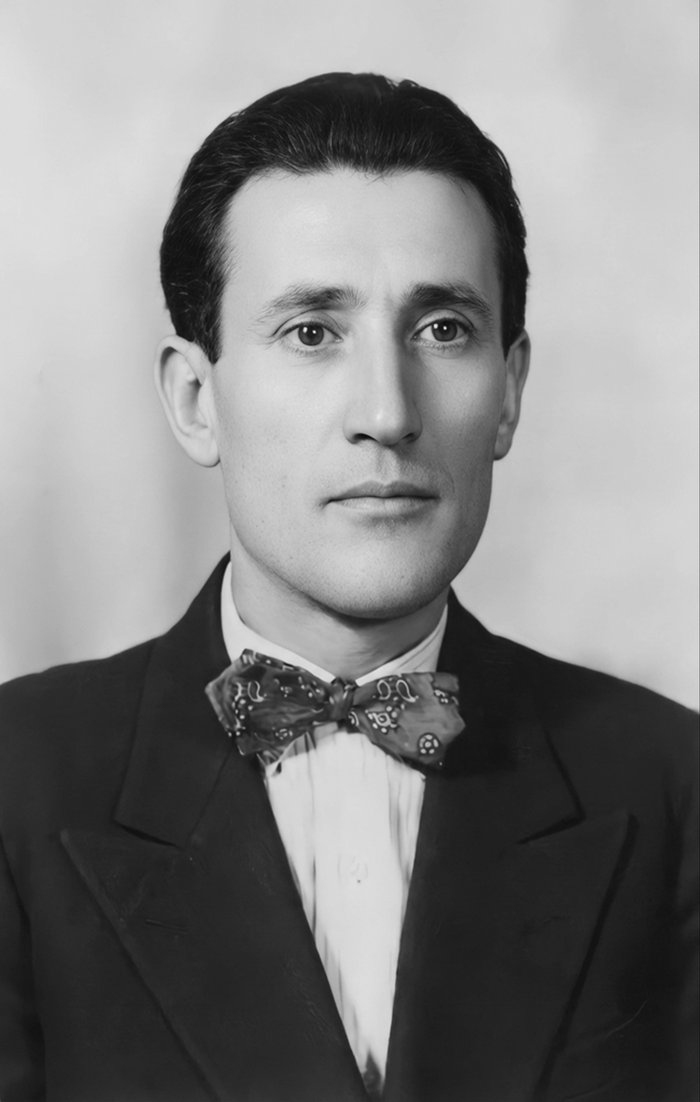
Franco Lalli
c. 1940, New York
Profilo · Chi era

A prolific voice of New York’s mid-century Italian-language press, and the hand behind Divagando’s “Il Taccuino.”

Franco Lalli (1898–1955) was one of the most prolific literary voices of New York's mid-century Italian-language press. Born in Liscia, in the Abruzzese province of Chieti, he wrote for Naples's Il Mattino before emigrating to New York in 1922, where he joined Il Corriere d'America under the mentorship of Luigi Barzini Jr.

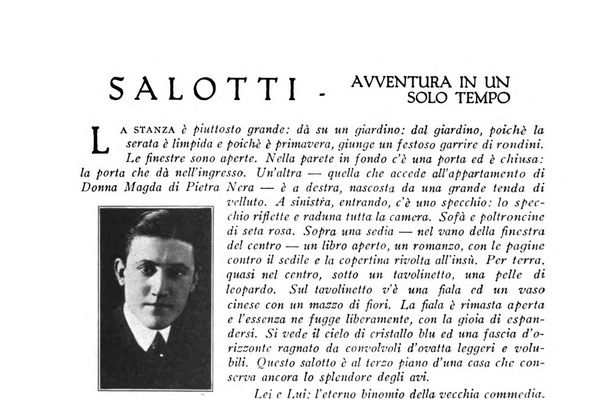
In the 1920s and '30s, he co-founded magazines with Fiorello La Guardia and Edward Corsi, and edited a number of publications, including the weekly Divagando, where his beloved column Il Taccuino blended commentary on current events, culture, and the arts with sketches of life in the metropolis.

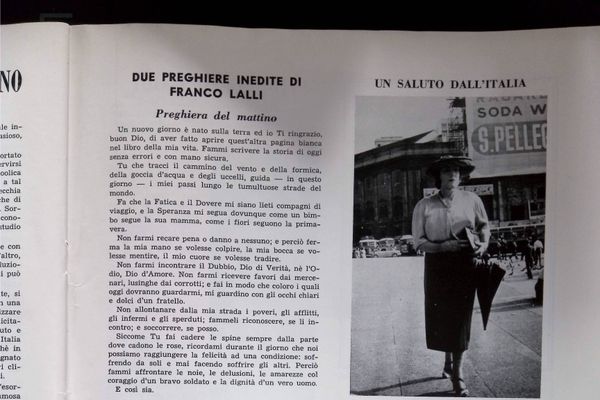
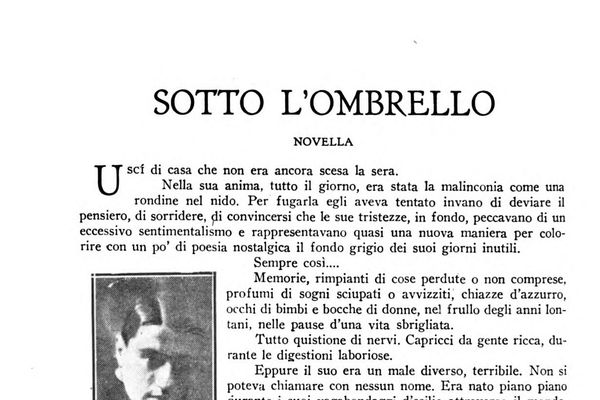
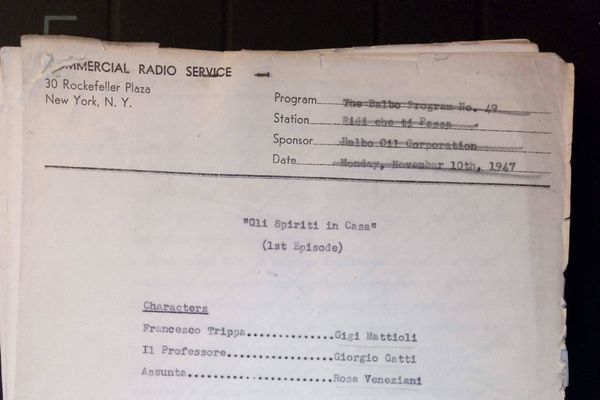
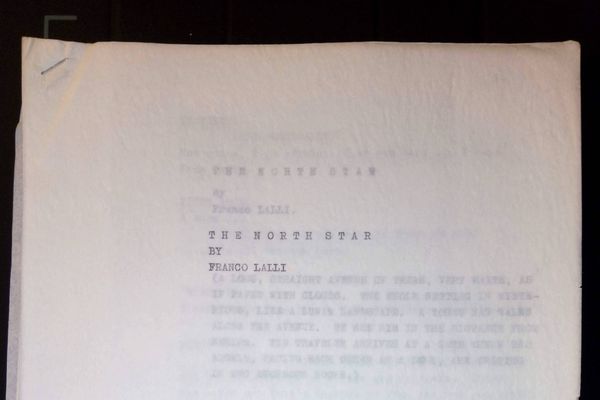
Aside from the newsroom, he was also a prolific poet, essayist, and playwright. In the 1940s, he also wrote popular biographies of figures dear to Italian-American readers (Mother Cabrini, Saint Francis, and an irreverent biography of Columbus). He spent his final years writing for radio and television—more than forty plays, for Andrea Luotto's productions and NBC's Julius LaRosa Show—before his premature death in 1955.
Fili d'Erba
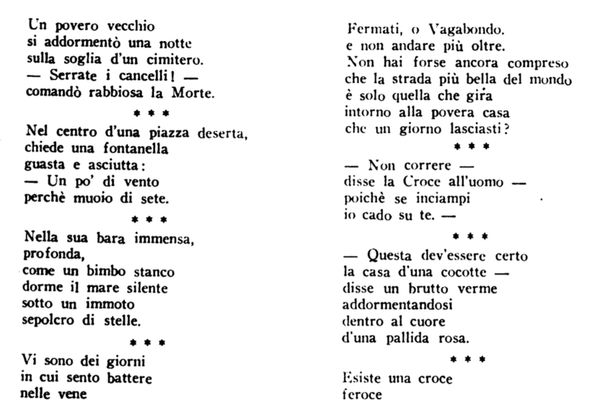
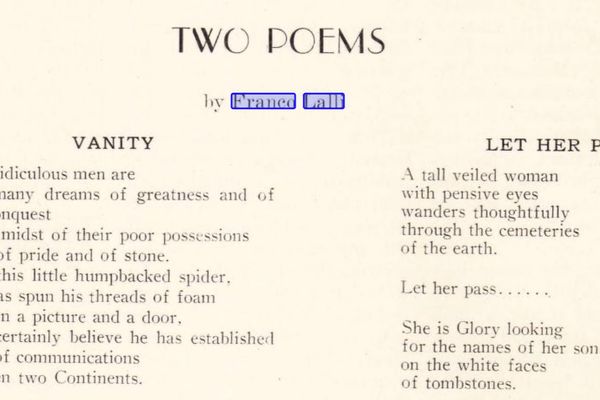
Poetry·Italian ·11 poesie
Fili d'Erba
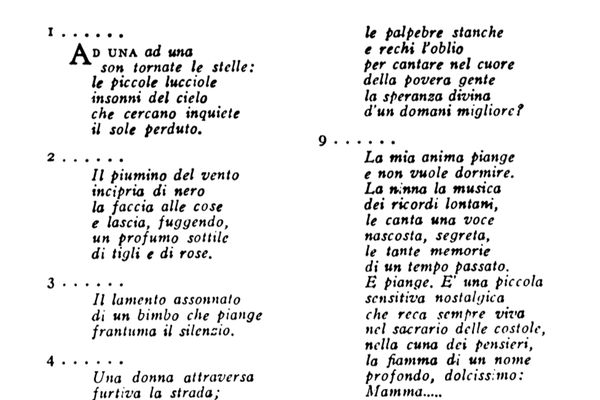
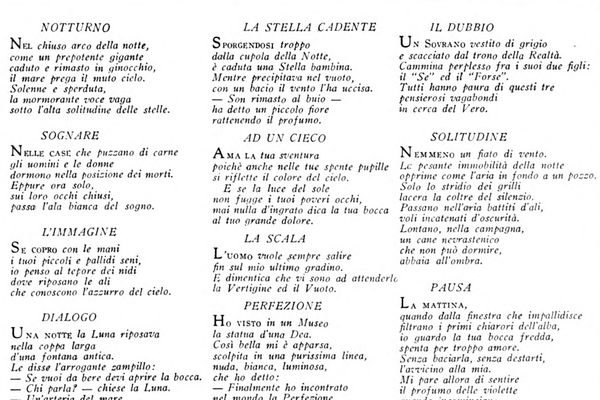
“Notturno” is a short sequence of lyric poems in Italian, closer to symbolist prose-poetry in tone than to narrative verse. Across ten titled pieces, an “I” speaker meditates on night, desire, and human limitation through dense natural imagery and personification. The arc moves from cosmic seascapes to intimate dawn, tracing a descent from awe to fragile tenderness. In “Nocturne,” the sea is imagined as a fallen giant kneeling, “praying” to a mute sky under lonely stars. “Dreaming” shifts indoors: in houses that “smell of flesh,” men and women sleep like corpses, yet the “white wing” of dream passes over their closed eyes. Erotic intimacy appears in “The Image,” where covering a lover’s pale breasts evokes warm nests and wings that know the blue sky. Several poems stage allegorical dialogues: the Moon answers a fountain jet that she drinks not from it but from “the small veins of the mountains,” and a “child star” falls and is “killed” by the wind, leaving a flower in darkness. Other pieces offer aphoristic reflections on blindness, ambition (“the last rung” leads to vertigo and emptiness), beauty as cold perfection (“the goddess is stone”), and the sovereign “Doubt” wandering with his children “If” and “Perhaps.” The sequence ends at morning with the speaker hovering near a beloved’s cold mouth, sensing violets beginning to sicken and die.
Foglia di Rosa
Text·June 1923·Italian
Foglia di Rosa
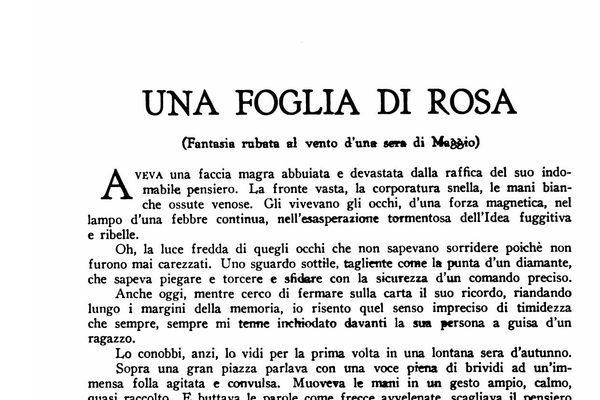
“Una foglia di rosa” is a lyrical, symbolist short prose tale framed as a memoir. The unnamed narrator, an eighteen-year-old aspiring poet, recalls Arnaldo Montana, a fifty-six-year-old former philosophy professor and scholar of Dante and medieval mysticism, marked by illness, solitude, and a commanding, unsmiling gaze. The narrator first sees him delivering a fiery public speech, then later visits him with a notebook of poems, hoping for approval. Montana reads in silence and dismisses the verses harshly, telling the youth he should study grammar instead of writing love poems, accusing him of ambition and “anemic” nostalgia. The rebuff crushes the narrator, yet months later Montana unexpectedly befriends him, inviting him into his cluttered rooms and becoming a rigorous mentor. Through evening walks and conversations, Montana voices a biting but not hateful pessimism about humanity, while showing tenderness toward children and animals, illustrated by an anecdote in which a horse safely guides a carriage when the drunken driver collapses. He finally confides the core wound of his life: an unfulfilled love for Anna, a noble girl he tutored, whom he could not marry because of age and class; their plan to flee was discovered, and he never saw her again. Montana dies of paralysis with the narrator at his bedside. A wind-blown rose petal lands on the dead man’s mouth, and it closes as if smiling for the first time. In an epilogue, an old woman named Anna tells grandchildren a “fairy tale” that is her own story, ending with the question of which petal brought life, love, or death.
Il Taccuino
Feuilleton column·1947–1951·Italian ·122 articoli
Il Taccuino
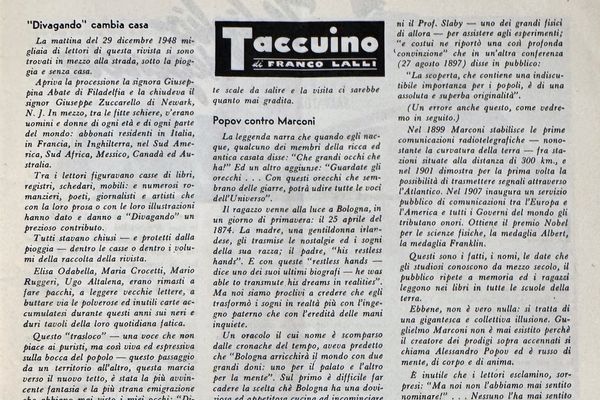
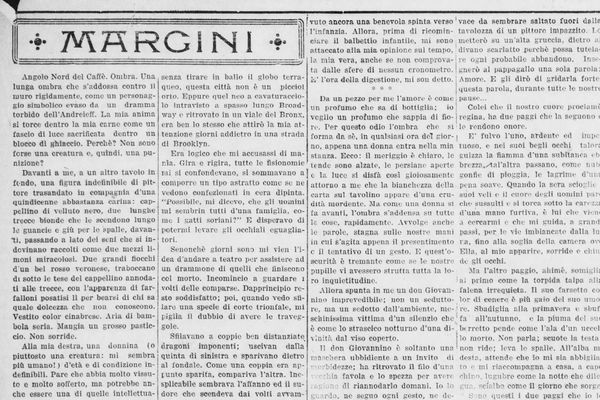
This text is a magazine-style miscellany (feuilleton/journalistic prose with satirical and essayistic sketches) written in Italian and set largely in postwar New York. It opens with a comic allegory: on 29 December 1948 the readers of the Italian-language magazine “Divagando” are imagined as a rain-soaked procession of subscribers, writers, and even furniture packed into crates, as the editorial office relocates from the Rockefeller Center “honeycombs” to a smaller house near Times Square (166 West 48th Street). Named staffers (Elisa Odabella, Maria Crocetti, Mario Ruggeri, Ugo Altalena) finish packing and sorting old letters. The piece then shifts to polemic and cultural commentary. In “Popov contro Marconi,” Lalli recounts Marconi’s biography and achievements only to denounce, with irony, a Soviet decree claiming the invention of wireless telegraphy for the Russian scientist Aleksandr Popov; the broader theme is propaganda’s “theft” of historical glory. “Scenario” offers a social portrait of New York’s Bowery “bums,” classifying three types and ending with a lyrical scene of them watching sunsets at Battery Place. A long “Taccuino” continues in brief vignettes: Father Divine’s movement, the 1947 blizzard paralyzing the city, consumerism and advertising, changing food prices, film gossip (Magnani/Rossellini/Bergman), jokes about dictators, and reflections on modern haste, memory, and immigrant life. The overall arc moves from a local office move to an expansive, ironic notebook of mid-century urban and political life.
Lettera da New York
Essay·c. 1940s–1950s·Italian
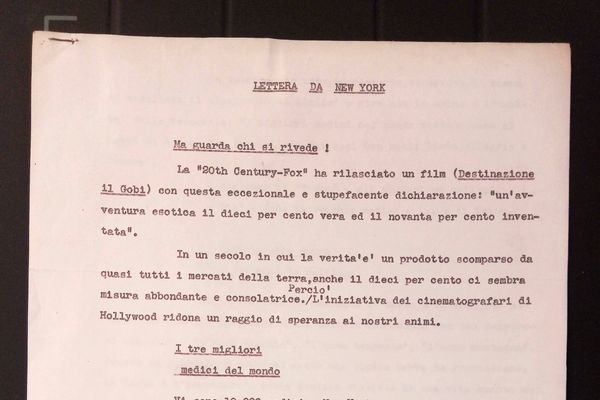
Lettera da New York
“Lettera da New York” is a journalistic feuilleton/epistolary column composed of short, loosely connected vignettes that sketch mid-century American public life with irony. The narrator opens by noting a 20th Century-Fox film advertised as “ten percent true and ninety percent invented,” treating even a small fraction of truth as rare and reassuring. He then reports on a major medical congress in New York, emphasizing the growing presence of women physicians and quoting their claim that men confide certain things only to women. An elderly observer counters with a proverb-like diagnosis: the best doctors are Diet, Cheerfulness, and Money, later adding Time. A darker anecdote follows: the wrestler Frank Leavitt, nicknamed “the devil-man” and famed for thousands of bouts, dies at 63 after a varied life (soldier, football player, film actor, political errand-runner). After disqualification and retirement he briefly tries politics, but flees, calling it a “witch” harsher than combat. The column then surveys public anxieties and cultural economics: relentless rain blamed by citizens on atomic tests; Broadway’s financial crisis, with costly flops by Moss Hart and Tennessee Williams and critics predicting a turn from realism toward subjective psychological drama. It closes with two comic notes: a divorcee whose maiden name becomes Miss Cork, and Presbyterians rejecting a proposal to change the Lord’s Prayer from “debts” to “sins.”
New York—Diario di un Reporter
feuilleton·1936–1937·Italian ·5 articoli
New York—Diario di un Reporter
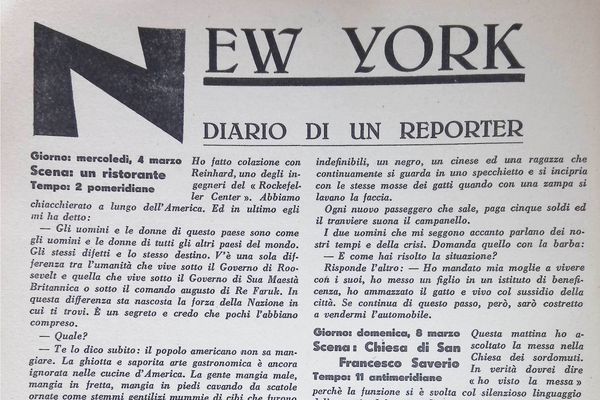
Franco Lalli’s New York—Diario di un Reporter is a literary journalistic diary: dated, scene-by-scene reportage from 1930s New York, written in Italian with aphoristic, satirical commentary. The narrator, an Italian reporter, records vignettes rather than a continuous plot, moving through restaurants, trams and subways, churches, Wall Street, cinemas, hotels, banks, dance halls, and city squares. Recurring themes are modern mass life, speed, consumerism, money as a quasi-religion, and the city as theatrical spectacle. A Rockefeller Center engineer, Reinhard, provocatively claims America’s “secret strength” is that Americans “don’t know how to eat,” so they avoid the lethargy of long meals and keep producing. The diary contrasts wealth and poverty: a man in a tram survives the Depression by sending his wife away, placing a child in charity, killing the cat, and living on city relief; the fall of financier William Durant becomes a moral parable. Lalli visits figures such as columnist Arthur Brisbane (who defines a newspaper as the second hand of history), Italian-American promoters and artisans, and observes street politics in “red” Union Square. Moments of quiet (a signed Mass for the deaf) alternate with nightlife, prostitution, advertising schemes, and constant numerical “facts,” ending in an ambivalent portrait of a city both ingenious and rootless.
Il morto sta bene
Radio and television play·c. 1940s·Italian
Il morto sta bene
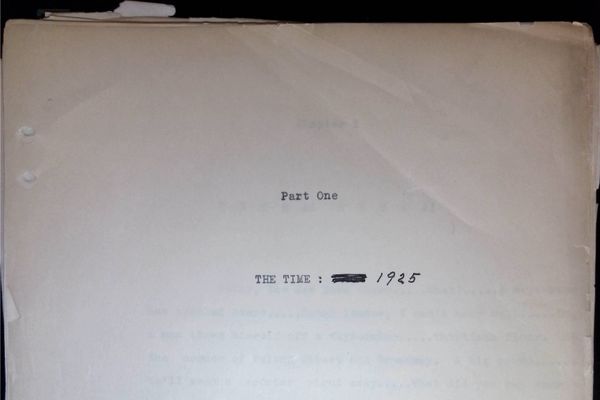
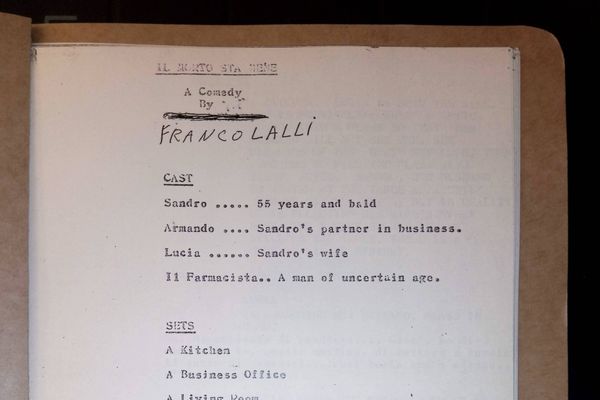
Il morto sta bene is a stage comedy by Italian-American writer Franco Lalli, set in three interiors (kitchen, business office, living room) and built around suspicion, deception, and marital betrayal. The main characters are Sandro, a 55-year-old businessman; Lucia, his wife; Armando, Sandro’s business partner; and “the Pharmacist,” identified as Don Bartolo, an older, fussy, self-important man. In Part One, Lucia furtively pours a white powder into Sandro’s tomato juice. Sandro pretends to read the newspaper but watches her closely, refuses to drink, and leaves. Alone, Lucia dumps the drink, reinforcing the appearance that she is trying to poison him. At the office, Sandro confides in Armando that his life is in danger: he believes Lucia is having an affair with Don Bartolo and that the mysterious “little powder” in pharmacy-style packets is intended to kill him. Sandro admits he has been pretending to drink the juice and discarding it. Armando proposes a trap: Sandro should “die without dying,” staging his suicide so Lucia and Don Bartolo will reveal themselves through their reactions and plans. Sandro returns home, hints he will leave “for the other world,” theatrically takes the tomato juice with him, and exits as Lucia watches in alarm. Part Two begins in the living room with Don Bartolo’s absurd, pedantic monologue, signaling a satirical turn toward the fallout of Sandro’s staged death.
La fuga
Radio and television play·Italian
La fuga
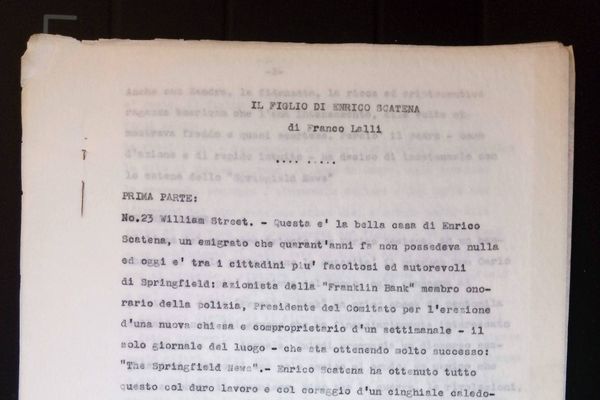
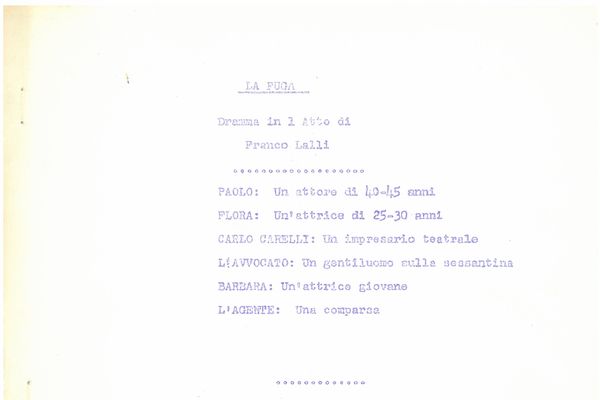
La Fuga is a realist one-act stage drama (presented in several parts and scenes) centered on two struggling performers who try to escape their past. Paolo, an actor in his forties with a history of gambling, debt, and arrests, lives in a sparsely furnished Springfield apartment with Flora del Val, a young singer who now gives modest voice lessons. Flora insists they left Chicago to redeem themselves after a spiritual “crisis,” but Paolo feels trapped by poverty and monotony and suspects her motives include jealousy and possessiveness. Their only domestic comfort is a caged canary, Trill, which, like them, no longer sings. The plot turns when Carlo Corelli, a theatrical impresario, appears and offers Paolo a place in a new “first-rate” Chicago company. Paolo seizes the chance and flees without waiting for Flora. On the Chicago stage, amid rehearsal chaos, Paolo reunites with Barbara Rivoli, only to learn she is married. Immediately after, a police agent arrests Paolo; he is accused of a serious crime and held on high bail, with “strong circumstantial evidence,” including an unpaid debt to the victim. Paolo’s only defense is an alibi: he was in Springfield with Flora. Back in Springfield, Flora loses her students, despairs, prepares to return to Chicago, and releases Trill. An адвocate arrives to verify the alibi and is revealed to be Flora’s father; he asks forgiveness, recognizes her resolve to change, and proposes they go together—adding that Paolo is still waiting for her.

Lalli, Franco. La prima santa d’America: vita di madre Cabrini, la suora italiana che fu la “viaggiatrice di Dio.” With a preface by Pietro Novasio. Brooklyn, NY: Fortuna, 1944.

Lalli, Franco. La fontana nascosta: vita di San Francesco d’Assisi. Brooklyn, NY: Fortuna, 1945.

Novasio, Pietro, Franco Lalli, and Elisa Odabella. La strada della gioia. New York: Liberal Press, 1946.

Lalli, Franco. L’immortale canaglia. With a preface by Edward Corsi. Florence: A. Vallecchi, 1956.